
Skip to content
The Inner Developer
Exploring the craft of code and the person behind it
The Inner DeveloperThe Inner Developer
  • Home
  • About
  • Blog
    • The Pragmatic Programmer Series
    • E-Learning Standards
      • AICC
      • SCORM 1.2
      • SCORM 2004
      • xAPI
    • AI Agent Engineering for Developers
      • The Agent Loop
      • Memory Management in Agents
  • Home
  • About
  • Blog
    • The Pragmatic Programmer Series
    • E-Learning Standards
      • AICC
      • SCORM 1.2
      • SCORM 2004
      • xAPI
    • AI Agent Engineering for Developers
      • The Agent Loop
      • Memory Management in Agents

LLM Engineering

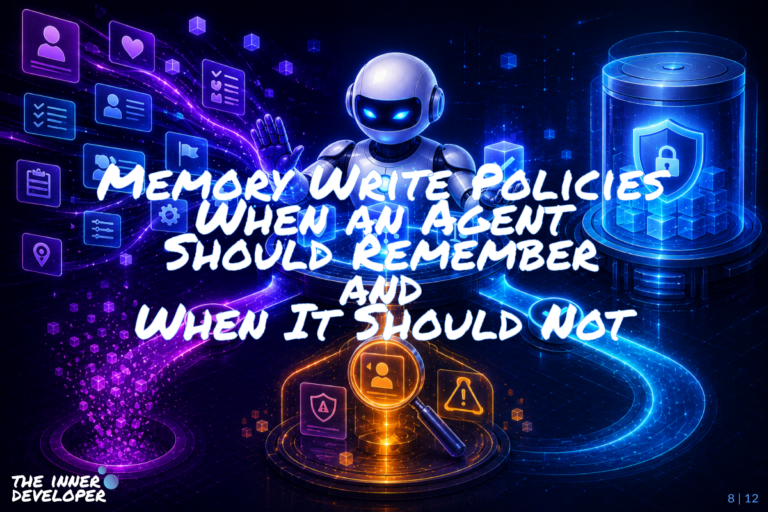
A futuristic robot stands over a glowing decision platform, filtering incoming memory candidates and routing them into three paths: discarded items on the left, flagged items for review below, and approved memories flowing into a secure vault on the right, illustrating memory write policies and when an AI agent should remember or not remember information.

Memory Write Policies: When an Agent Should Remember and When It Should Not

AI Agent Engineering for Developers, Multi-Agent SystemsBy Sami02.09.2026Leave a comment

Memory bugs in AI agents usually come from bad writes, not weak recall. Learn how to design write policies that decide what an agent should persist, when it should write, and when it should not.
Discover more
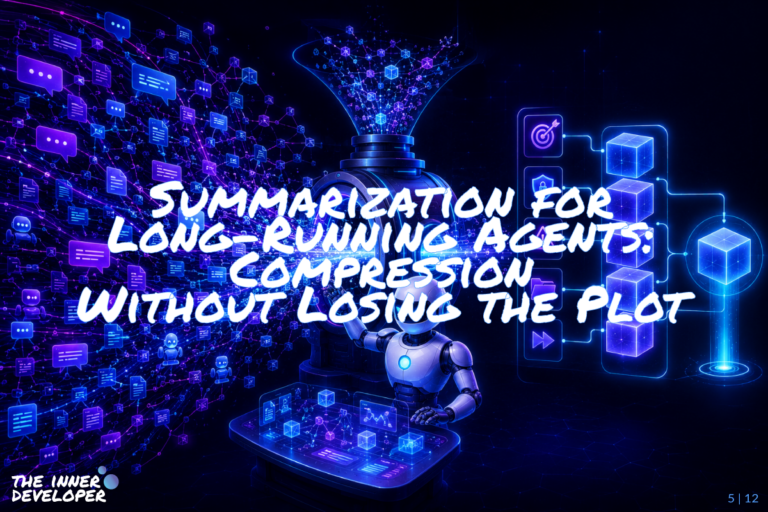
A futuristic robot oversees a stream of glowing chat bubbles, notes, and data fragments flowing into a large compression machine, which condenses the chaos into a smaller set of structured cubes and organized task-state blocks, illustrating summarization for long-running AI agents without losing important context.

Summarization for Long-Running Agents: Compression Without Losing the Plot

AI Agent Engineering for Developers, Multi-Agent SystemsBy Sami12.08.2026Leave a comment

Long context windows do not solve long-running agent state. This article explains why summarization is really state compression, how to design structured summaries, when to trigger compaction, and how to detect behavioral drift before bad memory causes wrong tool calls or broken constraint handling.

Discover more
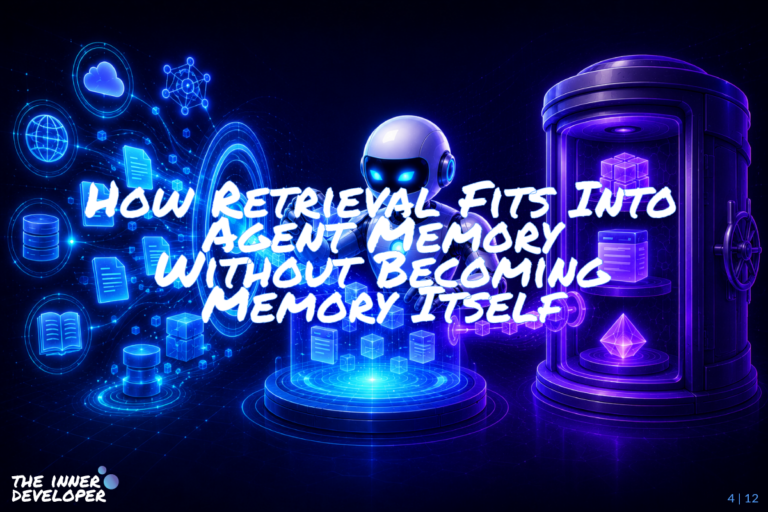
A futuristic robot stands between a glowing retrieval portal and a secure memory vault, selecting data cubes from live external sources such as documents, databases, cloud systems, and the web, while only a few chosen pieces flow into long-term storage, illustrating that retrieval supports agent memory without becoming memory itself.

How Retrieval Fits Into Agent Memory Without Becoming Memory Itself

AI Agent Engineering for Developers, Multi-Agent SystemsBy Sami05.08.2026Leave a comment

Retrieval is not memory. In production AI agents for developers, retrieval should stay a read path to external systems, while memory remains a write path for learned continuity like preferences, instructions, and successful procedures.

Discover more
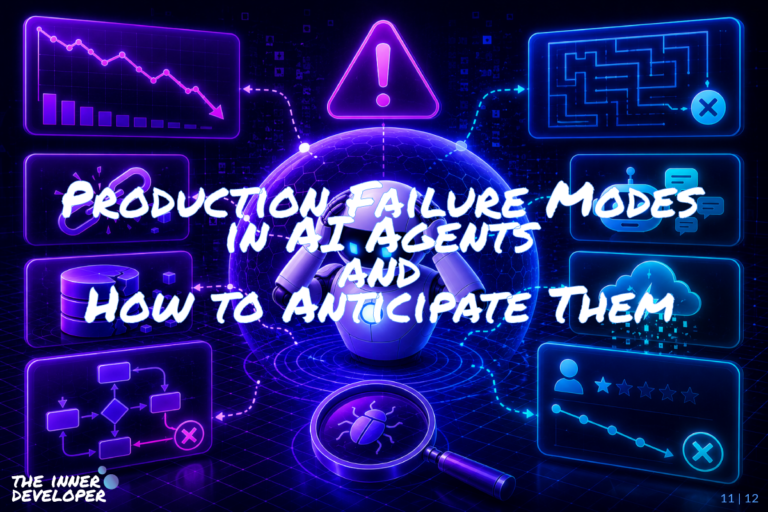
Futuristic AI operations scene showing a robot under pressure at the center of a glowing control environment, surrounded by interconnected panels displaying broken workflows, failed tool calls, degraded performance metrics, system outages, data failures, bugs, and warning indicators. Neon purple, blue, and cyan data paths connect the failures, illustrating the complexity of diagnosing and anticipating production failure modes in AI agent systems.

Production Failure Modes in AI Agents and How to Anticipate Them

AI Agent Engineering for Developers, The Agent LoopBy Sami01.07.2026Leave a comment

AI agents usually do not fail with a dramatic crash. They fail quietly through wrong tool calls, invalid arguments, retry storms, looping behavior, and weak recovery. This article explains where the agent loop breaks and how to design traces, guardrails, limits, checkpointing, idempotency, and evals that catch incidents before users do.

Discover more
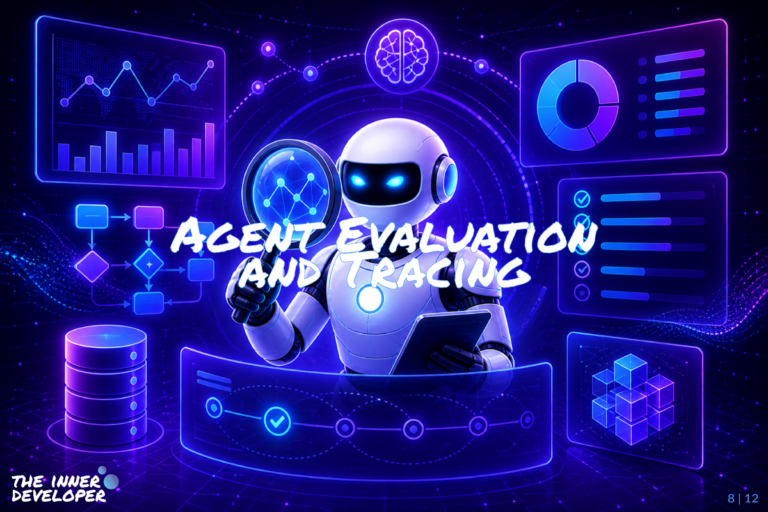
A robot surroundend by different screens and dashboards

Agent Evaluation and Tracing: Why Prompting Is Not Enough

AI Agent Engineering for Developers, The Agent LoopBy Sami10.06.2026Leave a comment

Prompting can improve a single run, but it cannot prove that an agent workflow is reliable. This article explains how traces, scorecards, offline evals, and online monitoring turn agent quality into an engineering discipline.

Discover more
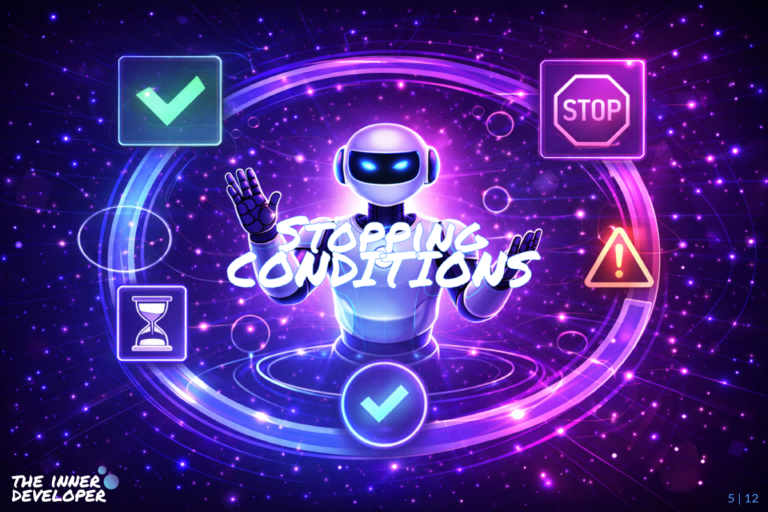
A Robot surrounded by check and warning signs

Stopping Conditions: How Agents Know When to Finish

AI Agent Engineering for Developers, The Agent LoopBy Sami20.05.2026Leave a comment

Most bad agent experiences come from bad stopping decisions. Learn how to design stop logic in code with explicit exit states, tool signals, step limits, and traceable runtime policies.

Discover more
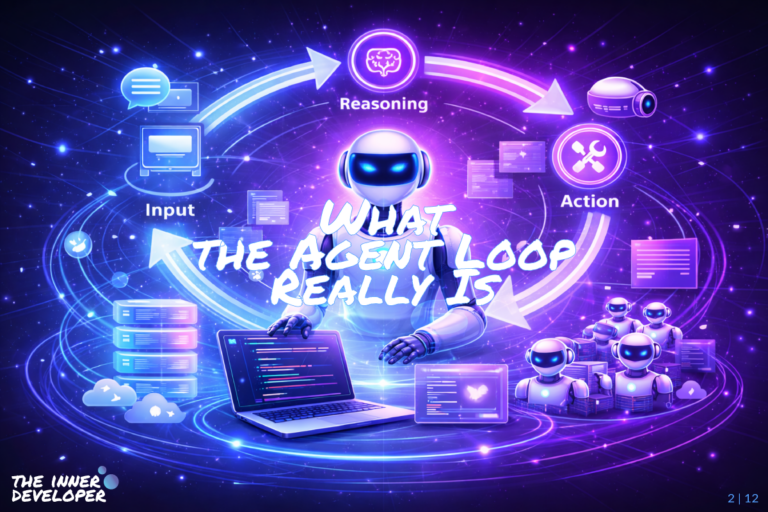
A Robot surrounded by the agent loop and a group of robots and a laptop and servers

What the Agent Loop Really Is

AI Agent Engineering for Developers, The Agent LoopBy Sami29.04.2026Leave a comment

Most agent failures are not prompt failures. They happen because teams misunderstand the control loop the system is actually running. This article breaks the loop into its real runtime parts and shows why that changes debugging, reliability, and production behavior.

Discover more
Explore
  • Home
  • About
  • Blog
Get in touch
Contact me today!
© The Inner Developer 2025

whoami.akkawi.ch

Go to Top