
Skip to content
The Inner Developer
Exploring the craft of code and the person behind it
The Inner DeveloperThe Inner Developer
  • Home
  • About
  • Blog
    • The Pragmatic Programmer Series
    • E-Learning Standards
      • AICC
      • SCORM 1.2
      • SCORM 2004
      • xAPI
    • AI Agent Engineering for Developers
      • The Agent Loop
      • Memory Management in Agents
  • Home
  • About
  • Blog
    • The Pragmatic Programmer Series
    • E-Learning Standards
      • AICC
      • SCORM 1.2
      • SCORM 2004
      • xAPI
    • AI Agent Engineering for Developers
      • The Agent Loop
      • Memory Management in Agents

LLM Architecture

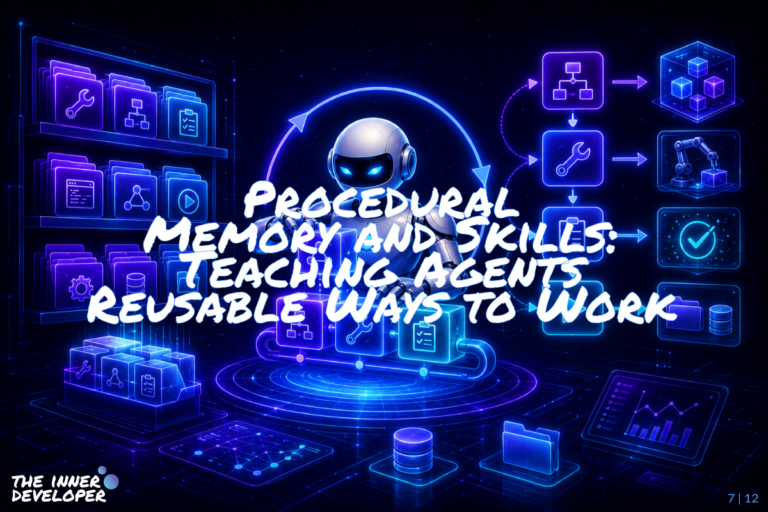
A futuristic robot assembles glowing blue and violet workflow cubes at the center of a digital workspace, while shelves of reusable skill modules and step-by-step process panels surround it, illustrating procedural memory as reusable methods that help AI agents follow consistent workflows.

Procedural Memory and Skills: Teaching Agents Reusable Ways to Work

AI Agent Engineering for Developers, Multi-Agent SystemsBy Sami26.08.2026Leave a comment

Procedural memory is not about facts or chat history. It is the reusable method an agent follows to complete recurring tasks. This article explains why skills matter, how they work, and why they make agents behave more like software systems than chat systems.
Discover more
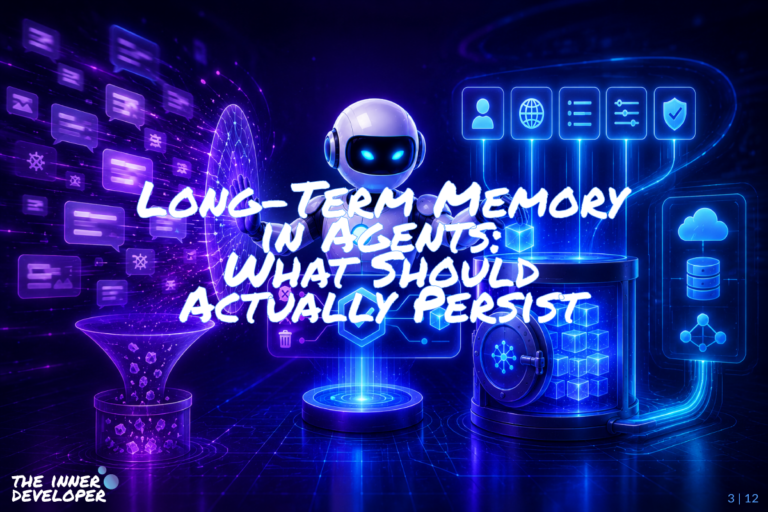
A futuristic robot carefully filters digital information, rejecting noisy chat fragments on the left while storing selected, verified memory blocks in a secure glowing vault on the right, illustrating selective long-term memory in AI agents.

Long-Term Memory in Agents: What Should Actually Persist

AI Agent Engineering for Developers, Multi-Agent SystemsBy Sami29.07.2026Leave a comment

Short-term state is not a transcript. It is the working memory of the current task. This article explains how clean, structured thread state improves agent focus, reduces context pollution, and makes tool-using systems easier to debug and scale.

Discover more
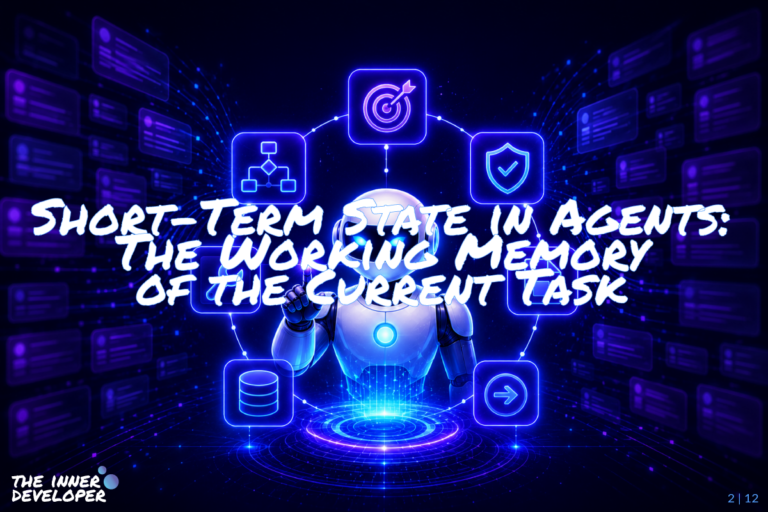
A friendly futuristic robot manages a compact ring of glowing task-state icons, while blurred transcript panels fade into the background, visualizing short-term state as focused working memory for the current AI agent task.

Short-Term State in Agents: The Working Memory of the Current Task

AI Agent Engineering for Developers, Multi-Agent SystemsBy Sami22.07.2026Leave a comment

Short-term state is not a transcript. It is the working memory of the current task. This article explains how clean, structured thread state improves agent focus, reduces context pollution, and makes tool-using systems easier to debug and scale.

Discover more
A friendly futuristic robot orchestrates three connected AI systems: flowing conversation state on the left, structured memory storage on the right, and external knowledge sources below, all linked by glowing violet, blue, and cyan data streams.

AI Agent Memory: Why State and Memory Are Not the Same Thing

AI Agent Engineering for Developers, Multi-Agent SystemsBy Sami15.07.2026Leave a comment

State keeps an agent moving through the current thread. Memory persists selective information for future runs. External knowledge stays in source systems and should be retrieved on demand. This distinction matters because AI agent memory is a systems design problem, not a prompt trick.

Discover more
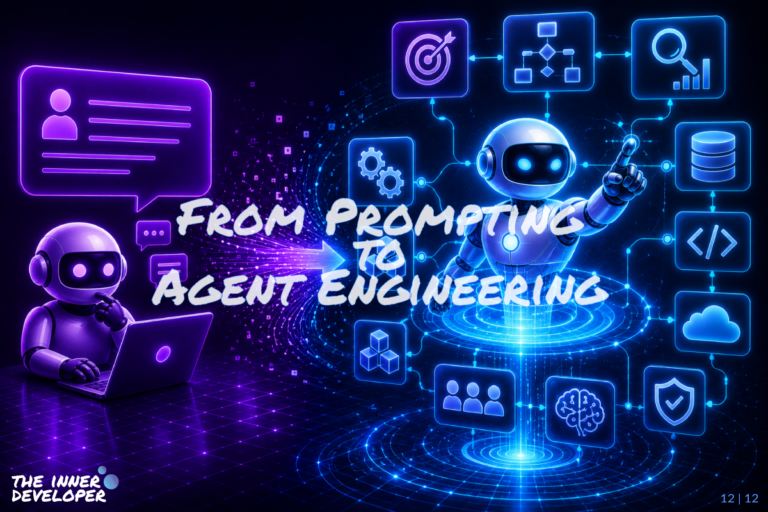
Futuristic split-scene illustrating the evolution from prompt-based AI interactions to agent engineering. On the left, a small robot works with a laptop and simple conversational interfaces, representing traditional prompting. On the right, a larger advanced AI agent operates within a network of interconnected systems, tools, workflows, memory, evaluation, and orchestration components. A glowing stream of energy bridges the two sides, symbolizing the transition from isolated prompts to structured, production-ready agent systems.

From Prompting to Agent Engineering

AI Agent Engineering for Developers, The Agent LoopBy Sami08.07.2026Leave a comment

Prompting matters, but it is only one control layer. Reliable agents come from designing the loop, validating tool use, tracing decisions, and treating runtime behavior as the real unit of quality.

Discover more
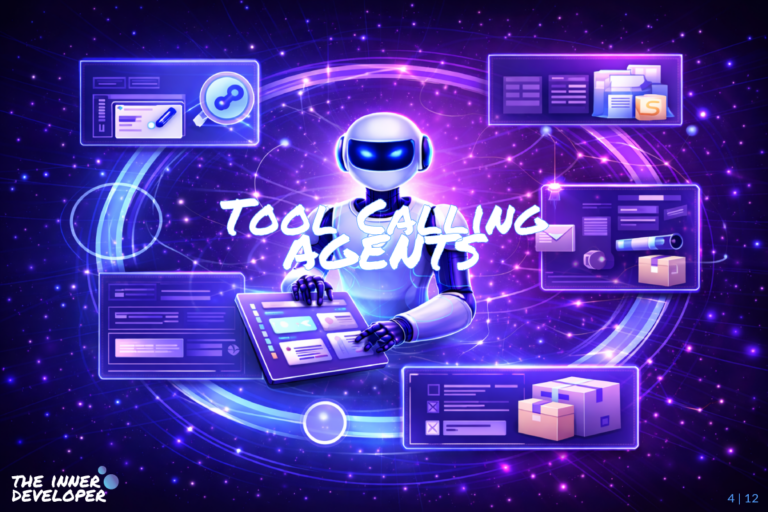
A Robot surrounded by tools to choose from

Tool Calling Agents: How Models Turn Decisions Into Actions

AI Agent Engineering for Developers, The Agent LoopBy Sami13.05.2026Leave a comment

Tool use is where an agent stops generating text and starts affecting real systems. This article explains why tool design acts as both decision boundary and action contract, and how better schemas, validation, and tracing make tool calling agents more reliable.

Discover more
Explore
  • Home
  • About
  • Blog
Get in touch
Contact me today!
© The Inner Developer 2025

whoami.akkawi.ch

Go to Top