
Skip to content
The Inner Developer
Exploring the craft of code and the person behind it
The Inner DeveloperThe Inner Developer
  • Home
  • About
  • Blog
    • The Pragmatic Programmer Series
    • E-Learning Standards
      • AICC
      • SCORM 1.2
      • SCORM 2004
      • xAPI
    • AI Agent Engineering for Developers
      • The Agent Loop
      • Memory Management in Agents
  • Home
  • About
  • Blog
    • The Pragmatic Programmer Series
    • E-Learning Standards
      • AICC
      • SCORM 1.2
      • SCORM 2004
      • xAPI
    • AI Agent Engineering for Developers
      • The Agent Loop
      • Memory Management in Agents

Multi-Agent Systems

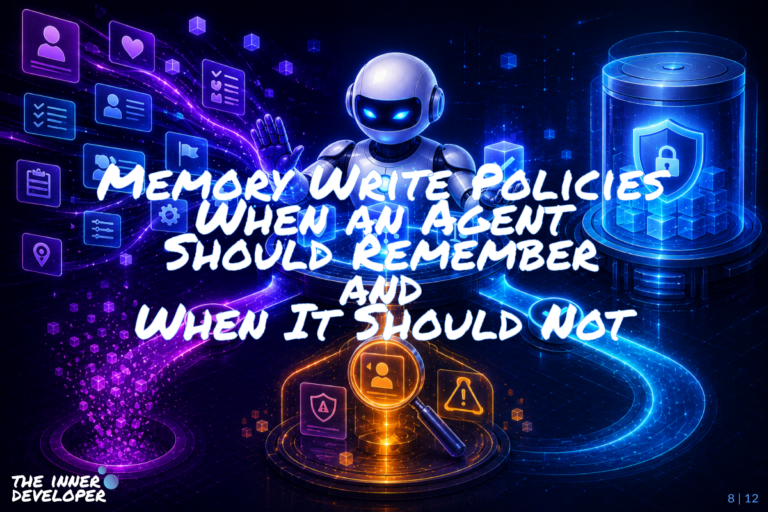
A futuristic robot stands over a glowing decision platform, filtering incoming memory candidates and routing them into three paths: discarded items on the left, flagged items for review below, and approved memories flowing into a secure vault on the right, illustrating memory write policies and when an AI agent should remember or not remember information.

Memory Write Policies: When an Agent Should Remember and When It Should Not

AI Agent Engineering for Developers, Multi-Agent SystemsBy Sami02.09.2026Leave a comment

Memory bugs in AI agents usually come from bad writes, not weak recall. Learn how to design write policies that decide what an agent should persist, when it should write, and when it should not.
Discover more
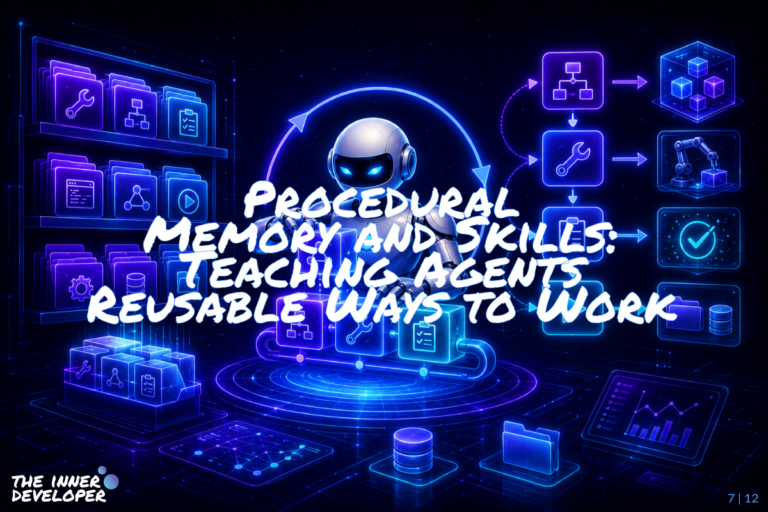
A futuristic robot assembles glowing blue and violet workflow cubes at the center of a digital workspace, while shelves of reusable skill modules and step-by-step process panels surround it, illustrating procedural memory as reusable methods that help AI agents follow consistent workflows.

Procedural Memory and Skills: Teaching Agents Reusable Ways to Work

AI Agent Engineering for Developers, Multi-Agent SystemsBy Sami26.08.2026Leave a comment

Procedural memory is not about facts or chat history. It is the reusable method an agent follows to complete recurring tasks. This article explains why skills matter, how they work, and why they make agents behave more like software systems than chat systems.

Discover more
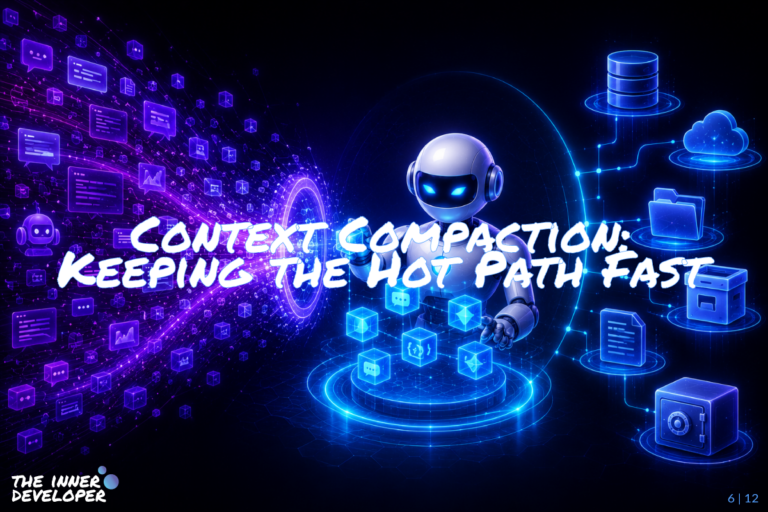
A futuristic robot stands at the center of a glowing blue platform, compacting a flood of purple chat bubbles, logs, and data fragments into a small set of bright structured cubes, while external storage icons on the right show databases, cloud files, archives, and a secure vault, illustrating context compaction and a fast hot path for AI agents.

Context Compaction: Keeping the Hot Path Fast

AI Agent Engineering for Developers, Multi-Agent SystemsBy Sami19.08.2026Leave a comment

Most long-running agent failures are context failures, not reasoning failures. This article explains how context compaction keeps the hot path small, preserves recoverability, and turns memory management into an operational policy.

Discover more
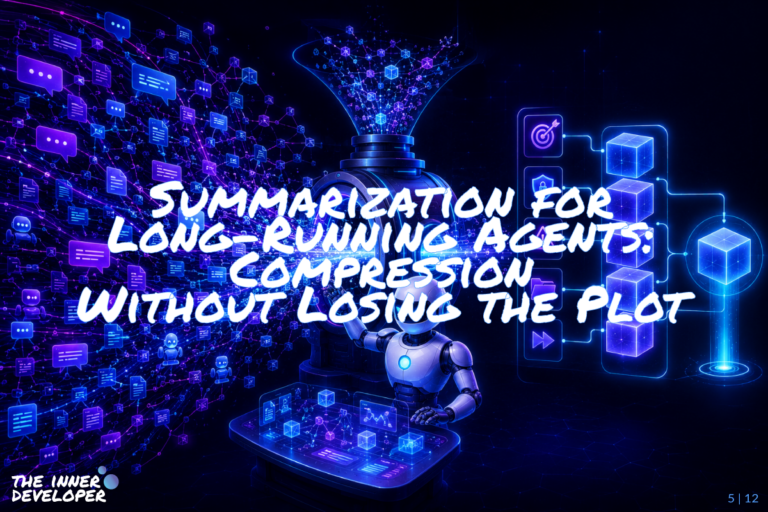
A futuristic robot oversees a stream of glowing chat bubbles, notes, and data fragments flowing into a large compression machine, which condenses the chaos into a smaller set of structured cubes and organized task-state blocks, illustrating summarization for long-running AI agents without losing important context.

Summarization for Long-Running Agents: Compression Without Losing the Plot

AI Agent Engineering for Developers, Multi-Agent SystemsBy Sami12.08.2026Leave a comment

Long context windows do not solve long-running agent state. This article explains why summarization is really state compression, how to design structured summaries, when to trigger compaction, and how to detect behavioral drift before bad memory causes wrong tool calls or broken constraint handling.

Discover more
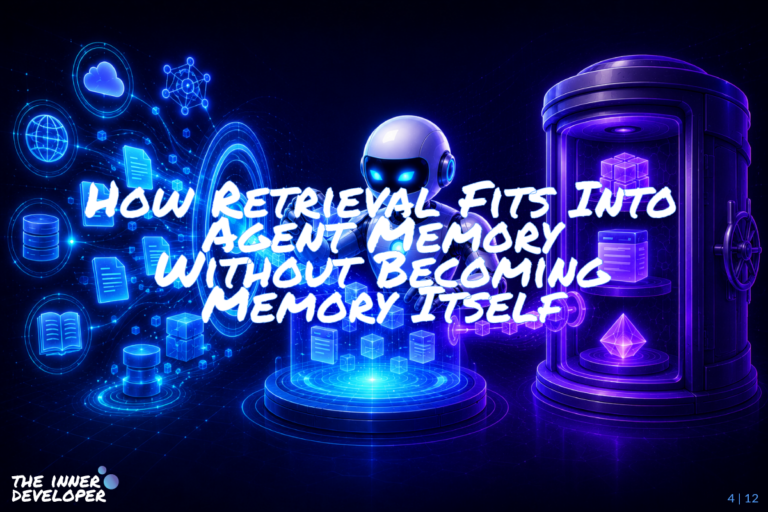
A futuristic robot stands between a glowing retrieval portal and a secure memory vault, selecting data cubes from live external sources such as documents, databases, cloud systems, and the web, while only a few chosen pieces flow into long-term storage, illustrating that retrieval supports agent memory without becoming memory itself.

How Retrieval Fits Into Agent Memory Without Becoming Memory Itself

AI Agent Engineering for Developers, Multi-Agent SystemsBy Sami05.08.2026Leave a comment

Retrieval is not memory. In production AI agents for developers, retrieval should stay a read path to external systems, while memory remains a write path for learned continuity like preferences, instructions, and successful procedures.

Discover more
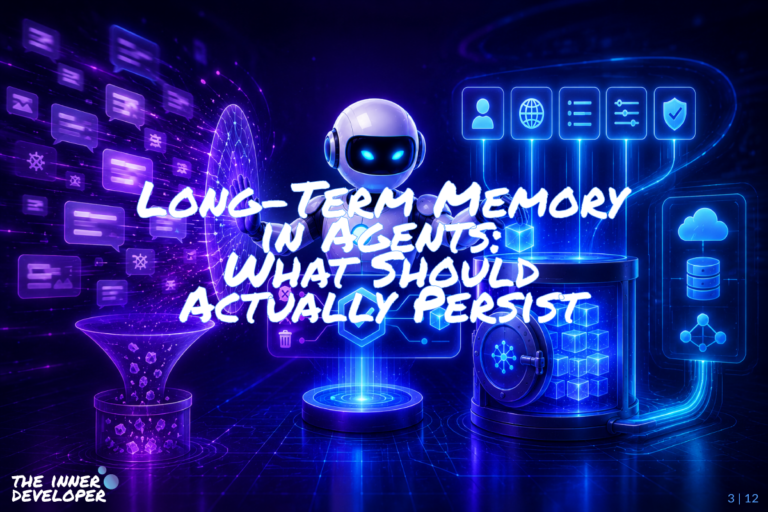
A futuristic robot carefully filters digital information, rejecting noisy chat fragments on the left while storing selected, verified memory blocks in a secure glowing vault on the right, illustrating selective long-term memory in AI agents.

Long-Term Memory in Agents: What Should Actually Persist

AI Agent Engineering for Developers, Multi-Agent SystemsBy Sami29.07.2026Leave a comment

Short-term state is not a transcript. It is the working memory of the current task. This article explains how clean, structured thread state improves agent focus, reduces context pollution, and makes tool-using systems easier to debug and scale.

Discover more
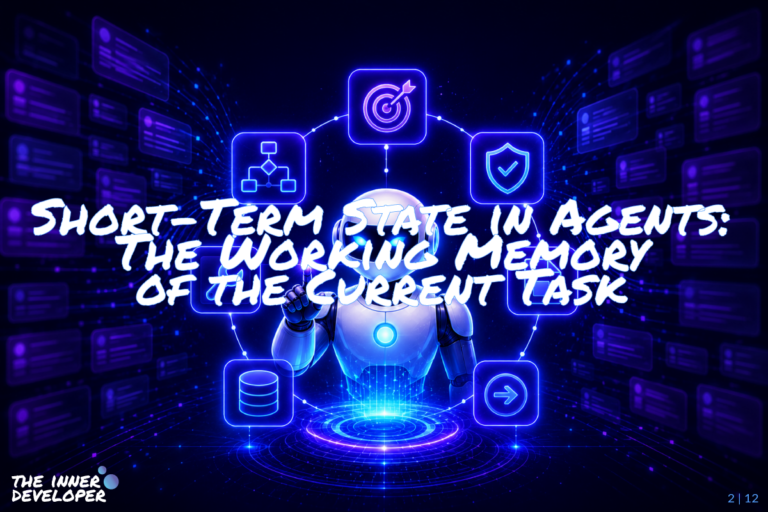
A friendly futuristic robot manages a compact ring of glowing task-state icons, while blurred transcript panels fade into the background, visualizing short-term state as focused working memory for the current AI agent task.

Short-Term State in Agents: The Working Memory of the Current Task

AI Agent Engineering for Developers, Multi-Agent SystemsBy Sami22.07.2026Leave a comment

Short-term state is not a transcript. It is the working memory of the current task. This article explains how clean, structured thread state improves agent focus, reduces context pollution, and makes tool-using systems easier to debug and scale.

Discover more
A friendly futuristic robot orchestrates three connected AI systems: flowing conversation state on the left, structured memory storage on the right, and external knowledge sources below, all linked by glowing violet, blue, and cyan data streams.

AI Agent Memory: Why State and Memory Are Not the Same Thing

AI Agent Engineering for Developers, Multi-Agent SystemsBy Sami15.07.2026Leave a comment

State keeps an agent moving through the current thread. Memory persists selective information for future runs. External knowledge stays in source systems and should be retrieved on demand. This distinction matters because AI agent memory is a systems design problem, not a prompt trick.

Discover more
Explore
  • Home
  • About
  • Blog
Get in touch
Contact me today!
© The Inner Developer 2025

whoami.akkawi.ch

Go to Top