
🎯 Chapter Insight
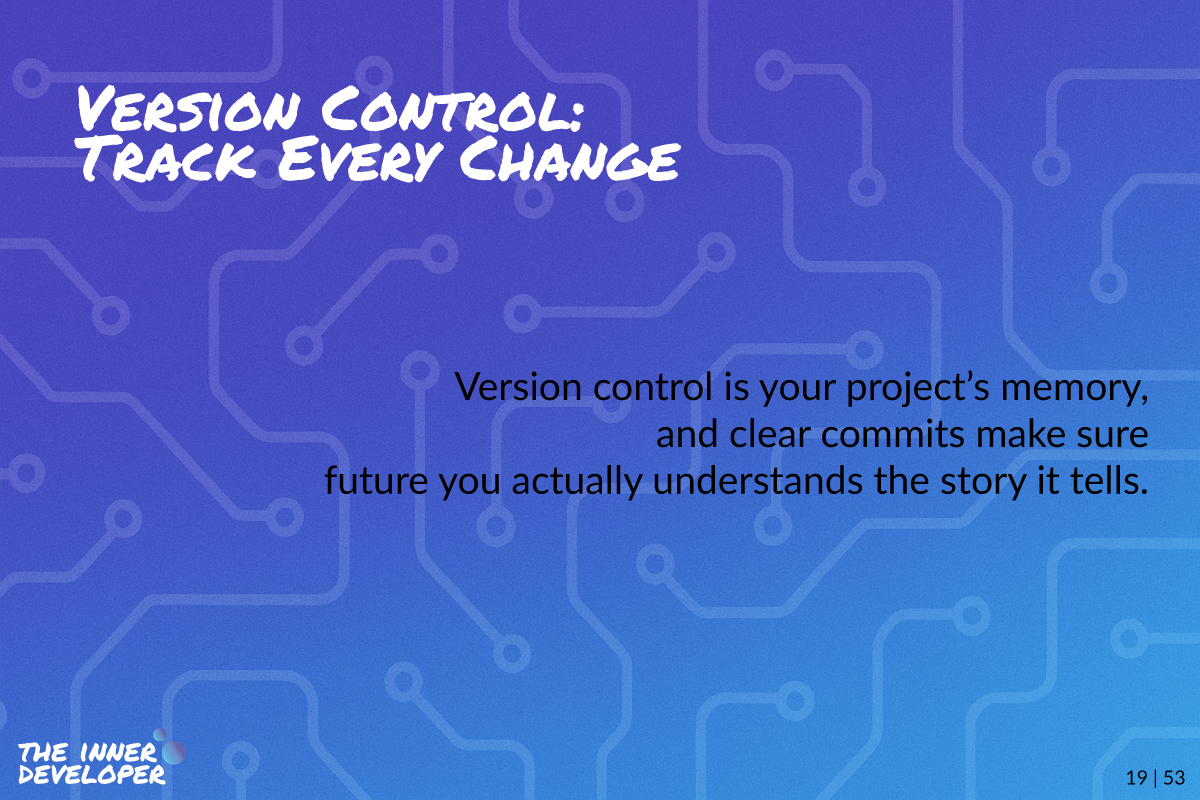
Version control is far more than a backup system. It is the shared memory of a software project. It records how the system evolved, why decisions were made, and how problems were solved along the way.
When used well, version control captures intent, not just code. It tells the story of a system over time and allows teams to reason about past choices instead of guessing. Pragmatic developers treat version control as a first class part of development, not an optional safety net they hope never to need.
A strong version control practice creates confidence. Every change is deliberate, traceable, and reversible.
💡 Developer Lens
In everyday engineering, version control enables collaboration without fear. It allows multiple people to work in parallel, experiment safely, and review each other’s work with clarity. When something goes wrong, it provides a reliable path back.
Good version control habits show up in simple but powerful ways:
Commits that do one thing and do it clearly
Commit messages that explain intent, not just mechanics
Meaningful history that makes debugging easier
Clean diffs that support effective code reviews
A record that helps new team members understand how the system grew
When commit history is messy or unclear, it becomes noise. When it is clean and intentional, it becomes a communication tool. It explains decisions long after meetings are forgotten and chats have disappeared.
Version control done well supports trust, learning, and long term maintainability.
🧭 Reflection
Look at your recent commit history and ask yourself:
How readable is it?
Could someone new to the project understand why changes were made?
Would your future self thank you for the clarity or curse the ambiguity?
Commit history is part of your documentation. It reflects how much you care about the people who will work with this code later, including yourself.
⚙️ Practical Tip
This week, focus on writing clearer commits.
Make each commit do one thing
Describe the reason for the change, not just the change itself
Avoid bundling unrelated work together
Treat commit messages as notes to future readers
A clean and intentional history saves hours of confusion later. It turns version control into a powerful ally instead of a last resort.
🔢 #19 of 53 | The Pragmatic Programmer Series
This post is part of my 53-week series summarizing The Pragmatic Programmer, one timeless principle each week, translated into modern software practice and reflection.