
🎯 Chapter Insight
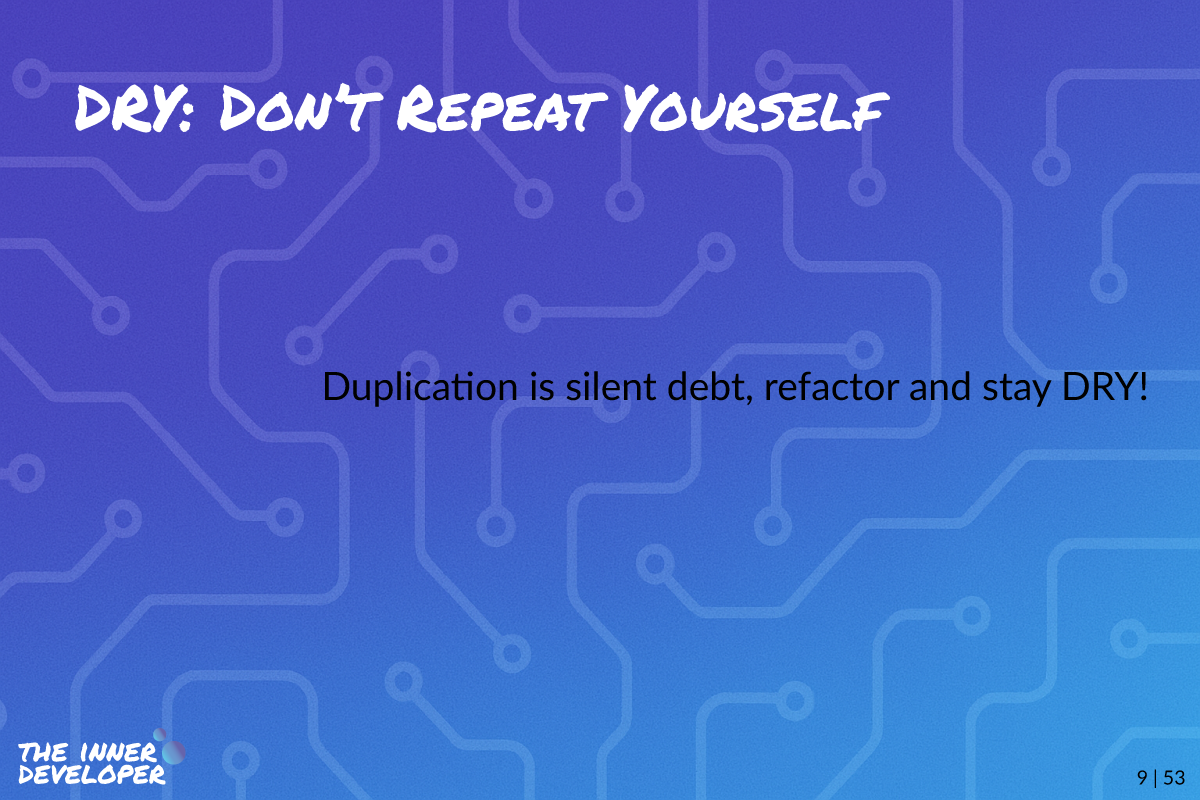
Duplication is one of the most silent, and most expensive, forms of technical debt.
Every time you copy a piece of logic, rewrite a rule, or duplicate configuration data, you’re adding invisible weight to the system. It might feel harmless in the moment, a quick copy-paste to meet a deadline, but over time, these duplicates compound into fragility.
The next time requirements change, you’ll fix one part of the system but forget another. Suddenly, things break in places you didn’t expect. The codebase starts to resist change.
The Don’t Repeat Yourself (DRY) principle isn’t about writing less code: it’s about creating a single, reliable source of truth.
Every piece of knowledge, every rule, every intent should have one authoritative home.
When systems share one truth instead of many copies, they become easier to maintain, reason about, and extend. That’s not minimalism, that’s engineering clarity.
💡 Developer Lens
Duplication is sneaky. It doesn’t just live in copy-pasted functions, it hides in plain sight:
The same SQL query written in three different services.
The same constant defined in multiple files.
The same validation logic repeated in both frontend and backend.
Even the same business rule scattered across documentation, code, and API comments.
Each repetition becomes a potential inconsistency. When you fix one, the others quietly drift out of sync.
Pragmatic developers learn to spot duplication not just as a coding issue, but as a knowledge design problem. They ask,
“Where should this knowledge live?”
Maybe it belongs in a shared library, a configuration file, or a single function. Maybe it needs to be extracted into a service, or even just documented once and referenced everywhere else.
Every line of code should express intent, not redundancy.
Being DRY doesn’t mean writing “clever” code. It means writing honest code: clear, consistent, and anchored to one truth.
🧭 Reflection
Where have you introduced or inherited duplication recently?
Think about your current project:
Are there similar utility functions floating around in different modules?
Are multiple services implementing the same business rule separately?
Are your environment configs slightly different between dev, test, and prod — for no good reason?
What would it look like to consolidate that into a single, trustworthy place?
When you remove duplication, you don’t just clean code… you clean thinking.
⚙️ Practical Tip
This week, practice catching duplication before it multiplies:
When you feel the urge to copy code, pause.
Ask if you can extract it, reuse it, or document it once instead.
If you see similar patterns forming, refactor toward a shared abstraction.
DRY isn’t a one-time refactor, it’s a mindset.
A daily discipline that keeps systems lean, maintainable, and coherent.
Small DRY habits today prevent long debugging sessions tomorrow.
🔢 #9 of 53 | The Pragmatic Programmer Series
This post is part of my 53-week series summarizing The Pragmatic Programmer — one timeless principle each week, translated into modern software practice and reflection.