
Skip to content
The Inner Developer
Exploring the craft of code and the person behind it
The Inner DeveloperThe Inner Developer
  • Home
  • About
  • Blog
    • The Pragmatic Programmer Series
    • E-Learning Standards
      • AICC
      • SCORM 1.2
      • SCORM 2004
      • xAPI
    • AI Agent Engineering for Developers
      • The Agent Loop
  • Home
  • About
  • Blog
    • The Pragmatic Programmer Series
    • E-Learning Standards
      • AICC
      • SCORM 1.2
      • SCORM 2004
      • xAPI
    • AI Agent Engineering for Developers
      • The Agent Loop

Sami

A robot surroundend by different screens and dashboards

Agent Evaluation and Tracing: Why Prompting Is Not Enough

AI Agent Engineering for Developers, The Agent LoopBy Sami10.06.2026Leave a comment

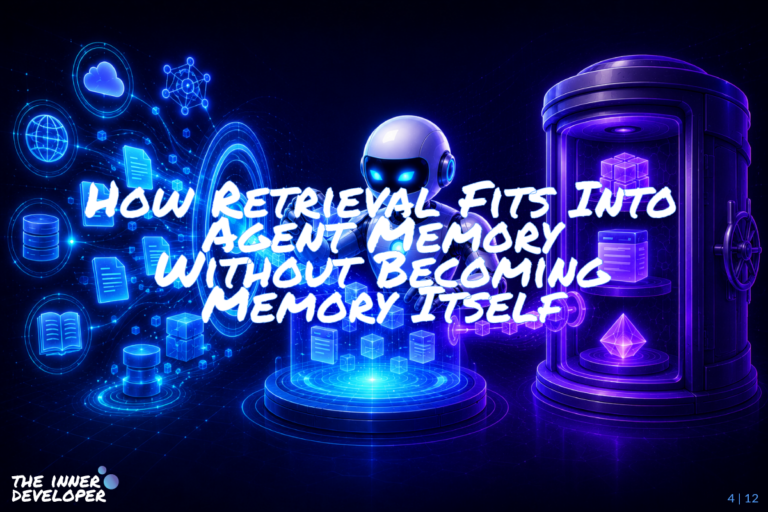
Prompting can improve a single run, but it cannot prove that an agent workflow is reliable. This article explains how traces, scorecards, offline evals, and online monitoring turn agent quality into an engineering discipline.

Discover more
Image displaying the Post title and excerpt

Inheritance Tax: The Cost of Rigid Hierarchies

Book Summary, The Pragmatic ProgrammerBy Sami09.06.2026Leave a comment

Inheritance feels elegant at first, but deep hierarchies often charge interest later.

Discover more
The text: Migrating from SCORM 1.2 to SCORM 2004 on a colorful image with a pattern of laptops

Migrating from SCORM 1.2 to SCORM 2004

E-Learning Standards, SCORM 2004By Sami04.06.2026Leave a comment

Migrating from SCORM 1.2 to SCORM 2004 is not a version upgrade. It is a behavioral redesign. If your migration strategy only updates API calls and manifest versioning, you are not migrating. You are creating hidden inconsistencies.

Discover more
Robot surrounded by icons of settings, configuration, warning, check and database.

Tracing Agent Behavior: The Fastest Way to Understand What Went Wrong

AI Agent Engineering for Developers, The Agent LoopBy Sami03.06.2026Leave a comment

If an agent fails and you only have the final answer, you are debugging blind. This article explains how useful traces expose the exact step, tool, state, or context failure that actually broke the run.

Discover more
Image displaying the Post title and excerpt

Transforming Programming: From State to Flow

Book Summary, The Pragmatic ProgrammerBy Sami02.06.2026Leave a comment

When you reduce hidden state and focus on clear transformations, debugging turns from detective work into simple reasoning.

Discover more
The text: SCORM 2004 Editions Explained on a colorful image with a pattern of laptops

SCORM 2004 Editions Explained

E-Learning Standards, SCORM 2004By Sami28.05.2026Leave a comment

SCORM 2004 is not one specification. It is a family of editions. If your content behaves differently across LMS platforms, the issue may not be your implementation. It may be how each system interprets a specific edition.

Discover more
A robot surrounded by icons of stop and different paths

Retries, Backoff, and Recovery Paths for Tool-Using Agents

AI Agent Engineering for Developers, The Agent LoopBy Sami27.05.2026Leave a comment

Reliable agents are not the ones that never fail. They are the ones that fail into the right path. Here is how to classify tool failures into retry, replan, user input, or hard stop, and why retry policy belongs at the tool boundary.

Discover more
Image displaying the Post title and excerpt

Juggling the Real World: Designing for Reality

Book Summary, The Pragmatic ProgrammerBy Sami26.05.2026Leave a comment

Real world software fails not because it is complex, but because it was designed for ideal conditions.

Discover more
The text: imsmanifest.xml in SCORM 2004 on a colorful image with a pattern of laptops

The imsmanifest.xml in SCORM 2004

E-Learning Standards, SCORM 2004By Sami21.05.2026Leave a comment

In SCORM 2004, the manifest is not just structure. It is behavior. If sequencing fails, navigation breaks, or activities become unreachable, the root cause is often not your code. It is your imsmanifest.xml.

Discover more
A Robot surrounded by check and warning signs

Stopping Conditions: How Agents Know When to Finish

AI Agent Engineering for Developers, The Agent LoopBy Sami20.05.2026Leave a comment

Most bad agent experiences come from bad stopping decisions. Learn how to design stop logic in code with explicit exit states, tool signals, step limits, and traceable runtime policies.

Discover more
←12345…
67
8→
Explore
  • Home
  • About
  • Blog
Get in touch
Contact me today!
© The Inner Developer 2025

whoami.akkawi.ch

Go to Top