
🧠 Why most teams misunderstand agents
Most confusion about agents starts with the wrong mental model. Teams picture an LLM that thinks hard enough, plans well enough, and somehow becomes autonomous. That framing feels natural because the model is the most visible part of the system. But it hides the part that actually determines behavior in production. For AI agents for developers, an agent is not just a model with a long prompt. It is a control system wrapped around a model.
That distinction matters because many real failures have very little to do with wording. Two systems can use nearly identical prompts and still behave differently under pressure. One retries a flaky tool call, asks a clarifying question when state is missing, and stops only after required checks pass. The other picks a tool too early, sends malformed arguments, and gives up after the first bad response. Same model family, similar instructions, very different runtime behavior.
Once you see that, a lot of common team debates start to look misplaced. People ask whether the model is smart enough, whether the prompt is strong enough, or whether a larger context window will fix the issue. Sometimes those things matter. But often the actual problem is that the loop has no validation step, no branch for missing data, no retry policy, or no durable state between turns. In other words, the system is behaving exactly as designed, and the design is thinner than the team realized.
This is why current platform guidance from OpenAI increasingly centers on orchestration, tool execution, traces, and evaluation instead of treating the model call as the whole system. Their agent materials describe an orchestrator that receives model output, invokes tools, and feeds results back into the model in a loop. That is the useful definition for developers because it matches what you actually have to build and debug. It is also why agent orchestration and agent reliability belong in the same conversation. See the OpenAI Agents SDK guide for that framing.
🔁 The loop is a control cycle, not a one-shot answer
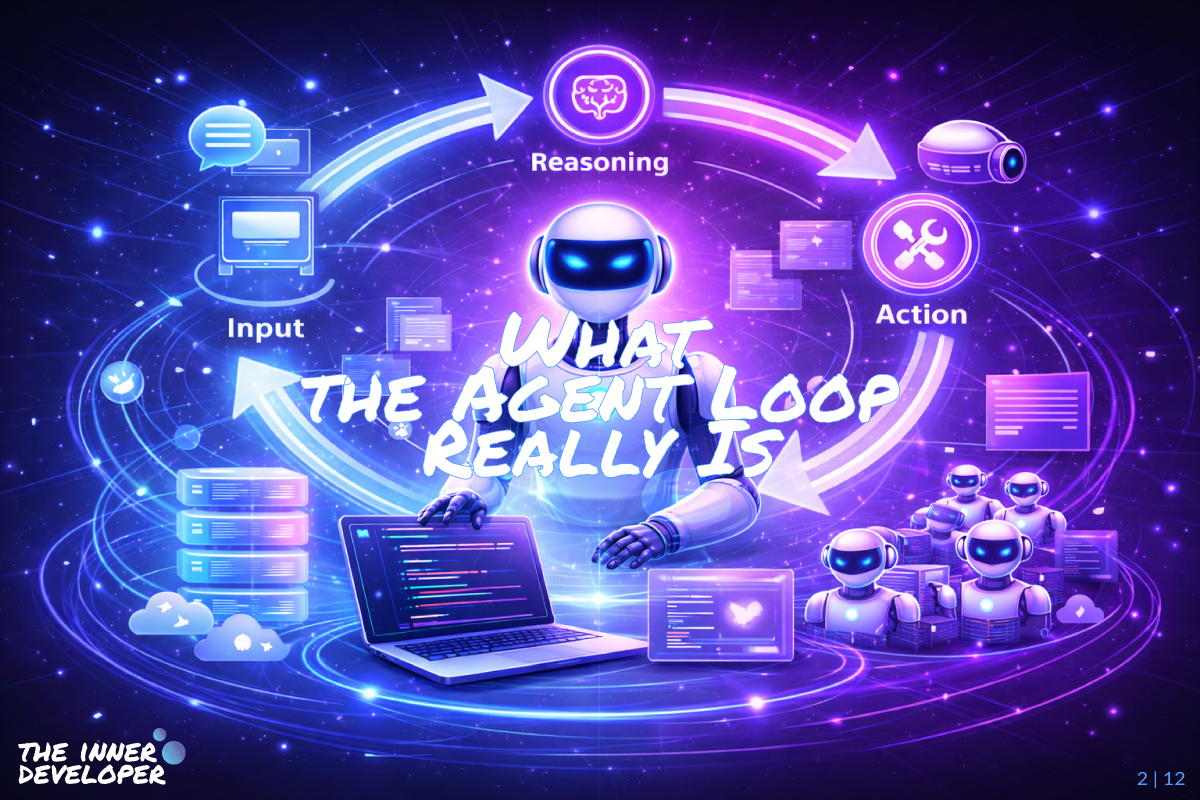
The simplest accurate definition is this: the agent loop is a repeated cycle of input, context assembly, action selection, execution, observation, state update, and stop or continue. The model participates in that cycle, but it does not define the whole cycle. That shift sounds subtle, but it changes how you reason about failures. It moves your attention away from “what did the prompt say?” and toward “what state did the system have, what action was chosen, what happened next, and why did the loop continue?”
In practical terms, a loop iteration often looks like this. A user goal arrives. The system assembles relevant state. The model decides whether to answer directly, ask for missing information, or call a tool. If a tool is called, the runtime executes it and captures the result as an observation. The system then updates structured state and decides whether another iteration is needed. The loop stops only when completion criteria are met or a failure path is triggered.
It helps to think of this less like a chatbot and more like an event-driven program. The model proposes a next move, but the environment decides what actually happened. A database call may return no record. A shell command may time out. A human may decline approval. A safety policy may block an action. Every one of those outcomes becomes an observation that shapes the next step. That is why calling the whole thing “a prompt” is too small a concept. The runtime is continuously reacting to the world.
This is also why long-running agents, especially AI coding agents, are more than bigger prompts. OpenAI’s recent work on the Responses API computer environment describes a stack where the model emits actions, a shell tool runs them in a hosted container, outputs come back, and the cycle continues with persistent runtime context and compaction as needed. That architecture is a loop design problem, not a prompt length problem. It is a practical example of LLM agent architecture for tool calling agents built for real work. The implementation details are worth reading in OpenAI’s computer environment post.
🧩 The five runtime parts teams should stop collapsing together
A lot of agent debugging gets harder because developers flatten distinct runtime artifacts into one thing called “the prompt.” That hides where the failure happened. A more useful decomposition is input, reasoning, action, observation, and state update. Each part has a different job. Each fails in different ways. And each should usually be represented separately in your system design.
Input is what the system receives from the user, environment, or prior workflow step. It is the raw demand placed on the loop. That may include a user message, authenticated account data, previous task outputs, or a scheduled event. Input quality matters because the system cannot recover from ambiguity it never records. If the user says “check my order,” input is incomplete unless the account context or order ID is already available.
Reasoning is the model’s intermediate process for deciding what to do next. In practice, this often means selecting a tool, deciding that a question should be asked first, or recognizing that the task can be answered immediately. The important point is not to confuse reasoning with durable state. Reasoning is a temporary decision process. Durable state is what the system must remember across steps. If you store only reasoning-like text and skip structured records, you make later recovery much harder.
Action is the concrete next step. That could be asking the user for missing information, calling a function, delegating to another component, or finalizing a response. Actions are the bridge between model intent and system behavior. This is where validation becomes crucial. If the model proposes a tool call with malformed arguments, a good runtime catches that before execution. Otherwise, you are letting generated text directly control side effects. This is one of the core differences between toy demos and tool calling agents that can survive production.
Observation is what comes back from the world. Usually that means tool output or environment feedback, but it can also include a human approval, a browser result, a timeout, or a permission denial. Observations matter because they are the only ground truth the loop has after taking action. Without them, the model is effectively guessing about whether progress happened. Developers often underestimate this and treat observations as just more text, when they are really evidence.
State update is the durable record of what now matters for the next turn. This may include validated identifiers, retrieved records, error classes, retry counts, pending tasks, and completion flags. If you compress all of that into a block of text, you lose structural clarity. OpenAI’s reasoning guidance makes this separation concrete. For complex multi-step function calling, they recommend using the Responses API with storage and carrying prior reasoning items forward, often through a previous response reference, because restarting the model’s thinking from scratch after each tool call hurts performance and quality. Just as importantly, reasoning is not the same as persistent state. Durable records should usually be structured data and trace events, not an opaque blob of hidden model thought. This is where agent state management starts to matter. The reasoning guidance is useful here: Reasoning best practices.
📦 A simple order-status agent shows the loop clearly
Consider a customer support agent that answers, “Where is my order?” If you think in prompt terms, the task seems trivial. But in runtime terms, the system is missing required state. It cannot truthfully answer without an order identifier, or some authenticated account context that maps to an order. So the first correct action is not to call a tool. It is to detect missing information and ask for it.
That single design choice already separates a reliable loop from a brittle one. A weak implementation may try to infer the order, hallucinate a likely status, or call a lookup tool with empty arguments. A stronger implementation treats missing state as a first-class condition. It explicitly records that the required identifier is absent, sets the next action to ask a clarifying question, and pauses execution until the user responds. This matters because the system avoids creating fake progress. It would rather be incomplete than incorrect.
Once the user provides the order ID, the next iteration begins. The agent checks that the ID is present, chooses the order-status tool, formats arguments, executes the call, receives a structured result, stores that observation, and only then decides whether it has enough information to respond. If the tool says the order is delayed, the agent can summarize that result. If the tool returns “not found,” the agent may ask for confirmation or route to a recovery path. The loop is the sequence of these controlled transitions.
You can picture the logic in plain steps. Step one, inspect state and verify whether an order identifier exists. Step two, if not, ask for it and stop. Step three, if it does exist, call the lookup tool with validated arguments. Step four, classify the response. A successful lookup leads to a final answer. A “not found” result leads to clarification. A timeout leads to retry or escalation depending on policy. Notice what is happening here: the model is not free-floating. It is operating inside a runtime that decides what to do with each class of result.
This example is especially useful because each failure point is distinct. The agent may fail to ask for the missing order ID. It may choose the wrong tool. It may send invalid arguments. It may misread the returned status. Or it may stop too early and respond before the tool result is validated. OpenAI uses order lookup examples in evaluation guidance for exactly this reason: they make agent behavior inspectable step by step instead of turning everything into an abstract prompt discussion. See evaluation best practices.
⚙️ Control flow is what shapes behavior under pressure
Prompting matters, but control flow is the layer that decides what the system actually does when reality gets messy. Retry policies, branching logic, interrupts, approval gates, handoffs, and stop conditions define behavior far more than most teams expect. This is why two agents with the same instructions can have very different reliability. One has disciplined control flow. The other does not.
LangGraph is particularly useful here because it documents agent behavior as explicit state transitions instead of magical model intelligence. Their examples show at least three failure classes that should not be treated the same. A transient infrastructure error might justify automatic retry. A tool failure that the LLM can recover from should be surfaced back into the loop with the error details so the model can choose a different action. A missing piece of user-provided information should trigger an interrupt or pause until the user responds. Those are three different branches, not one generic exception handler.
Why this matters becomes obvious in production. Imagine a billing agent calling a payment-status API. If the API times out, retrying once may be reasonable. If the API returns “account_id missing,” retrying is pointless because the fault is missing state, not unstable infrastructure. If the API returns “permission denied,” the system may need escalation rather than repeated model calls. Treating all three outcomes as “just ask the model again” is not flexibility. It is loss of control.
This matters because robust loops are partly error-classification systems. If every failure becomes “ask the model again,” you get retry storms, useless tool repetition, and hard-to-debug behavior. If failure types are explicit, recovery becomes intentional. This is also where agent handoffs and supervisor worker agents start to make sense, especially in multi-agent systems where one component may route work while another executes it. LangGraph’s materials on agent design, LangGraph memory, and interrupts show this clearly in practice: Thinking in LangGraph and interrupts.
🗂️ State is working memory, not just chat history
One of the most damaging simplifications in agent design is treating state as conversation history. Chat messages are part of state, but they are rarely enough for a production loop. Real systems often need tool outputs, retry counters, pending subtasks, validation flags, execution metadata, prior observations, approvals, and error records. Without those, replay is weak, recovery is brittle, and prompt changes become dangerous because too much behavior is encoded as prose.
LangGraph’s recommendation to store raw data in state instead of formatted prompt text is a deceptively important engineering decision. Raw tool outputs and structured fields stay stable even if your prompt templates evolve. That means you can change how the model sees information without rewriting the underlying system record. It also means downstream steps can consume data directly rather than scraping it back out of generated prose. This is cleaner architecture, but more importantly, it reduces hidden coupling.
A good example is a support workflow with partial progress. Suppose the agent has already validated the customer identity, recorded an order ID, attempted one tool call, and hit a temporary backend timeout. If that information lives only in rendered prompt text, a retry may lose important semantics. The system may restate the problem well but still fail to know what has already been done. If that information lives in structured state, the loop can resume intentionally. It can say: identity_verified=true, order_id=12345, tool_attempts=1, last_error=timeout. That is far more usable than a paragraph that happens to mention those facts.
This is why agent state should be designed like application state, not treated as extra chat context. The long-term benefit is not just reliability today. It is adaptability later. When the product changes, you can add new branches, new tools, or new review steps without rebuilding the whole system around prompt wording. Structured state gives the loop a stable backbone. It also clarifies the difference between AI agent memory and application state. Short-term vs long-term memory in agents is not just a modeling question. It changes whether the system can resume, personalize, or recover after interruption. In many cases, procedural memory for agents matters as much as conversational recall because the system needs to remember how work was being done, not just what was said.
🔍 Traceability is what turns mystery into engineering
When teams say an agent is hard to debug, they usually mean the system did several things in sequence and they cannot see which transition went wrong. Traceability fixes that by recording the loop as a series of inspectable events. OpenAI’s trace grading materials define a trace as the end-to-end record of decisions, tool calls, and reasoning steps. That framing matters because a final answer alone tells you almost nothing about the quality of the path.
A useful trace typically captures the input seen at each step, the action chosen, any tool arguments produced, the observation returned, the state change applied, and the reason the loop continued or stopped. With that record, the debugging conversation changes. Instead of saying “the agent failed,” you can say “tool selection failed on step two after missing-state validation was skipped,” or “the stop condition triggered even though the tool response had an error flag.” Those are fixable statements.
There is also a practical organizational reason to care about traces. As soon as more than one person works on the system, verbal descriptions stop being enough. A PM sees a bad final answer. An engineer wants the exact tool arguments. A platform team wants to know whether latency came from the model or the database. A safety reviewer wants to see whether a blocked action was attempted. Traces give each person the same underlying record, which reduces guesswork and blame-driven debugging.
Traceability also improves evaluation. You can grade tool choice accuracy, argument validity, recovery quality, and stop-condition correctness instead of only judging the final answer. That is a much better fit for agent systems, where nondeterminism often comes from planning and tool use rather than just wording. This is the foundation of agent evaluation and tracing, and it is closely tied to agent observability. OpenAI’s documentation on trace grading is a strong reference for this shift from prompt tweaking to systems engineering.
🧪 Why similar prompts produce different agents
The phrase “same prompt, different behavior” sounds surprising until you look at the loop. One system may preserve prior reasoning items across tool interactions, while another restarts the model from scratch on every call. One may validate tool arguments before execution. Another may execute whatever the model produced. One may compact context during long runs. Another may keep appending tokens until cost and latency spiral. These are loop design choices, not prompt wording choices.
This is especially visible in long-running agents built for software tasks. A useful coding agent needs a runtime where shell commands can execute, outputs can be captured, files can persist, and the loop can continue with updated context. It also needs stop conditions that distinguish “task complete” from “still exploring” and “stuck in repetition.” Without those controls, the agent either thrashes or burns tokens pretending to make progress. OpenAI’s hosted computer environment examples make this concrete because they show the runtime stack, not just the model call. For teams building Responses API agents or using the OpenAI Agents SDK, this is the difference between a clever demo and durable execution for agents.
Anthropic’s evaluator-optimizer pattern is another good reminder that many advanced agent designs are still loops. A generator produces output, an evaluator judges it, and the cycle repeats until a threshold is met. Different purpose, same core idea: explicit iterations with clear stop logic. That broader framing is helpful because it shows the agent loop is not a niche tool-calling trick. It is a general control pattern for model-driven systems. Anthropic’s architecture guide is helpful context: Building Effective AI Agents.
Why this matters in practice is that teams often over-credit the model and under-credit the system around it. If one agent looks more capable than another, the easy conclusion is that it had a better prompt or stronger base model. Sometimes the real reason is much less glamorous: better state, better validation, better stop rules, and better memory of prior steps. That should be encouraging. It means reliability is often available through engineering discipline, not just model upgrades.
🛠️ What to instrument if you want a loop you can trust
If the loop is the real unit of behavior, then your metrics should reflect the loop. Final answer quality is not enough. You want to know whether the agent chose the right tool, whether the arguments were valid, how many steps it took to finish, how often failures were recoverable, how often they were not, and whether the stop condition fired correctly. Latency per iteration and tokens per successful task also matter because a clever loop that is too slow or too expensive will not survive production.
Instrumentation should also make replay possible. A practical event record often includes user input, current state snapshot or state diff, selected action, tool name, arguments, observation, error class, retry count, and termination reason. That sounds operational because it is. Once agents move beyond demos, the core challenge is not making them sound intelligent. It is making them observable enough that failures can be reproduced and corrected.
In concrete terms, imagine you are reviewing a failed support session. If your logs only contain the final assistant message, you cannot tell whether the model selected the wrong tool, passed the wrong account ID, misunderstood the tool output, or exited after the first exception. If your event stream records each step, the issue becomes visible. Maybe the loop skipped validation. Maybe the retry budget was exhausted. Maybe the stop condition treated “partial data returned” as success. Each diagnosis points to a different fix.
The deeper lesson is slightly uncomfortable but useful. Prompt-centric thinking persists because it keeps the system feeling simple. But real agent behavior comes from the loop, and loops are architecture. Once you accept that, the work becomes less mystical and more disciplined. You start asking better questions: What state is durable? Which errors are retryable? What is the exact stop gate? Which traces should be graded? That is where reliable agent engineering starts. For AI agents for developers, that means treating the agent loop as the center of the system and building for observability, orchestration, memory, and reliability from the start.
🔢 #2 of 12 | The Agent Loop