

🧭 The real bottleneck is not specialization
Most multi-agent systems do not fail because they lack one more specialist. They fail earlier, when work is split badly. That is the less glamorous part of LLM agent architecture, but it is usually where reliability is won or lost. Teams often assume improvement comes from adding a researcher, a coder, a reviewer, and a planner. In practice, those roles help only when each receives a bounded task with a clear finish line.
This is why the supervisor-worker pattern matters. It is not a vague idea about agents collaborating. It is a control structure. One component owns decomposition, sequencing, constraints, and final synthesis. OpenAI’s multi-agent guidance frames this as a manager pattern where a central agent invokes specialists as tools and remains responsible for the answer, which differs from agent handoffs where control fully moves elsewhere. That difference matters operationally because it gives you a stable place to assign accountability. See OpenAI’s multi-agent guide and agent orchestration patterns.
If the supervisor keeps control, failures become easier to classify. Did the plan omit a necessary subtask? Did the worker receive the wrong files? Did synthesis flatten an important disagreement? Those are very different problems, and they need different fixes. Without an explicit supervisor, everything collapses into a generic complaint that “the agents were confused.” That sounds descriptive, but it does not help you improve the system.
This matters in production because debugging one opaque agent is already difficult. Debugging five opaque agents with no clear owner is worse. A supervisor gives the system a policy layer. It becomes the place for retries, stopping rules, budget control, and the decision of whether decomposition is even needed. That centralization is not bureaucratic overhead. It is what lets an agent system behave like software rather than theater.
🏗️ What supervisor-worker actually means
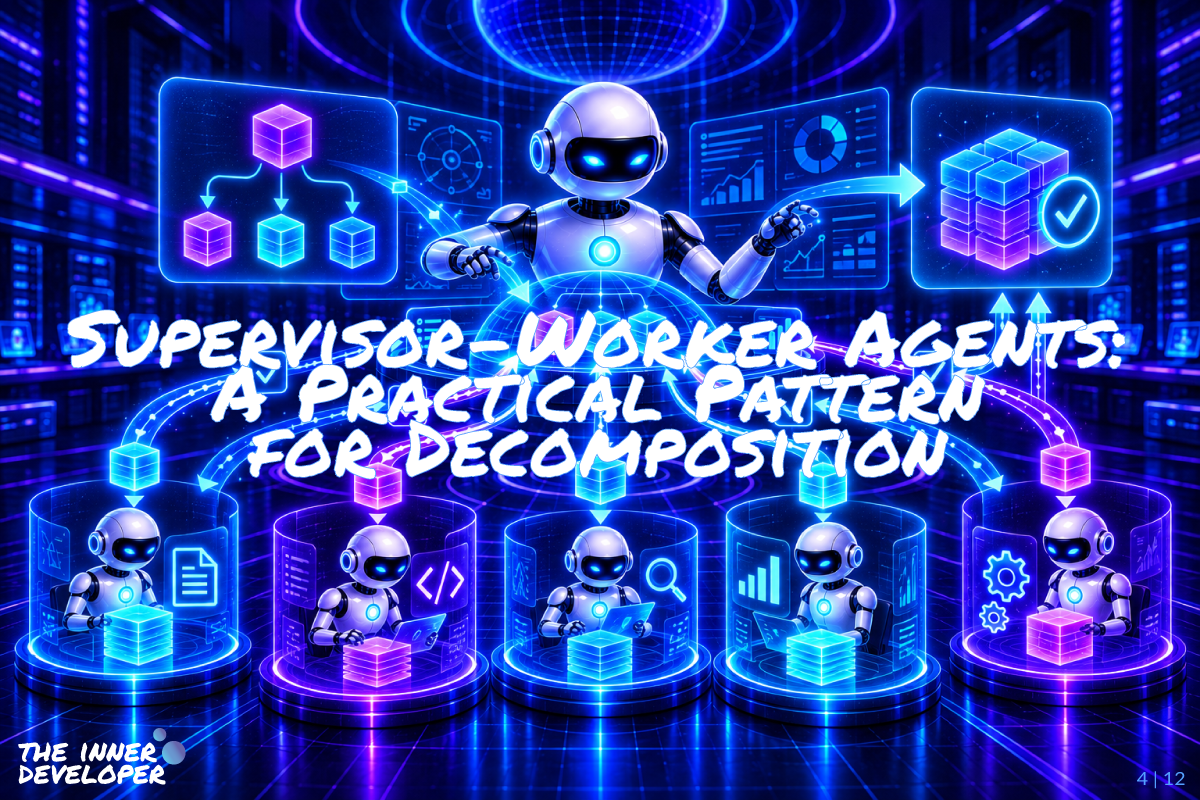
A practical definition helps. The supervisor owns the global objective. It receives the user request, decides whether direct execution is enough, creates subgoals when needed, invokes workers, validates what comes back, and assembles the final output. Workers do not co-own the task. They own bounded subtasks with narrow context and explicit success criteria. Anthropic describes a similar orchestrator-workers setup where a central model breaks work down, delegates, and synthesizes results. That framing is useful because responsibility stays clear. See Anthropic’s guidance on effective agents.
The centralized shape is what makes the pattern practical. If the supervisor acts like a manager and workers act like tool calling agents with reasoning ability, the system becomes easier to reason about. The supervisor can enforce a shared output format, track which constraints were communicated, and prevent workers from drifting into unrelated tasks. This is more controlled than letting agents freely message one another and hoping coordination emerges.
It also helps to separate three concepts that often get blurred together: planning, execution, and synthesis. Planning decides what work exists. Execution performs that work. Synthesis turns several partial results into one answer for the user. In weak designs, one agent does all three informally and inconsistently. In strong designs, the supervisor explicitly owns planning and synthesis, while workers own execution. That separation is valuable because each stage fails differently. Planning fails through omission or unnecessary branching. Execution fails through bad tool use or poor reasoning in the agent loop. Synthesis fails through duplication, contradiction, or loss of nuance.
There is also a deeper architectural point here. Explicit control is not anti-agent. It is the mechanism that turns flexible reasoning into something operable. LangGraph leans into this idea by treating LLM-driven decisions and deterministic graph steps as parts of the same runtime rather than opposing choices. That matters because decomposition is useful only when the boundary between reasoning and control is visible enough to inspect. See the LangGraph introduction.
🧪 When a worker should exist at all
A worker should not exist because its name sounds useful. “Research agent” and “analysis agent” can easily become decorative architecture. The better test is capability-based. Create a worker only when at least one condition is true: it needs different tools, it needs isolated context, it can run independently or in parallel, or it needs a different instruction policy or model. If none of those apply, keeping the work inside one agent is usually cheaper and more reliable.
This heuristic matters because decomposition adds overhead before it adds value. The supervisor has to plan, package work, wait for results, and merge outputs. If a task is inherently sequential or depends on tightly shared evolving context, that overhead becomes pure drag. Anthropic explicitly warns that subagents can be overused for simple jobs where a direct tool call would be faster. That advice is worth taking seriously because many agent failures are self-inflicted architectural complexity, not model weakness. See Anthropic’s subagent prompting guidance.
A concrete example makes the distinction clearer. Suppose a user asks for a summary of three support tickets and a recommendation for a product response. If the same model can read all three tickets, extract the issue pattern, and produce a response recommendation in one pass, a worker layer adds little. But if the request becomes “compare billing complaints, security complaints, and performance complaints across the last quarter using different internal systems,” workers begin to make sense. Each category may need different tools, different filtering logic, and different context windows. The decomposition is not justified by style. It is justified by a real difference in execution.
A good mental model is this: if you cannot describe what makes one worker meaningfully different from a tool call plus a schema, you probably do not need a worker. The goal is not to maximize the number of agents. The goal is to create boundaries that improve focus, parallelism, or control. Decomposition should remove ambiguity from execution, not simply rearrange it into more moving parts.
📦 Delegation works only when the contract is explicit
The most common failure mode in supervisor-worker systems is vague delegation. The supervisor sends something like “look into this” or “analyze the code issue,” and the worker returns something equally fuzzy. Then the supervisor retries, clarifies, or asks a second worker to reinterpret the first. That loop can look intelligent from the outside, but inside it is usually just ambiguity being moved around.
The fix is to treat each worker invocation like a tool contract, not a chat. A worker packet should specify the objective, scope, constraints, allowed tools, expected output, and done criteria. This turns delegation into an interface. OpenAI’s agents and handoff documentation repeatedly pushes in this direction by exposing typed inputs and tool-like boundaries for orchestration. The deeper lesson is that agent systems become more reliable when subtask interfaces look more like APIs than conversations. See the OpenAI Agents Python docs.
{
"objective": "Review changed files for security issues",
"scope": ["auth.ts", "billing.ts"],
"constraints": ["focus on exploitable risks", "no style feedback"],
"allowed_tools": ["code_search", "diff_reader"],
"expected_output": {
"findings": "array",
"severity": "low|medium|high",
"evidence": "string",
"fix_suggestion": "string"
},
"done_criteria": "Return only validated findings with file references"
}
Each field does real work. The objective defines what success means at a high level. Scope limits the files or records the worker is allowed to examine, which prevents drift. Constraints narrow the style of reasoning, such as focusing on exploitable risks instead of code quality in general. Allowed tools define the action surface, which matters for both safety and consistency. Expected output provides structure for downstream validation. Done criteria define when the worker should stop instead of continuing to speculate.
Why this matters is not only answer quality. Explicit contracts make retries safer, evaluation easier, and agent observability clearer. If a worker fails, you can inspect whether the packet was underspecified or whether the worker ignored a valid contract. That is an engineering diagnosis. Without the boundary, every failure becomes “the model acted weird,” which is not specific enough to fix. Good contracts also make replacement easier. You can compare two workers against the same packet and see which one is actually better, rather than comparing vibes across different conversations.
⚠️ Overplanning and under-specification are opposite failures
Supervisor systems tend to fail in two opposite directions. The first is overplanning. The supervisor decomposes simple work into too many branches, spawns unnecessary workers, and burns tokens on planning that adds no accuracy. Anthropic’s recent prompting guidance notes that modern models may over-explore and create subagents too readily. That is not just a prompt style issue. It directly affects latency, cost, and predictability.
The second is under-specification. Here the supervisor delegates, but the request packet is too loose. Workers infer hidden assumptions, ask for clarification through multiple retries, or return output that cannot be merged cleanly. The resulting system looks busy but produces little progress. These failures often appear together. A system that over-delegates usually also delegates vaguely because the supervisor did not have a strong reason for decomposition in the first place.
The practical fix for overplanning is to enforce decomposition limits in code, not only in prompts. Cap workers per request, delegation depth, and retries per worker. Add simple gate checks such as “use direct execution unless tasks require distinct tools or can run in parallel.” These checks sound basic, but they protect the system from the model’s tendency to expand the search space. If every request can branch indefinitely, eventually some requests will.
The practical fix for under-specification is to demand structured outputs with bounded fields. If a worker cannot express completion in a schema, the task boundary is probably not ready. This can feel restrictive at first, especially to teams that like free-form reasoning, but the restriction is productive. It turns vague completion into explicit deliverables. That makes the system testable. The long-term health benefit is significant because once worker outputs are structured, you can build validators, regression tests, and failure dashboards around them instead of reading transcripts by hand.
🧠 Worker context is architecture, not plumbing
One of the most underrated decisions in this pattern is what the worker gets to see. Many teams pass the full conversation transcript to every worker by default. That feels safe because more context seems better. In reality it often weakens specialization. A research worker does not need every earlier tool call. A code review worker does not need an hour of planning chatter. Excess history raises token cost, distracts the worker, and creates cross-agent contamination where irrelevant details leak into the result.
LangGraph’s supervisor tooling makes this visible by letting you choose how much history propagates, including modes like full history or last message only, plus hooks for trimming and summarization. That is not a cosmetic feature. It reflects a deeper truth: message history design is part of the orchestration architecture. See the LangGraph supervisor reference.
There are really three context choices to think about. First is raw history, which is the transcript itself. Second is curated state, which includes the few facts the worker actually needs, such as repository path, changed files, or user priority. Third is task-local instruction, which defines how the worker should use that state. Strong systems prefer curated state plus task-local instruction over raw history. That combination preserves relevance without forcing the worker to reconstruct the important parts from a long conversation.
Why this matters is that narrow context improves both focus and modularity. A worker that sees only a task packet is easier to reason about because its behavior depends on a smaller, more intentional input surface. It also becomes easier to swap, test, or compare workers when they are not entangled with the full transcript. In other words, controlling worker context is not just a token optimization. It is a way to protect the integrity of the decomposition itself.
This is also where AI agent memory and agent state management become practical concerns. If everything is passed as transcript, the system has no clean boundary between active context and stored knowledge. Thinking clearly about short-term vs long-term memory in agents helps. Short-term memory should support the current task packet and active orchestration state. Long-term memory should store reusable facts, policies, or past outcomes that improve future execution. If those two are mixed casually, workers inherit noise instead of useful state.
For teams building stateful workflows, this distinction becomes even more important. Procedural memory for agents can encode recurring operating rules such as review criteria, escalation policies, or preferred remediation patterns. Systems like LangGraph memory make this separation more concrete by combining conversational state, persistence, and controlled recall. Why it matters is simple: better memory boundaries lead to better worker focus, and better worker focus leads to more reliable outputs.
🔄 A concrete end-to-end flow
Consider a user request: “Review this pull request for security issues and summarize deployment risk.” A well-designed supervisor does not immediately spawn five agents. It first checks whether direct execution with code search and diff tools is enough. If the codebase is small, direct execution may win. If the pull request touches authentication, billing, and infrastructure, the supervisor may decompose into three parallel workers because the workstreams are independent and need different evidence.
The security review worker receives changed files and a strict schema for exploitable findings. The infrastructure worker receives deployment config diffs and looks only for rollout or secret-management risk. A third worker may examine test coverage gaps if that concern has its own criteria and tools. Each worker returns structured results only, not an essay. The supervisor validates that outputs satisfy the schema, removes duplicates, resolves contradictions, and decides whether another targeted worker pass is necessary.
Walk through the logic step by step. First, the supervisor inspects the request and the changed files. Second, it decides whether the request should stay centralized or split. Third, for each subtask, it builds a packet with scope and constraints. Fourth, workers perform bounded analysis with approved tools. Fifth, the supervisor checks whether outputs are complete and compatible. Sixth, it synthesizes a user-facing result that explains risk level, evidence, and recommended next action. Nothing magical is happening. The pattern works because every step has a clear owner.
This example shows why supervisor-worker is a decomposition pattern rather than a collaboration fantasy. The supervisor is not asking specialists to improvise together. It is coordinating bounded, inspectable units of work. If the final answer is poor, you can ask specific questions. Was the auth worker never called? Was the deployment worker given the wrong files? Did synthesis flatten severity incorrectly? That level of diagnosis is what makes the pattern viable for real developer workflows, especially in AI coding agents where trust depends less on eloquence and more on traceable reasoning.
🔍 Trace the orchestration, not just the answer
If you evaluate only the final response, you miss where the system actually failed. A supervisor-worker setup needs observability at the orchestration layer. OpenAI’s tracing model already separates agent runs, loop turns, function calls, guardrails, and handoffs into spans, which gives a natural debugging structure for this pattern. See OpenAI’s tracing guide.
At minimum, trace four layers separately: the supervisor planning step, the worker invocation, the worker’s own tool use, and the supervisor synthesis step. That separation matters because bad decomposition and bad execution are different classes of failure. If the supervisor chooses the wrong worker, no amount of worker prompt tuning fixes the real problem. If the worker uses tools poorly under a valid task packet, the decomposition may be fine and the specialist needs improvement.
This also leads to better metrics. Measure worker calls per task, duplicate delegations, planning token share, worker retry rate, time spent waiting on the slowest worker, and supervisor correction rate. These are decomposition-quality metrics, not just answer metrics. They tell you whether the architecture is spending its budget on useful execution or on managerial confusion.
Why this matters in the real world is that teams often overfit to end-user satisfaction scores. Those scores are useful, but they lag behind the root cause. Traces expose failure before users complain. If planning token share suddenly doubles after a prompt change, or if duplicate delegations spike for one task category, you have early evidence that decomposition quality is degrading. For AI agents for developers, this shift from prompt tinkering to trace-based systems engineering is where production maturity actually begins.
This is where agent evaluation and tracing should be treated as part of the architecture, not as an afterthought. It is also where newer implementations such as Responses API agents and the OpenAI Agents SDK matter in practice. They give teams a more structured way to observe orchestration, compare runs, and understand whether failures come from planning, tool use, memory, or synthesis. That visibility is what makes improvement cumulative instead of anecdotal.
🛡️ Guardrails and control boundaries are easy to misunderstand
There is a subtle implementation risk in delegated systems: guardrails do not automatically cover every step the way people assume. In OpenAI’s Python SDK, input guardrails apply to the first agent in the chain, and output guardrails apply to the final producing agent. Tool guardrails operate at the guarded function-tool boundary. If your supervisor treats workers as tools, you cannot casually assume agent-level guardrails protect each worker action or each side effect. See the agents docs and the related guardrail behavior in the SDK documentation.
This matters most when worker output can trigger real operations such as refunds, repository changes, or infrastructure actions. The reliable place to validate is the actual execution boundary. That usually means wrapper tools, argument validation, result validation, and side-effect checks outside the model. It is less elegant than assuming the orchestration layer will handle everything, but it is much safer.
Think about a worker that recommends deleting a stale cloud resource. The worker may reason correctly most of the time, but the irreversible step should still pass through a deterministic validation layer that checks environment, permissions, target resource type, and change policy. The model should propose. The system should verify. That distinction matters because natural-language confidence is not the same thing as operational safety.
There are smaller implementation traps too. If you generate many workers from a base configuration, watch for shared mutable state such as shallow-copied tool lists. A small mutation can accidentally change multiple workers and create behavior that looks like model inconsistency but is really object reuse. These details sound low level, yet they matter because supervisor-worker architectures amplify boundary mistakes. The cleaner your boundaries, the less mysterious the system becomes over time.
⚙️ OpenAI manager style versus LangGraph supervisor runtime
There are two useful implementation styles here. In OpenAI’s SDK, the cleanest mapping is usually a manager agent that invokes specialist agents as tools and keeps responsibility for the final output. This is a relatively low-abstraction approach. It gives you primitives for tools, orchestration, and traces without imposing a heavy runtime model. That is a good fit when your workflow is short-lived and you mainly need explicit control over delegation. See the OpenAI agents guide.
LangGraph offers a more explicit supervisor abstraction with history propagation controls, memory integration, checkpointers, and support for hierarchies. That becomes valuable when the workflow is long-running agents, stateful, or nested. A graph runtime makes message trimming, resumability, and durable execution for agents first-class concerns rather than custom plumbing. See the LangGraph supervisor module.
The choice matters because orchestration complexity compounds over time. A lightweight manager pattern may be enough for bounded tasks like research synthesis or pull request review. Once you need resumability, multi-level teams, or explicit state outside message history, a graph-style runtime becomes easier to reason about. The important point is not which framework is superior. It is that supervisor-worker systems stop being simple the moment orchestration state becomes part of the product, so your runtime should match that reality.
A useful way to decide is to ask where failure recovery should live. If a failed run can simply be restarted from the top, a lightweight manager is often sufficient. If a failed run must resume from a checkpoint after several expensive worker steps, you are already in runtime territory. That question seems operational, but it shapes architecture. Choosing too little runtime too early creates fragile custom code. Choosing too much runtime too early creates unnecessary complexity. The right answer depends on how durable the workflow needs to be.
✅ The practical rule that keeps this pattern honest
The best rule I know for deciding whether a task needs a worker instead of a direct tool call is blunt: if you cannot define a stable task packet, do not delegate yet. That usually means the problem is still prompt quality, not decomposition. A worker earns its existence only when the subtask boundary improves control. Different tools, isolated context, parallel execution, or a distinct policy are the usual reasons. Without one of those, you are just wrapping ambiguity in another agent.
This is worth emphasizing because multi-agent design often gets treated as a maturity badge. It is not. Official guidance from OpenAI, Anthropic, and LangChain all points in the same direction: use orchestration patterns when decomposition improves execution, not by default. That is a healthy correction to the idea that more agents automatically produce better systems.
Supervisor worker agents are valuable precisely because they narrow responsibility. The supervisor owns planning, validation, and synthesis. Workers own bounded execution. When those boundaries are explicit, you can inspect failures, evaluate decomposition quality, and scale modular tasks with more confidence. That is the practical promise of this pattern for AI agents for developers: not more autonomy, but more understandable control.
That final point is why this pattern tends to survive contact with production better than looser collaboration models. It gives developers something solid to work with: interfaces, packets, traces, limits, and validation points. In other words, it turns decomposition into an engineering discipline. Once you see it that way, the main question stops being “how many agents should we add?” and becomes “where does a clean boundary improve execution?” That is the more useful question, and it usually leads to better systems.
🔢 #4 of 12 | Multi-Agent Systems