

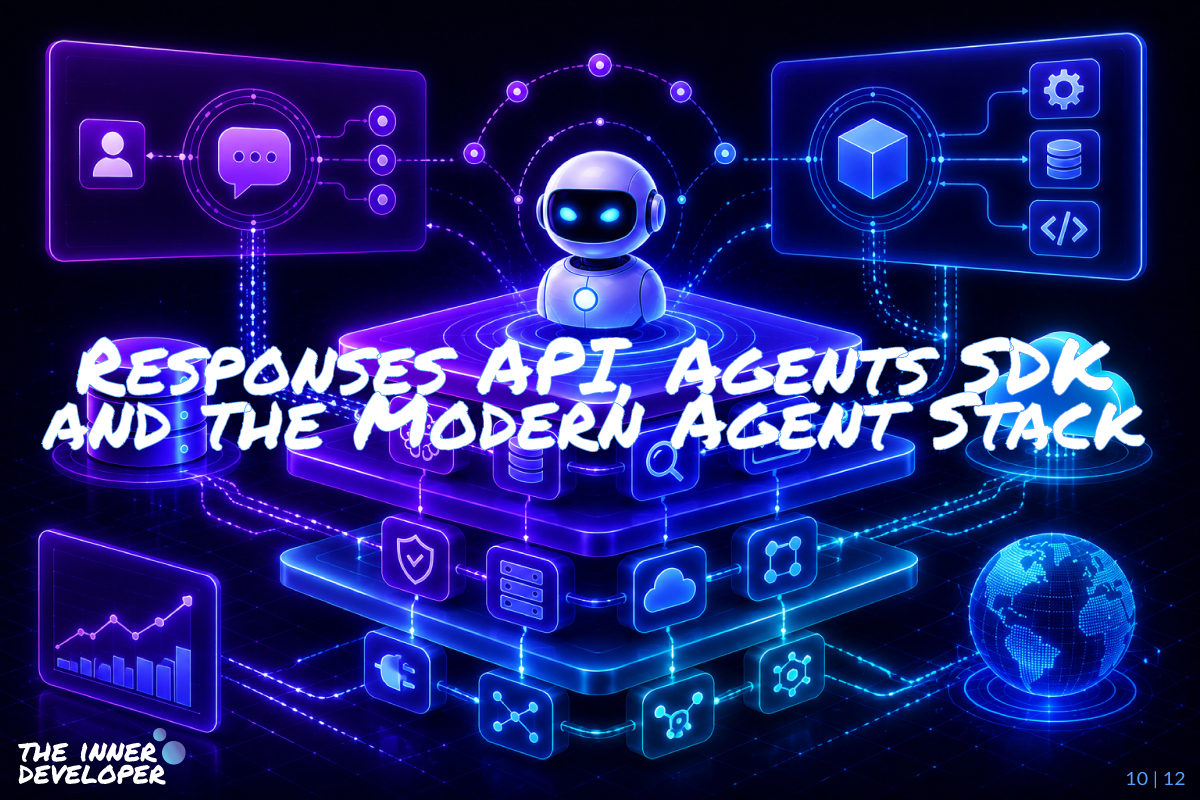
That shift matters because modern agent systems are not just model wrappers. They are execution systems with tools, state, long-running work, and observability requirements. For AI agents for developers, the distinction between the Responses API and the Agents SDK is useful precisely because it forces clearer thinking. One handles execution. The other adds orchestration primitives on top. If you blur those responsibilities, architecture starts to look simpler than it really is.
This is why stack choice is best understood as an operational contract. It defines how your agent reaches outside the model, how intermediate state surfaces to humans and systems, how history is managed, and how failures are inspected later. That is the real shape of a modern agent stack.
🧩 The Core Mental Model: Execution First, Orchestration Second
The simplest accurate framing is this: the Responses API gives you the execution protocol, and the Agents SDK gives you higher-level orchestration primitives. That sounds subtle, but it changes how you reason about the whole system. For AI agents for developers, this is the foundation of practical LLM agent architecture.
At the execution layer, the system is concerned with a single run lifecycle. A model receives input, may generate tool calls, waits for tool outputs, and continues reasoning with those results in context. This is the core agent loop. In OpenAI’s current stack, built-in capabilities such as web search, file search, computer use, Code Interpreter, image generation, and remote MCP support are treated as first-class parts of that lifecycle, not as awkward add-ons bolted around a chat endpoint. OpenAI’s product direction makes that explicit in its recent Responses API updates: the API is meant to be the native substrate for agentic applications, not just another text generation interface. You can see that clearly in the official announcement of new tools and features in the Responses API.
The orchestration layer starts when one execution step is not enough. Now you care about named agents, agent orchestration, handoffs between them, session abstractions, helper utilities for streaming, and trace capture across the workflow. That is where the OpenAI Agents SDK becomes useful. Its purpose is not to replace the underlying execution protocol. Its purpose is to make multi-step agent behavior manageable. This matters because many developers casually describe an SDK as if it were the platform itself. It is not. It is a layer built to organize and instrument a protocol that already exists underneath.
A practical way to see the difference is to imagine a research assistant that must gather sources, summarize them, and then hand the result to a compliance reviewer agent. The execution layer is responsible for each individual interaction with the model and each tool invocation inside those interactions. The orchestration layer decides that the research agent should run first, that its output should be passed to the reviewer, and that the full sequence should be captured as one understandable workflow. If you collapse those layers into one mental bucket, it becomes hard to know where a failure belongs. Did the model choose the wrong tool, or did your orchestration logic hand off too early? That distinction is not theoretical. It determines how you debug and what you change.
Why this matters long term is simple. Systems age at their boundaries. A stack that clearly separates execution from orchestration is easier to evolve because each layer can change without forcing a rewrite of everything above it. You might adjust prompts, swap orchestration logic, or change how sessions are persisted while keeping the underlying execution contract stable. That is the difference between a system that grows with your product and one that becomes fragile as soon as requirements stop looking like a demo.
🔍 Why This Layer Boundary Matters in Real Projects
If you ignore the difference between execution and orchestration, stack decisions look cosmetic. In a prototype, two systems can appear equivalent because both answer a prompt and both can call a tool. But the moment something goes wrong, the hidden differences surface fast.
Imagine an order-support agent that can look up shipment status. In a demo, it calls a tool once and returns a clean answer. In production, users ask follow-up questions, tools time out, the agent retries with malformed arguments, and support wants to know why one customer was told an order had shipped when the database said otherwise. At that point, what matters is not whether your code felt elegant on day one. What matters is whether the execution layer exposes tool events clearly, whether the orchestration layer records the run, and whether agent state management can reconstruct the session without guessing.
This is the broader lesson also reflected in OpenAI’s Agents SDK guidance and in production recommendations from LangChain. Agent systems should be evaluated as systems, not as prompt wrappers. The stack has to make action, state, and failure explicit. If those details are hidden behind convenience abstractions, development feels easy early and expensive later. You spend less time writing code in the first week and much more time debugging blind in the third month.
There is also an ownership question hiding here. When an agent gives a wrong answer, different teams often need different levels of detail. Product wants to know what the user experienced. Engineering wants to know which tool call failed. Operations wants to know whether this is reproducible. Compliance may want to know what data was accessed and when. A stack that only exposes a final answer leaves all of those groups arguing from partial information. A stack with explicit execution and orchestration boundaries gives each group something concrete to inspect.
That is why the modern stack is really about control surfaces. Can you see what happened? Can you intervene while it is happening? Can you recover after it fails? Those are architectural questions, not framework preferences.
🛠️ Tool Calling Is Not a Feature, It Is the Agent’s Reach
Tool calling is often presented as a convenience feature, but that framing is too shallow. Tool calling agents work because tool use is how the agent reaches outside the model boundary. Without it, the model can only transform text already inside the prompt. With it, the model can query a system of record, search the web, inspect files, execute code, or interact with a computer environment.
Why this matters is practical. Once tool use becomes central, the quality of your stack depends on how natively it handles those tool calls. A native tool event model means the system understands tool invocation as part of execution. A wrapper approach means the framework is pretending a tool call is just another text pattern to intercept. Those two designs may look similar in a notebook, but they diverge under stress. Native execution usually gives clearer event boundaries, better usage reporting, and fewer ambiguous transitions between model reasoning and external action.
The current Responses API direction is important here because built-in tools are first-class. That includes provider-native tools like web search and file search, but also broader integration paths like remote MCP servers. The upside is obvious: tighter integration and less glue code. The tradeoff is just as real: your event formats, semantics, and operational assumptions are now closer to a specific provider. This is why portability is never free. If your agent deeply depends on one provider’s tool behavior, migrating later is not a matter of changing one adapter. It is a matter of rewriting assumptions about tool execution itself.
A concrete example helps. Suppose a finance operations agent needs to answer, “Why was invoice 4812 not paid?” In a serious system, the agent might call an ERP lookup tool, inspect an approval log, search an internal policy document, and maybe run a small calculation to compare invoice amount against approval limits. The final answer is only as good as those external calls. If one tool returns stale data, if one call fails quietly, or if argument formatting is inconsistent, the answer can sound confident while being wrong. That is why tool calling is not just an extra capability. It is the mechanism by which an agent touches reality.
So when evaluating a stack, ask a concrete question: are tool calls visible as explicit, inspectable execution steps, or are they hidden behind abstractions that make failures harder to diagnose? That answer tells you more than any quickstart ever will.
📡 Streaming and Tracing Are What Make Agents Operable
In ordinary chat apps, streaming is often treated as a user experience feature. Tokens arrive earlier, the interface feels faster, and everyone is happy. In agent systems, streaming plays a deeper role. It is how intermediate state escapes the black box.
If an agent is planning, calling tools, waiting on external systems, or handing work to another component, users and supervisors need visibility into progress before the run finishes. That is what makes streaming architectural rather than cosmetic. It can show that the agent has entered a tool step, is waiting for a result, or is retrying after an error. That is useful for user trust, but also for control. A human cannot supervise what the system does not reveal in time.
Tracing goes one step further. Streaming tells you what is happening now. Tracing tells you what happened after the fact. In the Agents SDK, tracing can capture LLM generations, tool calls, handoffs, guardrails, and custom events, as documented in the tracing docs. This is the basis for real debugging and for agent evaluation and tracing as an engineering discipline. If an agent loops, picks the wrong tool, retries excessively, or silently stops too early, traces are how you reconstruct the path that led there.
This also explains why traceability is tightly linked to evaluation. You cannot grade agent behavior well if all you have is the final answer. You need to inspect the path. Did it choose the right tool? Did it recover correctly from failure? Did it waste three calls before arriving at the same result? Modern agent engineering is moving from prompt tuning toward execution analysis, and tracing is the bridge.
There is a useful practical distinction here. Streaming is for live awareness. Tracing is for durable understanding. If a customer-facing agent pauses for ten seconds, streaming can show “searching knowledge base” or “waiting for policy lookup,” which reduces perceived failure and improves trust. Later, if the customer disputes the answer, tracing can show the exact sequence of events that produced it. Many teams invest in one and underinvest in the other. That creates blind spots. Live observability without durable traces makes postmortems weak. Durable traces without live visibility makes operations slow and users uncertain.
Why this matters for long-term system health is that agents fail in layered ways. Some failures are immediate and visible, like a tool timeout. Others are slow, like a planning pattern that wastes tokens for weeks before anyone notices. Streaming helps you supervise the first class. Tracing helps you discover the second. If you want agent reliability and agent observability, you need both.
⏳ Long-Running Work Changes the Stack Requirements
A lot of early agent design assumed a request-response shape: user asks, model replies, request ends. That assumption breaks as soon as the agent needs to do meaningful work. A coding agent may need to inspect files, run commands, revise output, and wait on a longer task. A research agent may search multiple sources, synthesize findings, and continue after external delays. These are not unusual edge cases anymore. They are normal workloads for long-running agents and AI coding agents.
This is why support for long-running and asynchronous execution is a real stack boundary. The Responses API includes background mode for work that outlives a single HTTP request. That matters because it acknowledges something older chat wrappers mostly ignored: an agent run may need platform-level support to continue durably. Without that, developers end up building fragile polling layers, custom job queues, and ad hoc recovery logic around an API that was not designed for the pattern.
There is also an important operational caveat here. OpenAI documents that background mode is not compatible with Zero Data Retention because response data is stored temporarily for polling. This is exactly the kind of detail teams miss when they think they are just choosing a framework. They are not. They are choosing storage behavior, retention assumptions, and failure surfaces. For privacy-sensitive deployments, that can be a decisive constraint.
Durability, then, is not just a performance feature. It is a reliability and compliance decision. If your stack cannot support long-running work cleanly, the agent remains trapped in short-lived web request semantics, and many real workflows become much harder than they need to be. This is why durable execution for agents has become a practical requirement rather than an advanced extra.
Think about a document-review agent used inside a legal team. A user uploads a long agreement, asks for a risk summary, and then expects citations and clause-level notes. That workflow may involve file parsing, retrieval, comparison against policy text, and one or more review passes. If your application server must hold an open request the entire time, the system becomes brittle. One timeout in the wrong layer can turn an otherwise valid run into a failed user experience. Background execution changes that by turning the task into a durable job rather than a fragile live connection.
The design choice matters because it shifts where failure is handled. In a short-lived request model, failure often appears as a network problem or a generic timeout. In a durable background model, failure can be treated as part of workflow state. You can retry, inspect progress, or resume intelligently. That is a big operational difference. It means your system is built around the reality that valuable agent work often takes time and may cross multiple infrastructure boundaries before it is done.
💸 State Is Useful, but It Is Not Free
State is another place where abstractions can mislead. Developers often hear that server-managed conversation state simplifies agent development, which is true. But they then assume that simpler state handling also means cheaper state handling. That is not always true.
With the Responses API, you can maintain continuity by chaining calls with
previous_response_id
or by attaching messages to a more durable conversation object, as described in the conversation state guide. This is useful because it means state can live at the API layer before you introduce a framework session abstraction. The mental model is important: state does not begin when you add an SDK. Some agent state management decisions already exist in the execution substrate.
The cost pitfall is that preserving continuity does not eliminate token costs. OpenAI’s docs explicitly note that when chaining with
previous_response_id
, prior input tokens are still billed as input tokens. That point matters because many teams incorrectly equate managed state with cheap state. In reality, persistence and billing are separate concerns. Your stack may help you maintain continuity while still charging for the context necessary to preserve semantics.
This is one reason explicit state boundaries matter so much. If the stack hides how history grows, when compaction happens, or which parts of prior context are replayed, it also hides cost growth. A system that feels wonderfully convenient in a prototype can become quietly expensive in production. Good stacks do not just preserve context. They make the cost and shape of that context inspectable.
Here the developer perspective is important. Teams often start with a simple pattern: append every user and assistant message to the thread forever. That works until it does not. Latency rises, token bills creep upward, and the model begins to lose focus because too much old context is dragged along with each turn. The fix is not always “store less.” Often it is to separate what must remain verbatim from what can be summarized, what should be externalized to retrieval, and what should expire completely. Those are architecture choices, not prompt choices.
Why this matters long term is that state has two dimensions: semantic value and operational cost. Useful systems preserve enough context to stay coherent, but disciplined systems also know when context should stop traveling with every request. If your stack makes those boundaries explicit, you can control both quality and cost. If it hides them, both become harder to predict.
🗂️ Sessions, Persistence, and the Difference Between State and Memory
One of the most common sources of confusion in agent systems is the way teams blur session history, state, and memory into one vague bucket. The modern stack works better when those concerns are separated. Session state is the thread-local history needed to continue a workflow. AI agent memory is a broader design question about what should persist across tasks or over time. They are related, but they are not the same thing.
The Agents SDK is useful here because it makes session handling explicit. Its session abstractions, including a production-oriented SQLAlchemySession, let teams persist conversation history in databases such as PostgreSQL, MySQL, or SQLite. That is more than convenience. It affects multi-user deployments, operational ownership, and how clearly state can be scoped per tenant or per thread.
This distinction matters because many teams say they need memory when what they actually need is reliable session persistence. If a customer support agent must remember what happened earlier in the same thread, that is usually a session problem. If it must remember long-term customer preferences across different interactions, that is a memory policy problem. Conflating them leads to bloated context, unclear retention rules, and harder debugging.
There is another subtle point in the stack design: compaction may happen partly in the provider path and partly in the framework session layer. That means portability is affected not only by model behavior, but also by hidden context-management semantics. If you switch providers or frameworks, latency, token usage, and even failure behavior can change because the compaction boundary moved. This is the kind of systems detail developers only appreciate after a migration becomes painful.
A useful rule is this: sessions answer “what happened in this thread,” while memory answers “what should still matter later.” That is the core of short-term vs long-term memory in agents. For example, a travel-booking agent may need session state to finish one booking flow, but long-term memory to remember a user’s preferred airport or seating preference across future trips. Treating both as one pile of historical messages usually creates more confusion than value. It also makes deletion, compliance, and access control harder because different kinds of information often deserve different lifecycles.
Why this matters operationally is that persistence defines accountability. If a user asks why the agent made a recommendation yesterday, you need to know whether that answer came from thread-local context, a durable memory store, or an external knowledge source. Once those categories are explicit, debugging becomes more precise and governance becomes more realistic. In practice, teams often end up mixing semantic memory, retrieval memory, and procedural memory for agents, so these boundaries need to be intentional.
🧠 Memory Design Is an Architecture Decision, Not a Convenience Setting
Once teams move beyond short-lived chat flows, memory becomes one of the hardest design choices in LLM agent architecture. The challenge is not simply storing more history. The challenge is deciding what kind of memory the agent needs, how that memory should be updated, and when it should influence the next action.
Short-term memory is usually tied to the active thread. It helps the agent remain coherent during the current workflow. Long-term memory is different. It carries information across tasks, sessions, or time horizons. That can include user preferences, durable facts, or operating procedures. If these categories are mixed carelessly, the result is often a bloated context window and unclear behavior. The agent appears to remember everything, but in reality it remembers inconsistently.
This is where frameworks like LangGraph memory have influenced the broader conversation. They push teams to think about memory as an explicit system component rather than a passive message log. That matters because memory has side effects. It changes latency, cost, retrieval quality, and user trust. A mistaken memory can be more damaging than a missed memory because it creates false confidence.
There is also a practical distinction between factual memory and procedural memory for agents. Factual memory stores things like “this customer prefers weekly reports.” Procedural memory stores ways of working, such as how an agent should route a support escalation or how a coding agent should validate a patch before proposing it. Procedural memory is powerful because it can shape future behavior consistently, but it also deserves stronger controls because a bad procedure can spread mistakes across many runs.
Why this matters is simple. Memory is not just retention. It is policy. The moment your agent can remember, it can also misremember, overremember, or apply old information in the wrong context. That is why strong AI agent memory design depends on explicit scope, update rules, and reviewability.
🔀 Multi-Agent Systems Work Only When Coordination Is Explicit
As soon as one agent is not enough, coordination becomes its own architecture problem. Multi-agent systems are often presented as a natural upgrade path, but in practice they introduce new failure modes. More agents do not automatically mean better results. They often mean more hidden state transitions, more handoffs, and more places for responsibility to become unclear.
This is why agent orchestration must be explicit. If you use supervisor worker agents, the supervisor needs a clear policy for when to delegate, what context to pass, and how to validate returned work. If you use agent handoffs between specialized components, each handoff needs a reason to exist. Otherwise the system just fragments one problem into several less observable ones.
A concrete example makes the risk obvious. Imagine a customer operations workflow with one agent for billing, one for shipping, and one for policy compliance. If the billing agent hands off too early, the shipping agent may act on incomplete context. If the compliance agent receives only the final answer and not the tool history, it cannot properly assess risk. The issue is not that multiple agents are bad. The issue is that coordination without visible contracts is hard to operate.
The OpenAI Agents SDK is useful here because it gives developers named units, traceable workflows, and clearer coordination primitives. But the deeper lesson applies beyond any one framework. Agent handoffs must preserve enough context to be meaningful without blindly forwarding everything. That balance affects cost, latency, and reliability at the same time.
Why this matters in production is that multi-agent systems fail socially as much as technically. When something goes wrong, teams need to know which agent owned which step, which handoff changed the trajectory, and whether the supervisor made a poor delegation decision. Clear coordination turns a complex workflow into something you can still reason about. Without that clarity, complexity compounds faster than capability.
🔄 Portability Versus Native Capability Is a Real Tradeoff
Developers often talk about portability as if it were a feature you can simply turn on later. In practice, portability is a cost you either pay up front in abstraction or pay later in migration. Neither option is free.
If you lean into provider-native tools and semantics, you usually get richer capabilities. Responses API agents are a good example. Built-in search, computer use, Code Interpreter, and remote MCP support can make an agent stack feel dramatically more capable with less custom infrastructure. That is a real advantage, especially when time-to-value matters.
But capability has a shadow. Your code and operations become shaped by provider-specific event models, usage reporting, context semantics, and tool behavior. Even where multi-provider abstractions exist, OpenAI’s own documentation around adapter paths notes feature gaps in areas like structured outputs, tool calling behavior, usage reporting, and Responses-specific features. So a framework may advertise model portability while still leaving you with important capability mismatches once you move off the native path.
This is why the right question is not “Should we optimize for portability?” but “Which dependencies are we comfortable making structural?” If your product depends on best-in-class native tools, deeper coupling may be rational. If your risk model prioritizes flexibility across providers, you may choose a thinner execution layer and accept more custom work. The key is to treat that decision consciously. Stack design is not neutral. It locks in future options.
A good way to think about this is to separate interface portability from behavior portability. You can often normalize API calls across providers, but it is much harder to normalize how tools behave, how traces are emitted, how structured outputs are validated, or how conversation state is managed. This is why migrations are usually painful in the parts of the system that were most valuable. The more your product benefits from native capabilities, the more your product logic quietly absorbs provider assumptions.
Why this matters strategically is that teams often make portability promises to themselves that their architecture does not support. It is better to admit early that some choices are deliberate commitments. That honesty leads to better abstractions, clearer risk management, and fewer surprises when product requirements evolve.
✅ What to Evaluate Beyond Developer Experience
Developer experience matters, but it is the wrong top-level criterion. A smooth quickstart does not tell you how the system behaves under load, under failure, or under organizational scrutiny. A better evaluation lens is whether the stack exposes the operational surfaces you will need after the demo.
Can you inspect raw tool events rather than only seeing a polished final answer? Can session state be persisted cleanly and scoped correctly across users? Can long-running work continue outside the lifecycle of one web request? Can traces be exported or reviewed in a way that supports incident analysis and evaluation? Can the framework support both provider-native and custom tools without turning everything into opaque middleware? These are more durable questions because they reflect how real agent systems break.
This broader framing aligns well with production guidance from LangChain’s deployment docs and with Anthropic’s architecture guidance in Building Effective AI Agents. Both point in the same direction: the right stack is not the one with the most layers. It is the one that makes execution, control, and recovery explicit enough to support production reality.
Seen this way, the modern agent stack is not a single product category. It is a layered system with distinct responsibilities. The execution layer runs tool-capable model interactions. The orchestration layer manages agents, handoffs, and sessions. Persistence handles thread durability. Observability gives you traces and reviewability. Once those roles are explicit, framework choice stops being cosmetic. It becomes an operational contract about what your team will actually be able to see, control, and recover.
The reflective point is worth ending on. Teams rarely regret having too much clarity about execution, state, and failure. They do regret discovering too late that their stack hid the very details they needed to operate safely. That is why the Responses API versus Agents SDK distinction matters beyond naming. It encourages a cleaner mental model of the system you are actually building. And in agent engineering, better mental models tend to produce better systems.
🔢 #10 of 12 | The Agent Loop