

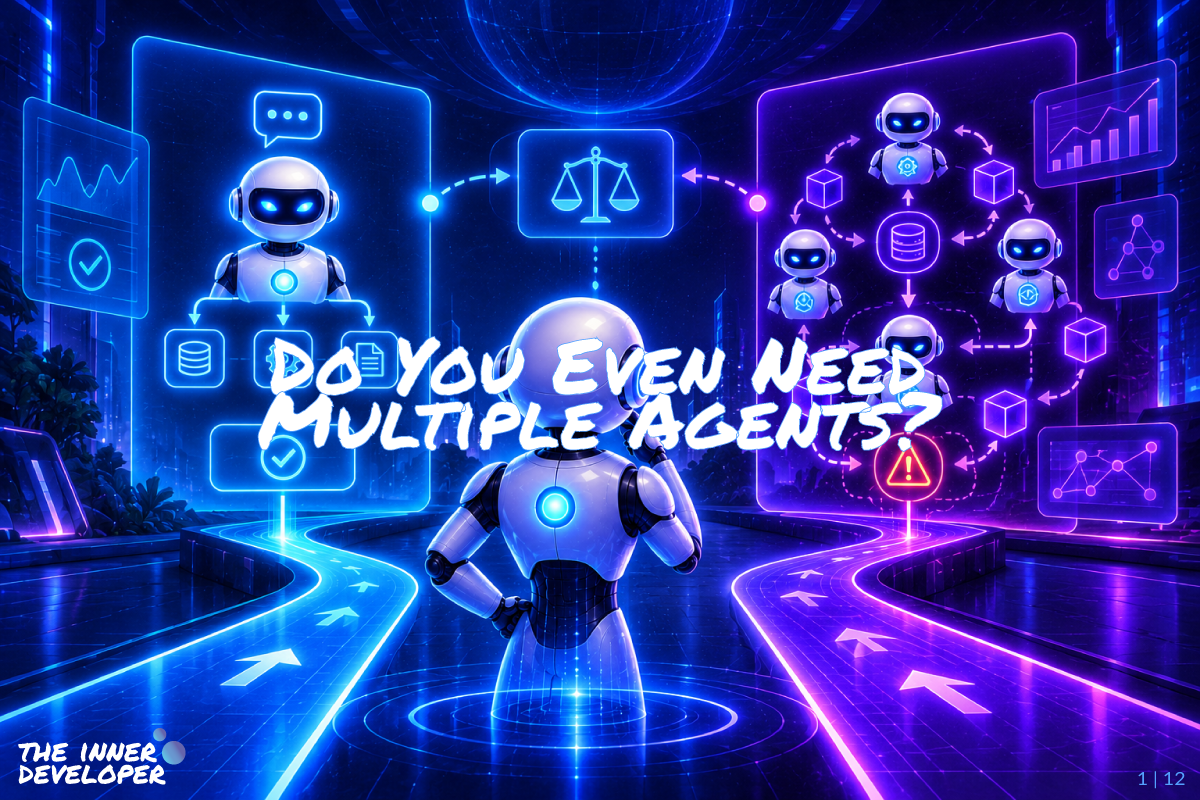
The deeper point is not that multiple agents are bad. It is that they are expensive in systems terms. If one agent is failing because its tools are vague, its instructions are weak, or its traces are invisible, splitting it into three agents usually hides the original problem instead of solving it. A visible single-agent failure is often easier to fix than a distributed multi-agent failure where nobody can explain which agent made the wrong call or why.
This is worth stating clearly because teams often inherit software instincts that do not map neatly onto LLM systems. In traditional software, decomposition is usually a path toward maintainability. In agent systems, decomposition can improve maintainability, but only if the boundaries are real and the interfaces are tight. Otherwise you are not modularizing behavior. You are fragmenting reasoning across components that each have partial context. That is a subtle difference, and it has practical consequences. When a system fails, the question is no longer just “what went wrong?” It becomes “which component had enough information to avoid the mistake, and did it actually receive that information?”
🔍 Start with the bottleneck, not the pattern
The cleanest rule for deciding whether you need multiple agents is this: only decompose when a single agent shows stable, observable failure modes. Not a vague feeling that things are getting complicated. Not a belief that specialists must be smarter. Observable failure modes. LangChain describes three especially useful signals: too many tools causing poor tool selection, tasks that require deep domain context that does not fit comfortably into one general prompt, and workflows with strict stage boundaries where capabilities should unlock only after specific conditions are met.
These signals matter because they tie architecture to evidence. Suppose a support agent has access to twenty internal tools and repeatedly calls the wrong one for warranty checks. That is a concrete bottleneck. Suppose a research workflow needs both legal reasoning and financial modeling, each with heavy domain instructions and separate knowledge sources. That is another real pressure point. Suppose refund approval must only become available after identity verification and policy checks. That is not just a conversational preference. It is a control-flow requirement.
Without that level of evidence, multi-agent systems become architecture tax. You pay more in tokens, agent state management, retries, and eval complexity without knowing whether performance will improve. This is exactly why teams should trace a failing single-agent path first. If you cannot explain why the current system fails, you do not yet have enough information to justify a more complex one.
A helpful developer mindset here is to treat agent decomposition like database sharding or microservice extraction. You do not start there because it sounds advanced. You start there because the current shape of the system is measurably breaking under load or responsibility. If a single agent can complete the task but occasionally uses the wrong tool, the first question should be whether the tool descriptions, schema constraints, or state checks are weak. If the single agent consistently loses track of distinct policy domains, that starts to look like a context-boundary problem. The architecture choice should follow the failure signature, not the aesthetic of the system diagram.
🧰 One agent is often enough when the workflow is really one thread
Many real tasks look larger than they are. A customer support flow with triage, warranty lookup, and refund approval sounds like a natural candidate for separate agents. But often the user experience is still one conversational thread with one active objective. The system is not solving three independent problems. It is moving through one stateful flow. In that case, one agent with the right tools and state-based permissions can be enough.
This is where developers often confuse workflow stages with agent boundaries. LangChain’s handoff guidance is useful here because it shows that changing prompts and tools by state can happen inside one runtime, not only across multiple autonomous specialists. A single agent can collect order details first, then unlock a warranty lookup tool once required fields are present, then unlock a refund action only if the policy check passes. From the outside, this feels structured. Internally, it remains easier to debug because the conversation history, decision path, and state transitions live in one place.
Why this matters in production is straightforward. One-agent systems are usually cheaper, faster, and easier to evaluate. You avoid repeated summarization between agents. You reduce the chance of stale context at handoff boundaries. You also make observability simpler because there is only one main agent loop to inspect. In many cases, better tool gating and clearer instructions solve what looked like a specialization problem. The temptation to split too early often comes from seeing complexity in the business process and assuming the software architecture must mirror it exactly.
A concrete example makes this clearer. Imagine a returns assistant. On turn one, it asks for the order ID and customer identity. On turn two, it checks whether the item is within the return window. On turn three, it offers a refund only if policy conditions pass. That is not three agents negotiating. It is one controlled interaction with phased capabilities. The user benefits from continuity because the system remembers prior answers and does not need to restate or summarize them. The engineering team benefits because every decision sits in one trace. If the wrong refund decision happens, there is one place to inspect the prompt, tool call, policy result, and final response. That simplicity is not glamorous, but it is operationally valuable.
🧭 Routing is not the same thing as supervision
A useful distinction that saves a lot of overengineering is router versus supervisor. LangChain’s router pattern is basically a classification step. If user requests fall into clear categories, the system can route them to the right capability with lightweight control flow. That may look like multi-agent design from a distance, but often it is really dispatch logic, not a collaborative group of reasoning agents.
A supervisor is different. It maintains conversational context over time and dynamically decides which subagent should act next as the task evolves. That is a much heavier orchestration pattern. It introduces memory questions, cross-turn planning, and more complicated evaluation. The distinction matters because many teams build supervisor worker agents for problems that are actually routing problems. If the decision is simply “billing question or shipping question,” a router is enough. If the system must coordinate several specialists across evolving state over many turns, supervision starts to make sense.
LangChain also recommends a useful middle ground: wrap a stateless router as a tool inside one conversational agent. That pattern keeps memory and user context centralized while still decomposing one part of the logic. This is an important idea because it shows decomposition does not require multiple peer agents with separate histories. Sometimes the best design is one agent at the conversational layer and a few deterministic routing helpers behind it. You still get structure, but you avoid a lot of agent orchestration complexity.
Why this distinction matters is that routing and supervision fail in different ways. Routers fail when categories are ambiguous or poorly defined. Supervisors fail when long-lived context, delegation rules, or handoff sequencing become unstable. A router mistake is often easy to test with labeled examples. A supervisor mistake can require replaying a multi-step conversation to understand why the wrong specialist acted. Those are very different debugging costs. If your use case only needs a front door that sends requests to the right place, buying a full orchestration layer is usually unnecessary.
⚙️ The real cost of multiple agents is hidden in context and protocol
When developers imagine multi-agent systems, they usually focus on specialization. In practice, the harder problem is context engineering. Each agent needs the right slice of information, in the right format, at the right time. Too much shared context and you lose the benefit of specialization. Too little and handoffs become brittle because downstream agents act on incomplete or stale summaries. This is why a visually elegant multi-agent architecture can become less reliable than one agent with carefully scoped tools.
Protocol complexity also rises faster than people expect. In a handoff design, you are not only passing intent. You are passing responsibility. That means message history, tool outputs, state variables, and decision rationale need consistent representation across boundaries. LangChain’s handoff documentation highlights a subtle implementation detail that makes this concrete: if a tool triggers a handoff and updates messages, it must emit a matching
ToolMessage
with the correct
tool_call_id
, or the conversation history becomes malformed. That is not a conceptual problem. It is an operational one.
This matters because failures in multi-agent systems become harder to localize. Was the refund denied because the policy agent reasoned poorly, because the router selected the wrong specialist, because the warranty tool returned malformed data, or because the handoff omitted a critical field? A single agent can fail visibly. A multi-agent system can fail diffusely. That changes the debugging posture completely and raises the bar for agent observability from day one.
Another hidden cost is summarization drift. Most handoffs do not transmit the entire raw history. They pass a compressed version of what matters. That sounds efficient, but every summary is an interpretation. If agent A says “customer identity confirmed, warranty likely valid, pending final policy check,” agent B is now relying on a compressed judgment rather than the primary evidence. Over several hops, small omissions compound. This is why context protocols deserve the same care as API design. A brittle handoff format can quietly degrade correctness even when each agent is individually competent.
🛠️ Before adding agents, improve tools and control flow
One of the most common mistakes in AI agents for developers is treating weak single-agent performance as proof that the architecture needs more agents. Often the real problem is lower in the stack. Tool interfaces may be vague. Argument schemas may allow malformed inputs. Permissions may be too broad or too narrow. Runtime feedback may be missing. In those cases, adding planner, executor, and reviewer agents just multiplies the number of components operating on the same broken foundation.
Anthropic’s discussion of AI coding agents is a useful reminder here. They note that meaningful gains often came from improving tools, not just rewriting prompts. A concrete example they share is that requiring absolute file paths removed a recurring class of tool-use errors. That detail is easy to overlook, but it captures something important: many “reasoning failures” are really interface failures. If the shell tool, file editor, or internal API is underspecified, the model has to guess. More agents do not reduce that ambiguity. They spread it around.
For a support system, this might mean tightening the refund tool schema so it refuses calls without verified identity and a validated order ID. For a coding workflow, it might mean adding stricter argument validation, exposing test results in a predictable format, or limiting file system access by stage. These changes often outperform decomposition because they improve the quality of action selection inside the existing loop. A single well-instrumented agent with reliable tool calling agents patterns can beat a clever multi-agent design built on noisy interfaces.
The logic in the example below is simple, and that simplicity is exactly the point. The function demands an
order_id
and
customer_id
before anything else happens. Then it checks
warranty_verified
before approving a refund. In other words, business policy is enforced by the tool boundary itself, not left entirely to the model’s judgment. That matters because tools are where you can make correctness concrete. A model may forget a policy in a long conversation. A validated tool call does not forget. Good tool design narrows the model’s room for dangerous improvisation.
def approve_refund(order_id: str, customer_id: str, warranty_verified: bool):
if not order_id or not customer_id:
raise ValueError("Missing required identifiers")
if not warranty_verified:
raise PermissionError("Refunds require warranty verification first")
return {"status": "approved", "order_id": order_id}
Long-term, this design choice keeps systems healthier because it moves reliability from prompt wording into enforceable interfaces. Prompts are important, but they are soft control. Schemas, validators, and permission checks are hard control. If you add more agents before strengthening those controls, you are scaling ambiguity. If you strengthen the controls first, you may discover that the original single agent is already good enough.
🧠 Memory and state are where complexity becomes real
A lot of agent design conversations stay focused on prompts and delegation. The harder engineering problem is usually memory. As soon as agents span more than one turn, you need to decide what short-term vs long-term memory in agents actually means for your system. Short-term memory covers the active conversation and current working context. Long-term memory covers what should persist across sessions, tasks, or users. If that boundary is fuzzy, agents become inconsistent in ways that are hard to notice until production.
This matters because AI agent memory is not just a convenience feature. It shapes correctness. A refund assistant with weak short-term memory may ask for the same identifier twice or lose track of verification status. A coding assistant with weak long-term memory may forget repository conventions, preferred workflows, or prior fixes that should guide the next action. In both cases, the user experiences the problem as unreliability, even if the model itself is capable.
For long-running agents, memory design quickly becomes a state management problem. You need to decide what gets stored as conversation history, what gets summarized, what becomes structured state, and what becomes reusable procedural memory for agents. A policy outcome like “identity verified” should usually live as explicit state, not just as a sentence in the transcript. A workflow preference like “always run tests before commit” may belong in reusable procedural memory. This separation matters because freeform memory is hard to validate, while structured state is easier to enforce.
Framework choices often reflect this distinction. Teams using LangGraph memory, for example, are often trying to make state transitions and persistence more explicit instead of letting everything dissolve into prompt text. That is useful because agent reliability depends on knowing which facts are durable, which are provisional, and which should expire. If you add multiple agents before getting that model right, you are not just multiplying prompts. You are multiplying uncertainty about what each component knows and why.
📊 Observability is the decision boundary
If there is one operational rule worth keeping, it is this: do not introduce multiple agents until you can observe the current system well enough to justify them. OpenAI’s Agents SDK treats tools, handoffs, sessions, and tracing as first-class orchestration primitives for exactly this reason. Whether you build with the OpenAI Agents SDK or Responses API agents patterns, you should be able to inspect who acted, why they acted, which tool was called, what came back, and how that changed the next decision. If you cannot do that with one agent, adding more will make diagnosis slower and less certain.
What should you actually measure? Tool selection accuracy is one useful signal. Handoff success rate is another. Retry frequency tells you whether tools or prompts are unstable. Latency by path matters because parallel specialists might improve throughput in one workflow and quietly slow another through coordination overhead. Completion rate, cost per successful task, and failure clustering by route are all more informative than a vague sense that the system feels smarter. OpenAI’s broader guidance around agent evaluation and tracing reinforces this shift from prompt tinkering to systems engineering.
Why this matters is simple. Architecture without observability is storytelling. A team may believe a planner agent improves quality, when traces would show that it mostly repeats user input and adds two extra model calls. Or they may assume a specialist agent improves safety, when failure logs show the real issue is a flaky internal tool. Decomposition should be a response to measured constraints, not a substitute for measurement. If you cannot replay a failure path and explain it, your architecture is already too opaque.
There is also a practical sequencing lesson here. Good tracing changes the quality of design conversations. Instead of saying “the system gets confused sometimes,” you can say “refund failures cluster after warranty lookup because the tool returns inconsistent field names.” That level of precision changes what you build next. Maybe you normalize tool outputs. Maybe you restrict tool availability until required state is present. Maybe you split out a specialist. The point is that observability turns architecture from opinion into diagnosis. That is why it is the decision boundary. It tells you whether complexity is earned.
🚦When multiple agents genuinely help
There are absolutely cases where multiple agents are the right call. Parallel research is a good example. If subtasks are independently executable, multiple specialists can reduce latency or improve coverage. Anthropic describes workflow patterns where parallelization helps because tasks can run separately or multiple attempts can increase confidence. That fits scenarios like comparing sources, running independent guardrail passes, or evaluating competing solution strategies before synthesis.
Specialization also helps when context pressure is real. If one agent must hold too many tool definitions, too much domain policy, and too many task modes at once, performance can degrade because the decision space becomes noisy. A legal specialist with a narrow toolset and policy context may genuinely outperform a general support agent trying to handle billing, logistics, compliance, and refunds in one loop. The key is that the need should be visible in traces and evals, not assumed in advance.
Strict stage-based workflows are another valid trigger. Some capabilities should only exist after preconditions are met, and in certain environments a stronger separation of concerns is worth the extra machinery. Even then, the best architecture is often a gradient rather than a leap. Start with one agent plus state-based tool gating. Move to routing where categories are clear. Add supervised subagents only when evolving context and specialist reasoning truly require it. That sequence keeps complexity proportional to the problem instead of letting pattern-matching drive the design.
A good rule of thumb is this: use multiple agents when the work can be cleanly separated without constantly reconstructing the same shared context. If every subagent needs almost the whole conversation, almost the whole policy set, and almost the same tools, then the system is probably not truly decomposed. It is just divided. Real gains tend to appear when each specialist can operate with a smaller context window, a narrower action space, and a clearer success criterion. That is when specialization stops being cosmetic and starts being useful.
⏱️ Long-running agents need durability, not just intelligence
Another place teams overfocus on reasoning is long-running workflows. If an agent handles tasks that pause, resume, wait on human approval, or survive process restarts, then durable execution for agents matters as much as prompt quality. A brilliant plan is not useful if the system cannot recover its state after an interruption.
This is where long-running agents expose the difference between demos and production systems. In a demo, the full context often lives in memory and the path is short. In production, you may need resumability, idempotent tool calls, checkpointed state, and reliable replay. Those are not glamorous concerns, but they determine whether the system can actually operate under real constraints.
Why this matters for architecture is simple. If your agent frequently waits on external systems, review queues, or asynchronous jobs, splitting it into multiple agents may increase coordination overhead without fixing the underlying durability issue. In many cases, better state persistence and cleaner agent state management create a larger reliability gain than adding more specialists.
That is also why agent reliability should be discussed alongside orchestration, memory, and tracing. Multi-agent systems are not just a reasoning pattern. They are distributed runtime systems. As soon as you treat them that way, the design priorities become clearer. Persistence, recovery, and observability stop looking optional and start looking foundational.
🧠 A practical default
If you need a default stance, make it this: begin with one agent, strong tools, explicit state, and full tracing. Then watch where it breaks. If the agent chooses the wrong tool because it has too many options, consider routing. If it struggles because two domains require very different context and policy instructions, consider specialization. If the workflow has strict checkpoints and permissions that should never blur together, consider stronger staged separation or agent handoffs. But do not jump to multiple agents just because the problem sounds important.
This matters for more than implementation speed. It shapes how your team learns. A simple system teaches you where the real constraints are. A complex system can hide them behind orchestration. There is something slightly humbling in that. The most mature design is often not the one with the most agents. It is the one whose behavior you can explain, measure, and improve with confidence.
🔢 #1 of 12 | Multi-Agent Systems