

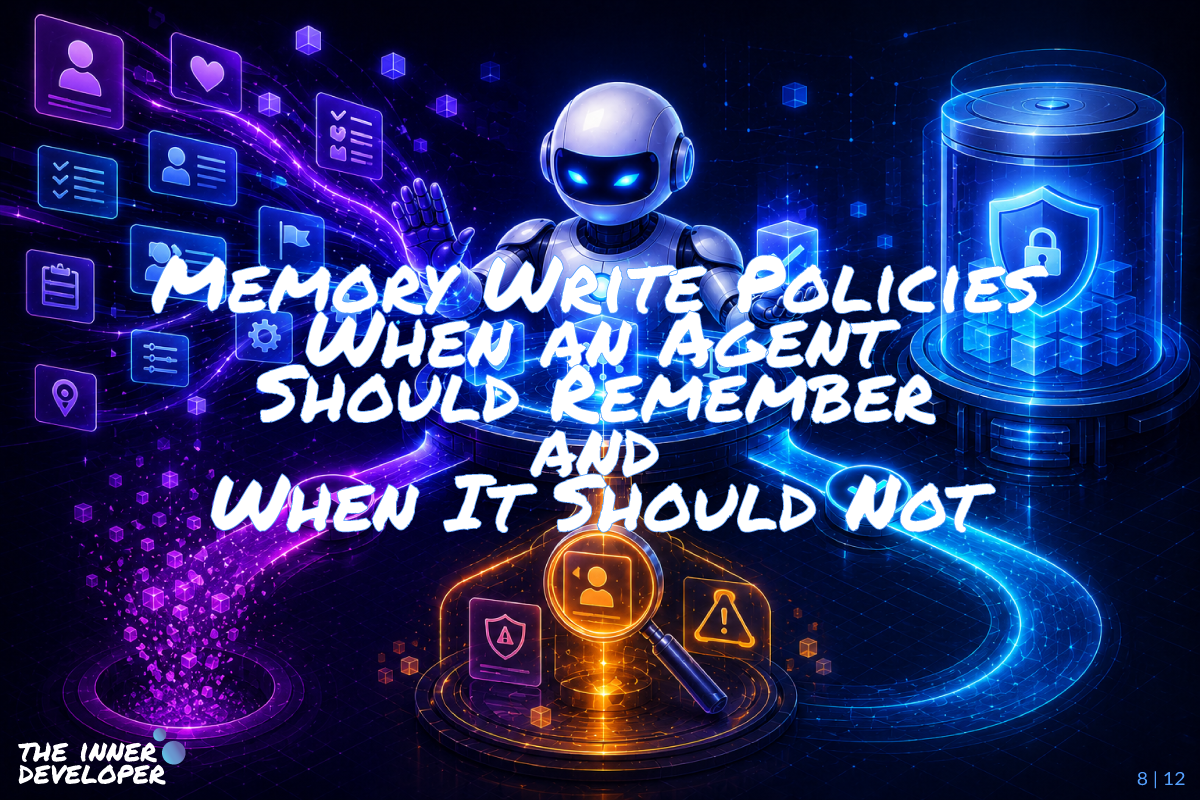
That is why memory in AI agents for developers should be treated as a systems problem, not as a convenience feature. Teams often focus on retrieval quality, embedding choice, and ranking strategies. Those matter, but they sit downstream of a more basic question: should the fact have been stored at all? If the stored memory is wrong, better retrieval only returns the wrong thing faster. A weak read path hurts a turn. A weak write path distorts the future.
Recent agent frameworks increasingly describe memory as a write, manage, and read loop rather than a simple store and fetch feature. That framing is useful because it shifts attention to the point where long lived errors are created. LangChain’s memory docs, for example, distinguish short term thread state from long term memory and separate hot path writes from background consolidation. That is not just implementation detail. It reflects a deeper principle: deciding whether to remember is often more important than deciding how to retrieve. You can see that logic in both the LangChain memory concepts and the broader production guidance around layered memory systems.
🧩 Why write policy matters more than most teams expect
A retrieval failure is visible. The agent forgets a preference, misses a relevant fact, or asks the user to repeat something. Annoying, yes, but usually local to the moment. A write failure is stealthy. Once persisted, it can influence future tool selection, summarization, personalization, routing, and even safety behavior. If an agent incorrectly records that a customer is a VIP, a later workflow may prioritize support, skip checks, or alter discount logic. If it incorrectly records that a user likes terse answers, that is usually recoverable. If it records that “company policy allows X,” the consequences are very different.
This matters in production because durable memory outlives the conversation that created it. Long term memory patterns often store JSON documents in namespaced stores backed by real databases such as PostgreSQL or document stores, not toy in memory maps. Once memory moves into persistent infrastructure, a bad write stops being a prompt quality issue and becomes an operational issue. It now has retention rules, audit implications, deletion requirements, and tenant boundaries. The long term memory guidance is useful here because it makes persistence concrete.
There is also a subtle psychological trap. Developers often treat stored memory as trusted because it feels like first party state. Retrieved web content gets skepticism. User memory often does not. That asymmetry is backward. Stored memory should often face stricter controls because it sits closer to identity, preference, policy, and intent. If you do not have a write policy, you do not really have a memory system. You have an ungoverned accumulation of guesses.
⚙️ Event driven writes are for facts with durable value
The cleanest practical rule is to reserve immediate writes for explicit and durable facts. If a user says, “Remember that I prefer terse answers,” that is a strong write candidate. It is explicit, attributable, low ambiguity, and likely to matter later. The same logic applies to confirmed preference changes, stable account facts, or critical task outcomes that must survive beyond the current thread. This is where hot path writing earns its cost. The value of instant availability is real because the agent may need that fact on the very next turn.
What should not go through this path matters just as much. Speculative inferences about mood, intent, or temporary goals should usually stay out of long term memory unless the user confirms them. If the model infers that a user is stressed, busy, price sensitive, or likely to prefer a workflow, that may help the current response, but it should not become durable state just because it sounds plausible. Plausibility is not evidence. A good shortcut for developers is simple: if the user would reasonably dispute the statement, do not auto persist it.
LangChain’s documentation gives a practical basis for this distinction by describing hot path writes as writes performed while serving the user, with the tradeoff that they add latency and force the model to multitask. That tradeoff matters because every immediate write competes with the main task. If the agent is answering a question, deciding on tool calls, and extracting memory at the same time, memory quality often drops. So event driven writes should be rare enough that the latency and quality cost is justified. The right question is not “Can the agent save this now?” It is “Will future reliability improve enough to justify immediate persistence?” That mindset is what keeps write policy aligned with user value rather than novelty.
🕒 Periodic writes are for noisy patterns and profile synthesis
Many useful memories do not arrive as single clean facts. They emerge as repeated patterns across sessions. Maybe a user often asks for examples before theory. Maybe they repeatedly ask for TypeScript instead of Python. Maybe they alternate between brief answers during work hours and detailed explanations on weekends. These are not ideal hot path writes because the signal is distributed over time and often mixed with temporary context. This is where periodic consolidation becomes the better pattern.
Background memory jobs can review multiple conversations together, identify repeated signals, and update stored memory outside the main interaction path. That architecture matters for two reasons. First, it removes user facing latency. Second, and more importantly, it gives memory extraction its own budget, prompt, and validation logic. In other words, consolidation is not just about speed. It is about quality. A memory extraction job that sees ten sessions can make a better call than a live interaction trying to infer a durable trait from one sentence.
The cadence should reflect actual usage. Running consolidation every few minutes when users interact once a day is mostly token waste and creates pressure to invent changes that do not exist. Good periodic writing is selective. It should reconcile contradictions, synthesize repeated signals, and compact noisy observations into something stable. For example, rather than storing six separate memories that the user asked for TypeScript examples in six conversations, the background process can update a profile field such as “prefers_code_language: TypeScript” with evidence links and a last confirmed timestamp. That design matters because it turns scattered traces into accountable state rather than clutter.
📦 Profiles and collections need different write rules
One reason memory systems become brittle is that teams treat all persistent data as if it belonged in one structure. The distinction between profiles and collections is useful because it forces different write behavior. A profile is a continuously updated canonical object, something like language preference, output style, timezone, or stable working context. A collection is a set of narrower records that accumulate over time, such as notes about prior projects, recurring constraints, or observations that do not fit neatly into one flat record.
Why this matters is practical. Profiles are vulnerable to merge errors. As a single JSON object grows, repeated updates become harder to reason about. A careless overwrite can erase valid data or create contradictions inside the same object. That is why profile writes should prefer schema enforcement and patch generation over full replacement. If the existing profile says the user prefers Python and a new session suggests TypeScript, the system should not blindly overwrite. It should generate a candidate patch, attach evidence, and possibly defer resolution until more signals arrive. A profile should change slowly because it is supposed to represent the most stable interpretation of the user.
Collections have a different failure mode. They tend to bloat, duplicate, and surface stale records unless you add dedupe, ranking, and expiry rules. Here the challenge is not merge discipline but retrieval hygiene. Near duplicate embeddings, repeated summaries, and outdated notes can all pollute recall. So write policy must match the storage model. Profiles need careful canonical updates. Collections need narrow records, deduplication, and lifecycle rules. Treating them the same is how AI agent memory quietly turns into clutter with authority.
🚦 The write gate is where reliability is decided
Most memory bugs are not fixed by smarter retrieval. They are prevented by making the write path harder to pass. A useful design is to treat every candidate memory as untrusted until it survives a gate that checks persistence intent, schema validity, evidence source, contradiction risk, sensitivity, namespace, and provenance. That is the difference between memory as product polish and memory as production infrastructure.
The small function below captures the core idea. It rejects writes that should not persist, sends high sensitivity items to review, rejects malformed schema, blocks weak evidence seen only once, and reviews contradictions instead of committing them automatically. The key point is not the syntax. It is the fact that these checks decide whether storage happens at all.
def should_persist(mem):
if mem.persist is False:
return "reject"
if mem.sensitivity == "high":
return "review"
if not mem.schema_valid:
return "reject"
if mem.source != "explicit_user" and mem.session_count < 2:
return "reject"
if mem.contradiction_score > 0.2:
return "review"
return "commit"
Line by line, the policy is doing something important. The first check respects explicit non persistence, which protects private or temporary interactions. The second check escalates high sensitivity memory because the cost of being wrong is too high for automation alone. The third check blocks malformed records before they poison the store. The fourth requires stronger evidence for inferred memories than for direct user statements. The fifth treats contradiction as a reason to pause, not a reason to guess. In a real LLM agent architecture, this gate belongs inside a pipeline, not as a helper glued to a tool call. Candidate extraction comes first. Then policy classification determines what kind of memory this is and whether the current mode even allows persistence. Schema validation checks fields such as subject ID, scope, source message IDs, confidence, and retention class. Contradiction checks compare against existing memory. Risk scoring decides whether review is required. Only then should the system commit with metadata. This is also where recent security work on long term memory becomes relevant: governance at storage time matters because mistakes propagate forward.
🔍 Contradictions, provenance, and namespaces are not optional details
When developers first add memory, contradiction handling often feels like a refinement they can postpone. In practice, it belongs in version one. If a user once said “I prefer short answers” and later says “I need more explanation,” the problem is not retrieval. The problem is deciding whether the new signal supersedes, complements, or merely reflects a temporary context. Without contradiction logic, the store accumulates mutually incompatible facts and the agent can justify almost any behavior by retrieving whichever one happens to rank higher.
Provenance helps because it turns memory from opaque state into inspectable evidence. Every record should carry where it came from, when it was written, which conversation or trace produced it, which policy version approved it, and which agent or subsystem wrote it. This is not bureaucratic overhead. It is how you debug future failures. If a memory says “customer is a VIP,” you need to know whether that came from explicit user input, a support transcript, a model inference, or a background consolidation job. Without that lineage, review becomes guesswork and deletion becomes risky because you cannot tell which downstream facts depended on the original record.
Namespaces matter for the same reason, but at the boundary level. Per user preferences, shared team knowledge, and organization wide policy memory should not live in the same undifferentiated pool. Separate namespaces make deletion, export, audit, and access control tractable. More importantly, they reduce the chance that one tenant’s memory influences another tenant’s behavior. In production, cross user leakage is not a minor bug. It is the kind of failure that turns architecture discussion into incident response. Namespacing is not just cleaner organization. It is one of the simplest ways to enforce memory scope before damage happens.
🛑 High impact memory deserves review, not optimism
Not all memories are equal. Some are mildly helpful if right and mildly annoying if wrong. Others silently steer many later decisions. That is why human approval should be tied to risk rather than applied uniformly. Practical guidance on human intervention for sensitive or irreversible actions generalizes well to memory writes. If a fact is hard to reverse, sensitive, or likely to alter downstream tool behavior, review is often cheaper than repair.
Consider a few examples. “User is diabetic” could affect dietary suggestions, purchase flows, or health related responses. “Customer is a VIP” could change routing, prioritization, and discounts. “Company policy allows X” could alter compliance behavior across a workflow. These should not be auto committed because the harm rarely appears at the moment of writing. It appears later, in a different context, where the original source is no longer visible and the agent acts with misplaced certainty.
This is where confidence thresholds need to become operational rather than rhetorical. A model saying it is 0.87 confident is meaningless if that number does not change system behavior. Better policies use dual thresholds. Auto commit only when the evidence is explicit or repeated, schema checks pass, contradiction risk is low, and sensitivity is low. Route medium confidence or high impact items to review. Reject speculative or unattributable claims outright. This feels stricter than many demos, but that strictness is the point. Memory should earn persistence because the long term health of the system depends less on how much it stores than on how trustworthy that stored state becomes.
🧪 A practical implementation pattern for the write pipeline
A useful way to think about memory persistence is as a pipeline with failure points you can test independently. Start with candidate extraction. This can happen through a tool call during the hot path or through a background job that reads recent conversations. The extractor should output a structured candidate, not raw prose, because downstream policy needs fields it can reason about. Then classify the candidate as a preference, identity fact, workflow constraint, task outcome, profile update, or transient note. Classification matters because policy depends on type. A task outcome may be retained for a few days. A preference may last months. A transient note may never leave the current thread.
Next validate the schema. Require fields such as
memory_type
,
subject_id
,
scope
,
source_message_ids
,
extracted_fact
,
confidence
,
sensitivity
,
retention_class
, and
expires_at
. After that, run contradiction checks differently depending on storage model. For profiles, compare against the canonical record and generate a patch. For collections, search for near duplicates and exact key collisions, then merge, supersede, or discard. This is where many systems improve once developers stop thinking of memory as one table and start thinking of it as a governed pipeline with typed records.
Only then apply risk scoring and possible approval. If approved, commit the record with provenance metadata and a policy version. Later, run compaction and expiry so the store does not become a graveyard of stale statements. This shape is consistent with patterns described across LangChain’s memory concepts, deep agents memory docs, and LangGraph persistence. The pipeline approach matters because it gives you hooks for evaluation. You can measure rejection rate, review rate, contradiction rate, stale memory rate, and downstream incident rate instead of treating memory as a black box. That is also where agent evaluation and tracing become essential. Without visibility into why writes were approved, rejected, or later contradicted, agent observability remains incomplete.
🗑️ Deletion and non persistent mode need first class design
One of the easiest mistakes in agent memory is assuming that deleting chat history also deletes derived memory. It often does not. Consumer memory systems have made this distinction explicit: saved memories can live separately from conversation history, which means deleting the source transcript may not remove the persisted memory itself. That is a subtle edge case with large architectural consequences. If your system separates transcripts from memory records, your deletion policy must separate them too.
For developers, this means forgetting is not the absence of retrieval. It is an API. You need targeted delete by memory ID, bulk delete by subject or namespace, retention windows, and a way to prevent accidental resurrection during later compaction or replay. Tombstones or version history can help here. If a memory has been deleted for policy reasons, a background job should not recreate it from old transcripts unless that behavior is explicitly allowed and auditable. This is where provenance and policy versioning matter again. They let you answer not just “what is stored” but also “why is it still stored.”
It also means a non persistent mode should exist from day one. Temporary interaction modes are a useful product example of running a session without updating memory. The implementation lesson is broader: support request level persistence flags for private tasks, regulated workflows, debugging sessions, or one time interactions. Some sessions should absolutely use tools and state without contributing to long term memory. If everything writes by default, the system eventually remembers things it had no business keeping, and fixing that later is always more expensive than designing the boundary early.
🏗️ The deeper architectural lesson: better forgetting improves agent reliability
Teams often talk about memory as if the goal were maximum recall. That framing sounds intuitive but usually leads to bloated, noisy, and risky systems. In long-running agents and complex agent orchestration setups, more memory is not automatically more intelligence. It can mean more stale context, more contradictions, more hidden bias from old sessions, and more unexplained actions. Better forgetting is often the stronger engineering move because it protects the quality of future decisions.
This is especially true when memory competes with another source of truth. If real account state already lives in an application database, the agent should usually retrieve it directly rather than maintain a shadow copy as memory. Memory is best used for durable preferences, cross session observations, and lightweight user specific context that does not already belong to a canonical business system. Many failed memory designs are really attempts to compensate for weak integration with existing application data. The result is drift: the database says one thing, the memory says another, and the agent has no principled way to choose.
The larger pattern is worth holding onto. Memory is not a trophy feature for an agent stack. It is a governed persistence layer inside the agent loop. Good write policy improves agent reliability, traceability, and compliance at the same time because it reduces the number of bad facts that can survive across sessions. Whether you are building AI coding agents, supervisor worker agents, systems with agent handoffs, or broader multi-agent systems, the central question is not “How can we make the agent remember more?” It is “What facts deserve durable state, under what evidence, with what review path, and how do we delete them later?” Once that becomes the guiding question, memory stops feeling mystical and starts becoming operable.
🧠 Where memory policy fits in modern agent stacks
For teams building production agents, memory policy does not live in isolation. It sits inside agent state management, tool execution, orchestration, and runtime control. In practice, that means the same write policy needs to work whether the agent is implemented with Responses API agents, the OpenAI Agents SDK, or graph based runtimes that support LangGraph memory and durable execution for agents. The storage details may change, but the decision logic should remain stable.
This matters because memory writes are often triggered during tool use, task completion, or handoffs between components. A supervisor may delegate work to a specialist. A worker may discover a useful preference or constraint. An orchestration layer may decide whether that result belongs in thread state, long term memory, or nowhere at all. Without a consistent policy, each component starts inventing its own memory rules. That is how otherwise solid systems become unpredictable over time.
A better approach is to define memory writes as a shared infrastructure capability. Every component in the stack can propose a candidate memory, but only the governed pipeline decides whether it persists. This is the practical bridge between short-term vs long-term memory in agents and real system reliability. Short term state supports the current task. Long term memory should survive only when the evidence, scope, and retention policy justify it. That separation keeps memory useful without letting it quietly become the agent’s accidental source of truth.
🔢 #8 of 12 | Memory Management in Agents