

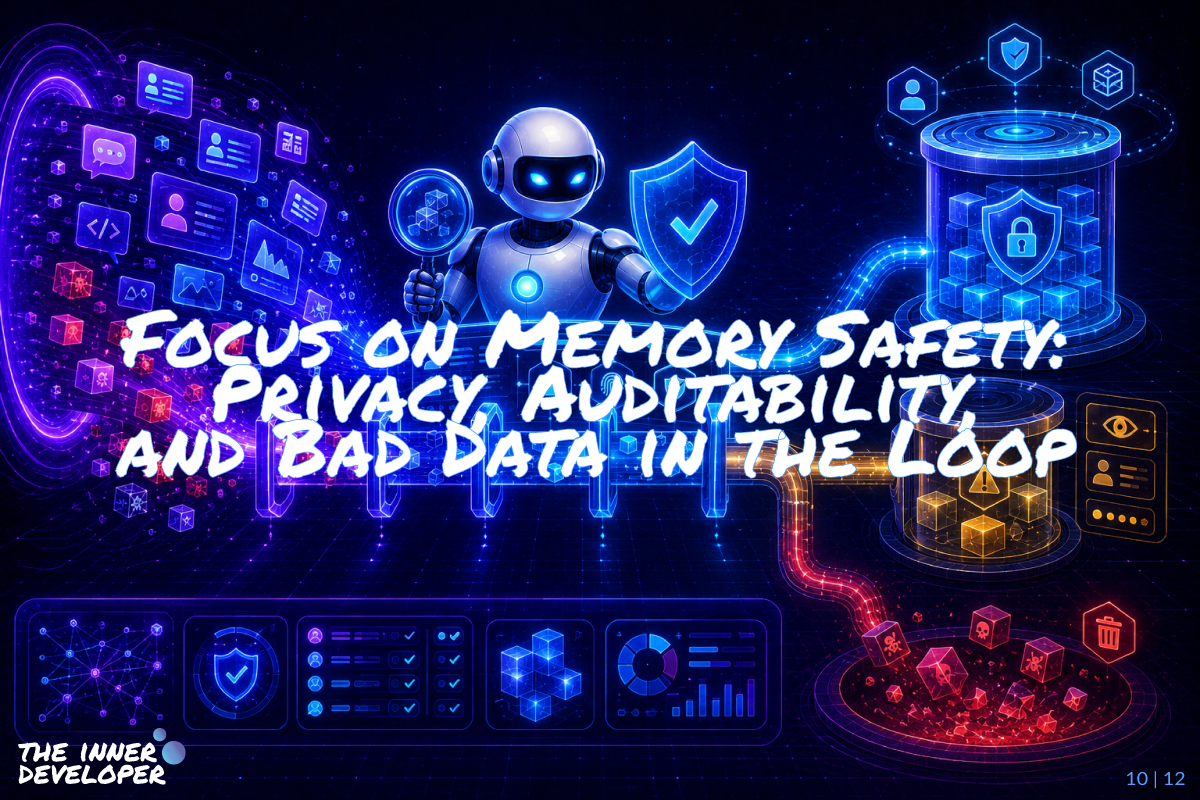
🔍 Why memory bugs become behavior bugs
In normal software, corrupted state causes strange output. In agents, corrupted memory causes strange decisions. That distinction matters because tool calling agents do not just generate text. They choose actions. If your support agent stores “user prefers terse answers,” future replies may become more concise. Fine. If it stores a pasted API key, a stale refund exception, or a bad summary that says “user is authorized for manual overrides,” later runs may not just sound different. They may take different actions, skip approval checks, or call the wrong system.
This happens because memory sits inside the control flow of the agent loop. The model receives a goal, inspects context, chooses an action, reads tool results, updates state, and decides whether to continue. Memory influences several of those steps at once. Retrieval changes context selection. Context changes reasoning. Reasoning changes tool choice. Tool outcomes affect whether the agent believes the task is complete. So one bad write can quietly propagate across multiple turns and multiple sessions.
That propagation is what makes debugging difficult. A prompt trace often shows only the final turn. It may explain what the model saw in that moment, but it rarely explains why that memory existed in the first place, whether it was confirmed, or whether it should have survived beyond a single task. When teams say an agent has become “weird” over time, that usually means hidden state has accumulated faster than anyone can inspect it.
The common framing of memory as a personalization feature is incomplete. In practice, memory is closer to configuration plus evidence plus learned shortcuts, all mixed together unless you separate them. When those categories blur, reliability drops. A summary gets treated like a fact. A fact gets treated like an instruction. An old task note becomes a durable preference. Once that happens, the agent is not merely recalling the past. It is reinterpreting future tasks through a distorted lens.
Why this matters in production is simple. Once memory can influence decisions, every unsafe write becomes a latent operational risk. The risk may stay invisible until a high-value workflow appears: a refund, an account change, a code deployment, a clinical summary, or a procurement approval. That is why memory safety belongs with system design, not just privacy review. It affects the quality of future decisions across AI coding agents and other long-running agents.
🗂️ Separate memory layers before you try to secure them
One reason teams struggle here is that “memory” often means too many things at once. LangChain and LangGraph make a helpful distinction between short-term thread state and long-term memory. Short-term state is thread-scoped and persisted through checkpoints so the workflow can resume. Long-term memory is stored separately and retrieved across threads or sessions. That split is not just conceptual. It should drive different retention, access, deletion, and audit rules. This matters directly to short-term vs long-term memory in agents and to agent state management more broadly. See LangChain memory concepts and LangGraph persistence.
Why this matters is simple. A checkpoint may contain temporary workflow state, intermediate outputs, and sensitive conversational context that exists only because a run is in progress. Long-term memory should contain narrower, durable information that improves future execution, such as an explicitly confirmed preference. If you apply the same storage and governance policy to both, you either over-retain transient state or under-protect durable user memory.
A useful pattern is to split storage planes entirely. Keep checkpoints in one plane, long-term semantic memory in another, and immutable audit records in a third. Even if they share infrastructure, they should have different tables, namespaces, and lifecycle rules. This gives you clearer deletion boundaries, better least-privilege access, and fewer accidental leaks across use cases. It also makes incident response realistic, because you can answer the basic question: what kind of state changed, where, and why?
Think about a travel assistant. During one booking flow, the agent may hold a temporary constraint like “find flights leaving after 6 p.m. today.” That belongs in short-term state because it is specific to the current run. A long-term note like “user prefers aisle seats” might deserve durable storage if the user has stated it clearly and repeatedly. A payment authorization or loyalty balance does not belong in memory at all if the booking platform already owns that truth. It should be fetched from the source system when needed.
This separation looks administrative at first, but it prevents category mistakes. Temporary state can be large and messy because it dies soon. Durable state must be small and explicit because it will shape future behavior. Audit state must be immutable because you need it when something goes wrong. If those three planes blur together, every later control becomes harder. You cannot delete cleanly, review accurately, or prove who changed what.
🏷️ Typed memory is what makes policy possible
Free-form memory blobs feel fast when a system is young. They become a liability as soon as you need validation, filtering, or auditability. If every memory is just text, your only control surface is prompt wording. That is too weak for production. A safer approach is a typed schema with explicit metadata:
id
,
tenant_id
,
user_id
,
memory_type
,
content
,
sensitivity
,
source_kind
,
source_ref
,
created_at
,
last_confirmed_at
,
expires_at
,
confidence
,
policy_version
,
review_status
, and
tombstoned_at
.
That structure matters because policy needs something queryable. You cannot reliably ask “should this memory be shown to this agent in this tenant for this task?” if the record does not carry tenant scope, type, source, and sensitivity. You also cannot distinguish a durable user preference from an unverified claim extracted from tool output unless the system records that distinction explicitly. OWASP’s guidance on treating tool outputs and retrieved context as untrusted data maps directly onto memory design here. See the prompt injection prevention cheat sheet.
It helps to think of each field as answering one debugging question.
memory_type
tells you what class of thing this is.
source_kind
tells you whether it came from the user, a tool, a human reviewer, or a model-derived summarizer.
confidence
tells you how strongly the system should rely on it.
expires_at
tells you whether it is still meant to matter.
last_confirmed_at
separates a currently valid preference from an old assumption that has simply survived too long.
A typed schema also lets you label memory correctly when it re-enters the prompt. Instead of injecting raw text, you can frame it as machine-readable context such as
[MEMORY type=preference sensitivity=low confirmed_at=2026-08-10 source=user]
. That small shift helps the model interpret memory as bounded data rather than hidden policy. It is one of those design choices that looks administrative until you need to explain a bad action.
There is a second benefit that matters just as much: typed memory reduces accidental overreach. If your system knows the difference between a preference, an observation, a derived summary, and an authorization fact, you can write different handling rules for each. Preferences may be retrievable in many tasks. Derived summaries may need freshness checks. Authorization facts may be blocked entirely from memory and fetched live from the identity system. Without types, everything becomes “relevant text,” which is exactly the problem.
This becomes even more important in agent orchestration and multi-agent systems. If supervisor worker agents or agent handoffs share memory without strict types, one agent’s temporary inference can become another agent’s durable assumption. Typed memory limits that spread by making provenance and intended use explicit.
🛡️ Put every write behind a memory service
If tools and workflow nodes can call storage primitives directly, unsafe writes become inevitable. LangChain’s long-term memory APIs are intentionally low-level, which is useful, but it also means the application has to add governance around operations like
store.put
,
store.get
, and
store.search
. The safest pattern is to wrap memory access in a dedicated service that constructs namespaces, applies policy, redacts sensitive content, and emits audit events. See LangChain long-term memory.
The key idea is that a memory write should be an explicit application event, not a hidden side effect. Require a reason code such as
user_explicit_preference
,
task_outcome
,
operator_approved_profile_update
,
derived_summary
, or
tool_observation_unverified
. Reject writes that lack a valid reason. This sounds strict, but it is what makes later review useful. Without a reason, you know that state changed but not whether it was a legitimate adaptation or a silent failure.
It also gives you a place to enforce “never store” rules. Secrets, raw access tokens, highly sensitive categories, full tool outputs from source-of-truth systems, and natural-language authorization state should be blocked or transformed before persistence. LangChain’s own advice is a good check here: if another system is the source of truth, retrieve from that system instead of inventing a separate memory copy. See the LangMem launch post.
From a developer’s perspective, a memory service is valuable because it centralizes boring but essential decisions. The service can reject records with missing metadata, normalize date fields, stamp policy versions, run secret scanning, and map records into safe namespaces. That reduces the chance that one workflow writes memory differently from another. Consistency is not just a style preference here. It is what makes governance enforceable.
It also creates a natural place for slower operations. For example, some memory types may require confirmation before becoming durable. A write request could enter a pending state, trigger a review rule, and only later move into the retrievable set. That kind of staged workflow is awkward if every agent node writes directly to storage. It becomes straightforward once writes pass through a service boundary. This is particularly useful for durable execution for agents and other systems where state persists across retries, resumes, and long-running workflows.
def safe_put_memory(store, event_log, record):
reject_types = {"secret", "access_token", "auth_state"}
if record["memory_type"] in reject_types:
raise ValueError("memory type not allowed")
if contains_secret(record["content"]):
raise ValueError("secret detected")
record = redact_sensitive_fields(record)
namespace = (record["tenant_id"], record["user_id"], record["memory_type"])
store.put(namespace, record["id"], record)
event_log.append({
"operation": "write",
"namespace": namespace,
"memory_key": record["id"],
"reason": record["write_reason"],
"policy_version": record["policy_version"]
})
The logic in this example is intentionally simple, but each step represents a policy decision. First, the function blocks forbidden memory types. That prevents entire categories, such as secrets or authorization state, from ever entering durable storage. Second, it scans content for secrets, which matters because bad data is often hidden inside otherwise valid text. Third, it redacts sensitive fields before persistence so downstream systems never see the raw value. Fourth, it builds a namespace from tenant, user, and type, which establishes both access boundaries and later deletion boundaries. Finally, it emits an event log entry so the write can be reconstructed later. The code is short. The consequences of skipping any step are not.
🔐 The three control points are where safety actually happens
Memory safety is easiest to reason about when you place controls at three separate moments: before write, at retrieval, and before prompt injection. Each stage catches a different class of failure. Before write, you classify content, redact PII, reject secrets, and decide whether the item deserves persistence at all. This prevents the system from turning noisy or dangerous input into durable state.
At retrieval, you enforce authorization, namespace scope, memory type constraints, and sensitivity filters. Namespacing is especially important. A compound namespace such as
(tenant_id, user_id, memory_type)
is safer than broad semantic search across a flat collection because the same boundary used for retrieval can also be used for deletion, export, and access policy. That is how you reduce cross-user leakage risk in multi-tenant systems.
Before prompt injection, you transform retrieved memory into bounded context. This is where type labels, timestamps, confidence, and stale markers matter. A memory should enter the prompt as a claim with provenance, not as invisible authority. For example, “user preference, last confirmed on 2026-08-10” is safer than silently appending “the user always prefers terse answers.” The model can reason over that distinction, but only if your system preserves it.
These control points matter because they are not interchangeable. If you only filter on the way into the prompt, unsafe data still exists in storage and may leak elsewhere. If you only filter before write, you still need retrieval controls to prevent cross-tenant access or overly broad searches. If you only secure retrieval, the prompt can still flatten nuanced memory into misleading text. Safety comes from layering, not from one perfect filter.
def search_memory(store, tenant_id, user_id, allowed_types, max_sensitivity, query):
results = []
for memory_type in allowed_types:
namespace = (tenant_id, user_id, memory_type)
hits = store.search(namespace, query=query)
for hit in hits:
if hit.value["sensitivity"] <= max_sensitivity and not hit.value.get("tombstoned_at"):
results.append(hit.value)
return results
This retrieval example shows the same principle in reverse. It searches only inside approved namespaces, not across the whole store. It limits retrieval to allowed memory types, which stops a low-risk task from accidentally pulling in unrelated state. It applies a sensitivity threshold, which is useful when one agent can answer both routine and privileged tasks. It also ignores tombstoned records so deleted items disappear immediately from operational behavior even before asynchronous purge completes. Retrieval logic is not just an optimization layer. It is an enforcement layer.
In practice, this is where agent observability and agent evaluation and tracing become useful. If you cannot see which memory records were retrieved, filtered, and injected into context, debugging behavior inside the agent loop becomes guesswork. Memory-aware tracing turns hidden state into something you can inspect.
🧪 Bad memory usually comes from ordinary extraction mistakes
It is tempting to discuss memory safety only in the language of adversaries, but many failures are mundane. A summarizer overgeneralizes a user preference from one sentence. A background extraction job preserves a temporary constraint as if it were durable. A tool output mentions a one-off exception, and the agent stores it as ongoing policy. None of that requires an attacker. It only requires a system that writes memory too eagerly.
This is why confirmation windows and expiration policies matter so much. A durable preference should often require explicit confirmation or repeated evidence. Volatile memory classes such as temporary task goals, one-off exceptions, and transient workflow constraints should expire automatically. Derived summaries should be versioned with
derived_from
references, extractor model identifiers, and confidence scores. A summary is not a fact, and treating it like one is a quiet source of personalization bugs.
Consider a simple example. A user says, “For this ticket, keep the reply very short.” A weak extractor might store that as a durable preference for all future conversations. A safer extractor would classify it as task-scoped guidance, attach an expiration tied to the ticket, and avoid promoting it to long-term profile memory unless the user repeats the preference across sessions. The sentence did contain useful context. It just did not justify durable state.
The deeper lesson is that not every useful observation deserves persistence. If the future value of a memory is small and the downside of being wrong is large, do not store it. Query the source-of-truth system again when needed. This is why memory design is a cost-quality tradeoff rather than a default capability. Storing less, with better structure and provenance, often produces more reliable agents than storing everything because the context window happens to be large.
This matters operationally because extraction pipelines tend to improve slowly while stored mistakes accumulate quickly. A better summarizer next month does not automatically fix the bad summaries you stored last month. Durable memory has history. That means a weak write policy creates debt, not just noise. Teams that understand this early usually bias toward conservative writes and aggressive expiry. That restraint often feels inconvenient in the short term, but it keeps the system understandable later.
For procedural memory for agents, the same rule applies. Storing successful patterns or workflow shortcuts can help, but only when the system knows whether they are stable procedures, temporary heuristics, or context-specific hacks. Otherwise procedural memory becomes another path for fragile behavior to spread.
📜 Auditability is how you debug state, not just how you satisfy compliance
When a user says, “Why did the agent suddenly start doing this?”, a prompt trace is rarely enough. You need a state diff. That means you need to know what memory was written, who wrote it, what source it came from, what policy approved it, which retrieval returned it later, and whether it actually entered the prompt. This is where auditability stops being abstract governance and becomes a developer tool.
A strong pattern is dual-write logging. On every memory read and write, append an immutable event with fields like
actor
,
thread_id
,
namespace
,
memory_key
,
operation
,
reason
,
source_span_id
,
policy_version
,
hash_before
, and
hash_after
. This lets you reconstruct the sequence of state transitions that changed later behavior. It also gives you a way to replay incidents, compare runs before and after a problematic memory update, and measure the blast radius of a bad summary.
Provider-level tracing and platform audit logs are useful but not sufficient. They tell you requests happened. They do not explain your domain-specific memory semantics. For that, you need application-level events. OpenAI’s enterprise compliance and audit materials are a good example of the broader principle: mutable product data and immutable operational logs are different tracks with different lifecycles. See OpenAI enterprise compliance and the audit logs API overview.
Why this matters for engineering is practical. When an incident happens, you want to answer three questions fast: what changed, when did it change, and how many future runs used that state? Good audit logs answer all three. Weak logs force teams into guesswork, grep sessions, and partial reconstructions from model traces. That is expensive during incidents and almost useless during postmortems.
There is also a trust benefit. If a user disputes a remembered preference or asks why a sensitive detail influenced a reply, auditable memory gives you a concrete explanation path. You can tell whether the memory came from the user, a human operator, a tool result, or a model-generated summary. Without provenance, memory becomes politically difficult inside organizations because nobody can explain it confidently. Auditability keeps memory governable.
This is especially relevant if you are building Responses API agents or using the OpenAI Agents SDK. Framework tracing can show requests, tool calls, and handoffs, but you still need memory-specific application logs to explain why a retrieval happened and how it changed behavior.
🧹 Deletion is a workflow, not a SQL statement
Deleting agent memory safely is harder than deleting a row. In production, a memory record may exist in the primary store, a vector index, an embedding cache, checkpoint snapshots, downstream trace systems, and derived summaries. If you only hard delete the visible record, retrieval may still surface the content indirectly. This is why a safer pattern is tombstone first, exclude immediately, purge asynchronously.
Tombstoning means marking the record deleted and removing it from retrieval results at once. The user-facing effect is immediate. Then a background workflow deletes or reindexes embeddings, invalidates caches, removes secondary references, and records non-content audit events proving the deletion happened. This preserves accountability without continuing to expose the underlying content.
Why this matters is both technical and legal. Technical, because stale indexed copies are a real source of ghost behavior. Legal and governance-related, because deletion from the product surface is not always the same event or timeline as deletion from operational logs. OpenAI’s public retention guidance is a useful concrete example. As of August 29, 2026, the Responses API docs note that application state may be stored for at least 30 days by default when
store=true
, while Zero Data Retention changes that posture. Runtime features can silently alter retention characteristics, so your memory design has to account for the actual storage path, not just the user interface. See default usage policies by endpoint.
A good deletion workflow usually has at least four steps. First, mark the record tombstoned and stop returning it anywhere in product behavior. Second, enqueue cleanup tasks for vector stores, caches, summaries, and replicas. Third, verify completion and record the result in an immutable log. Fourth, re-run any derived summaries or aggregates that might still contain the deleted content indirectly. If you skip the last step, the record may be gone while its influence remains.
This is one of those areas where architecture and policy have to match. A team may promise deletion, but if memory is copied into too many systems without a lifecycle map, the promise is weak. Designing deletion paths early forces discipline in how many places memory can flow. That discipline is useful even if no user ever asks for deletion, because it reduces uncontrolled spread of state across the stack.
🏢 A support agent example makes the boundary clearer
Consider a customer support agent. “User prefers terse answers” is a plausible long-term memory candidate. It is low sensitivity, behaviorally useful, and easy to label as a preference. “User pasted a screenshot containing an API key” should be blocked or redacted before storage. It has no personalization value worth the risk. “Refund exception approved for ticket 1234” should not become free-form memory at all. That belongs in the ticketing or CRM system, where authorization, workflow state, and audit are already managed properly.
This example clarifies a common confusion. Developers often use memory as a convenience layer for any fact that might help later. That is where trouble starts. Profile memory, workflow memory, and transactional truth have different failure modes. Profile memory can be stale. Workflow memory can expire. Transactional truth must be authoritative. If you let free-form memory impersonate the system of record, the agent starts making business decisions based on informal notes rather than controlled state.
The same idea applies to coding agents. Shell output, repository text, and MCP-connected tool responses may contain hidden instructions, stale assumptions, or secrets. If the agent writes that material verbatim into persistent memory, a one-time injection can become a durable behavior bug. That is exactly why memory should be treated as untrusted input even when the input originally came from your own tools.
The support example also shows why memory type should shape retrieval. A preference about answer style may be useful in almost every conversation. A note about an unresolved billing dispute may be useful only inside the support queue. A manually approved exception should probably be fetched from the case system only when the current ticket matches. The more specific the context, the less reason there is to preserve it as broad, reusable memory.
The same boundary becomes critical in supervisor worker agents and other multi-agent systems. If a supervisor passes broad memory into a worker that only needs narrow task state, you increase both noise and risk. Agent handoffs work better when each agent receives only the memory types that fit its role.
📏 The right metrics are memory-specific, not generic
If you only track answer quality, you will miss memory failures until they become expensive. Memory needs its own operational metrics. Useful examples include memory write precision, sensitive-memory block rate, stale-memory hit rate, cross-tenant retrieval rate, deletion SLA success, rollback frequency, and the percentage of answers influenced by unreviewed memory. These metrics connect governance to behavior, which is what matters for production systems.
They also help you choose where to automate and where to slow down. If write precision is low for background summarization, you may need confirmation windows or human review for certain memory types. If stale-memory hit rate is high, expiration and reconfirmation policies are too weak. If cross-tenant retrieval ever registers above zero, you do not have a tuning problem. You have an architectural bug.
NIST’s AI risk management framing is useful here because it pushes teams toward measurable controls rather than vague promises about responsible AI. The same mindset applies to memory safety: define the failure mode, instrument it, and review it like any other reliability issue. See the NIST AI RMF Playbook. Once memory can change actions, the quality bar has to be closer to state management than to prompt craftsmanship.
One practical habit is to review memory metrics alongside product metrics, not in a separate governance meeting. If a rise in complaint rate correlates with stale-memory hits, that is actionable. If successful task completion improves only when unreviewed memories are disabled, the system is telling you something about write quality. Metrics matter because they turn vague concerns into engineering feedback loops.
This is the operational side of agent reliability. Good memory metrics reveal whether your AI agents for developers are learning the right things, keeping the right state, and avoiding unsafe persistence as they scale.
⚙️ The architectural shift is small, but the effect is big
The core shift is not exotic. Do not let the agent spray writes directly into a memory store. Put a service in front of memory. Use typed schemas. Split storage planes. Namespace aggressively. Treat retrieval like a privileged tool call. Label memory before it enters the prompt. Tombstone before purge. Log every state transition that can change future behavior.
What changes after that is not only security posture. Reliability improves because the system stops mistaking old or unsafe data for helpful continuity. Debugging improves because you can explain behavior as a sequence of state changes, not as vague model drift. Multi-tenant safety improves because retrieval boundaries align with governance boundaries. And deletion becomes something the system can actually do with confidence rather than something it merely claims.
The reflective point is this: memory feels like an enhancement because its first visible effect is convenience. But systems are usually shaped more by what persists than by what flashes by in one prompt. Persistent state defines future behavior. That is true in traditional software, and it is even more true in agents because the model is constantly interpreting that state. Once you see memory that way, the safety work stops looking optional.
This is why memory governance belongs in runtime design from the beginning. Agents act on remembered state. If that state is wrong, stale, poisoned, or unauditable, the failure shows up as wrong behavior. That is the important connection. Memory safety is not just privacy work added later. It is part of making agents correct.
For teams designing LLM agent architecture, LangGraph memory layers, durable execution for agents, and production-grade agent orchestration, this is the practical conclusion: memory is not just context. It is part of control flow. Treat it with the same discipline you would apply to any other stateful system.
🔢 #10 of 12 | Memory Management in Agents