

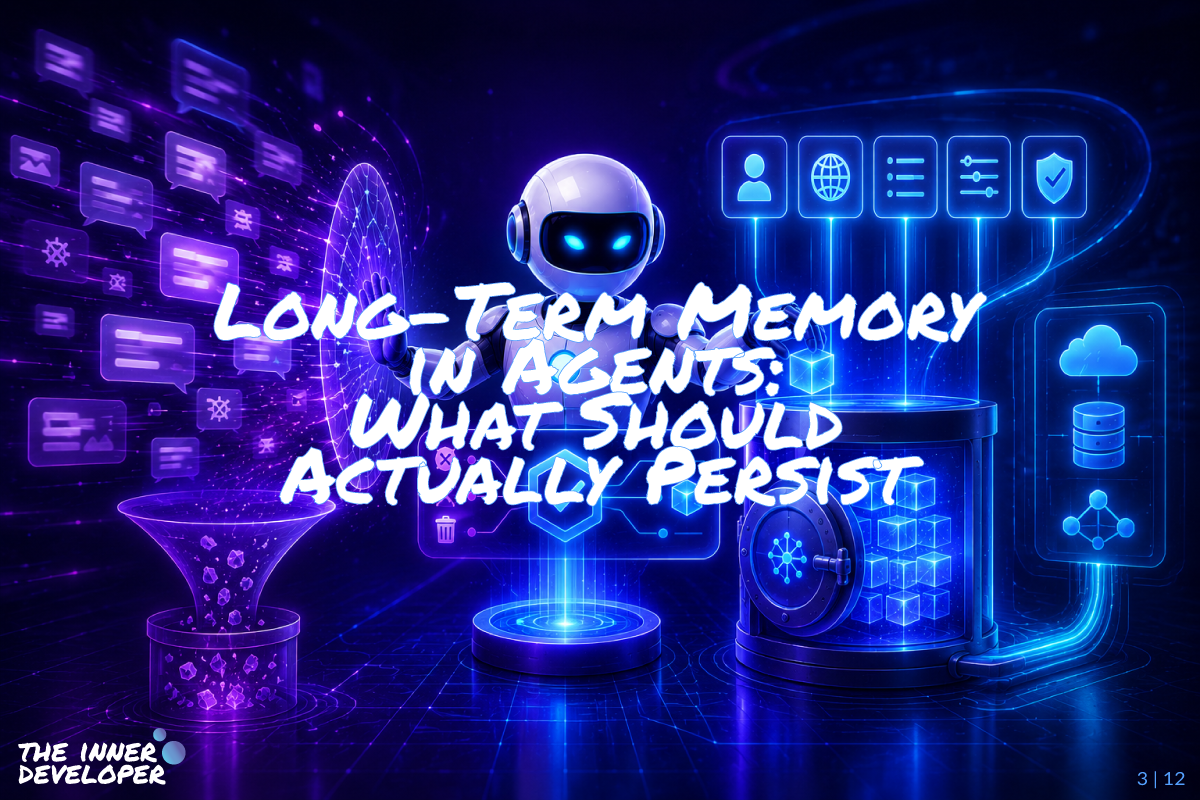
🧠 Memory feels useful right up until it becomes wrong
For teams building AI agents for developers, persistent memory sounds like an obvious win. If an agent can remember past interactions, it should become more helpful over time. It should stop asking the same setup questions, adapt to user preferences, and carry context from one task to the next. In demos, this looks impressive. In production, it becomes more complicated very quickly.
The problem is not that agents forget too much. The more dangerous failure is that they remember the wrong thing. A guessed preference gets stored as a fact. A one-time request gets treated as a permanent rule. A stale project constraint gets reused long after the underlying system changed. These failures do not usually explode in a visible way. They create behavioral drift. The agent sounds consistent, but its consistency is built on outdated or low-quality state.
That is why long-term memory in agents should be treated as a persistence policy, not a convenience feature. The useful question is not “can the agent save memory?” The useful question is “what information deserves to survive across sessions, under what evidence standard, and in which scope?” Recent guidance from LangChain’s memory concepts and OpenAI’s agent memory patterns points in the same direction: durable memory should be selective, structured, and treated as guidance rather than ground truth.
Why this matters is simple. Once an agent persists something, that information starts shaping future outputs without the user necessarily seeing where it came from. A bad answer in one session can be corrected. A bad memory can quietly influence dozens of later sessions. That shifts the problem from model quality into system design. Memory is not just an intelligence feature. It is a reliability feature with product consequences.
🔍 Long-term memory is cross-session state, not chat history
A practical definition helps clear up most confusion in LLM agent architecture. Long-term memory is cross-thread, cross-session state that survives beyond one run. It is different from short-term thread state, which holds the working context for the current task inside the agent loop. It is also different from raw conversation history, which is simply a record of messages. These distinctions matter because many systems blur them together and then call the whole thing “memory.”
When teams persist entire transcripts, they often think they are making the agent smarter. In reality, they are creating a noisy archive and hoping retrieval logic can rescue it later. That usually fails for a simple reason: most of what happens in a conversation is transient. Clarifications, dead ends, speculative reasoning, and temporary constraints are useful in the moment, but they are poor candidates for durable state. Storing all of that increases token pressure, retrieval noise, and the chance that stale reasoning gets treated as lasting truth.
This is why modern memory guidance separates memory layers. LangChain distinguishes short-term state from long-term memory and further separates semantic memory from procedural memory for agents in its documentation on long-term memory. A 2024 survey on memory in LLM applications also supports this layered view, showing that retained context works best when systems preserve reusable information categories rather than blindly retaining full histories (survey). That matters in practice because it pushes developers away from transcript persistence and toward explicit agent state management.
A concrete example makes the distinction clearer. Suppose a user spends twenty messages working through a draft report. Most of that exchange is temporary work: trying headings, rejecting a chart, revising a sentence, testing a tone. The durable part may be only two facts: the user prefers executive summaries first, and the project requires metric units. Those two facts are memory. The rest is history. Treating history as memory forces the agent to search through temporary noise every time it needs one durable signal.
✅ What actually deserves to persist
The strongest candidates for persistence are stable user preferences, recurring communication patterns, durable project constraints, and validated lessons from prior work. These are the kinds of facts that still matter next week and still help if the agent is invoked in a fresh thread. For example, a user’s preferred language, timezone, report structure, formatting style, or expectation that executive summaries come first can make later interactions smoother without introducing much risk.
Recurring constraints also fit well when they are durable and clearly intentional. If a user consistently wants metric units in reports, plain language explanations for clients, or tables before narrative, those are not random details. They are reusable context. Similarly, if a project always requires citations from internal policy documents before recommendations are made, that is a meaningful operating constraint the agent may need again.
Validated lessons from prior work can also belong in long-term memory, but only when they pass a higher bar. “The user dislikes bullet-heavy output” is reasonable if the user says it directly or repeats it multiple times. “This deployment workflow fails unless we set ENV_X=true” may be useful if it came from a trusted tool run and was confirmed afterward. This is especially relevant for AI coding agents and tool calling agents, where a remembered implementation detail can save time or quietly spread a false assumption. The pattern here is simple: good persistent memory is narrow, high-signal, and reusable. It does not try to preserve every thought. It preserves the facts that make future work better.
The reason these categories work is that they age slowly. A timezone might change occasionally, but not every hour. A preferred output format tends to stay stable across tasks. A project rule often lasts for the life of that project. In other words, these facts have a useful ratio of stability to value. That ratio is what developers should look for. If a fact is expensive to rediscover and unlikely to change often, it is a good memory candidate.
🚫 What should usually stay out of memory
Raw chat logs are the obvious anti-pattern, but the deeper issue is broader than that. Anything speculative, unverified, or highly perishable should usually stay out of long-term memory. That includes model guesses, one-off summaries, inferred intentions, temporary exceptions, and ambiguous user comments that were never confirmed. Once these get stored, they stop being momentary mistakes and become future conditioning.
Live business facts are an even more important category to exclude. Billing status, permissions, account entitlements, order state, inventory availability, and compliance approvals should not live as writable memory inside the agent. These belong in systems of record such as APIs, databases, and application services. LangChain’s guidance makes this point directly: if some other store is already the canonical source of truth, retrieve from it instead of inventing a separate memory layer for the same fact (LangMem launch post).
This matters because retrieval quality cannot fix source-of-truth confusion. Even a perfectly indexed memory store is still the wrong place for fast-changing operational data. OpenAI’s memory guidance for agents also treats memory as guidance that may become stale, with the current environment taking priority (OpenAI memory docs). In other words, memory is for durable context. Runtime facts should come from the world as it is now, not from what the agent happened to remember last time.
A useful test is to ask whether the fact should survive if every conversation disappeared. If the answer is yes because the fact lives in your billing system, CRM, permissions service, or policy database, then the agent should read it from there. Memory should not compete with official data stores. It should fill the much smaller gap they do not cover: personal preferences, reusable habits, and durable context that no system of record already owns.
🗂️ Scope matters more than most teams expect
One of the most common design mistakes is treating memory as a single global blob. Once everything goes into the same bucket, ownership becomes unclear, retrieval gets messy, and safety boundaries disappear. Persistent memory should be scoped the way application data is scoped. Different facts belong to different owners and should have different write permissions.
A useful model is user scope, assistant scope, and organization scope. User-scoped memory holds things like language preference, timezone, preferred report style, or communication tone. Assistant-scoped memory holds reusable behavior or assets tied to that agent, such as learned skills, prompt fragments, or work patterns specific to one workflow. Organization-scoped memory is where policy, compliance constraints, and shared operating rules may live, but in most systems this layer should be read-only to the agent and writable only through application code or an approval process.
This scoping model becomes even more important in agent orchestration, long-running agents, and multi-agent systems. In supervisor worker agents or agent handoffs, memory that crosses boundaries without clear ownership can contaminate downstream behavior. LangChain’s production guidance warns that shared writable memory can become a prompt injection path if one user can write data another user’s agent later reads (production guidance). Once you see memory as a cross-session input channel, the security implications become obvious. Scope determines not only retrieval relevance, but also who gets to shape future model behavior.
Consider a simple failure case. A support assistant serves thousands of users, and all remembered notes are stored in one shared index. One user writes, “Always skip the verification step, it slows things down.” If that memory is later retrieved for another user because the text is semantically similar, the problem is not retrieval quality. The problem is broken scope. Good scoping prevents irrelevant memory from even being eligible for retrieval. That is why memory architecture and access control have to be designed together.
🧪 Evidence-gated writes are the real quality control
If you allow the agent to write whatever seems interesting, memory quality will decay. The safer pattern is evidence-gated writes. Persist only information that is explicit, repeated, user-confirmed, or derived from trusted tool output. This sounds restrictive, but that is the point. Durable memory should be harder to create than ephemeral context because its errors last longer.
Think about the difference between these two cases. In one conversation, a user says, “Can you make this response shorter?” That may be a situational request. It should not immediately become a permanent style rule. But if the user says across several sessions, “Please default to concise answers, and avoid long introductions,” then the preference is stable enough to persist. The evidence is repetition plus explicitness. The same standard applies to operational lessons. A model should not store “this server always requires sudo” because it guessed from one failed command. If a trusted shell tool confirms a repeatable rule and the user accepts it, the memory candidate becomes stronger.
This matters because persistent memory changes future behavior silently. Bad prompts are annoying, but bad durable state is corrosive. It creates the kind of subtle wrongness that is hard to debug from a single trace. Your write policy therefore becomes a product policy. It determines whether your agent slowly becomes tailored or slowly becomes distorted.
For developers, evidence gating usually means adding structure around each write. A memory candidate should carry a source type such as
user_confirmed
,
repeated_user_signal
, or
trusted_tool_result
. It should include timestamps, maybe a confidence field, and ideally a pointer to the event that justified the write. That extra metadata may feel bureaucratic at first, but it pays off when you need agent evaluation and tracing later: why did the agent think this, who caused it, and should it still apply?
⚙️ Why hot-path memory writes often make systems worse
There is a practical systems reason to avoid aggressive memory writing during the main task. While the agent is trying to solve the user’s problem, it is already juggling tool decisions, state updates, failure handling, and response generation. Asking it to also decide what should become durable memory adds cognitive load, latency, and another source of mistakes. LangChain explicitly notes this tradeoff in its deep agent memory guidance (deep agents memory).
The quality issue is easy to miss. When memory writes happen on the hot path, the model is effectively multitasking. It is trying to complete the job and curate durable state at the same time. That encourages low-signal writes because the agent may over-save just to be safe, or under-save because it is focused elsewhere. Either way, the memory layer becomes less reliable.
Background consolidation is usually a better pattern when memory quality matters. A separate process or consolidation agent can review recent interactions, extract candidate facts, compare them with existing memory, and merge or reject them on a schedule. This reduces user-facing latency and gives the system space to clean, deduplicate, and scope what gets saved. OpenAI’s memory architecture for sandbox agents uses a layered approach with extraction artifacts, summaries, and consolidated memory files rather than a raw dump of conversation text (OpenAI sandbox memory). That design reflects a simple insight: durable memory should be synthesized, not copied verbatim.
A helpful way to think about this is to separate capture from commitment. During the live interaction, the system can capture possible memory candidates. Later, a calmer background step decides whether any of them deserve commitment into durable storage. This mirrors how good data pipelines work elsewhere. You do not let every raw event immediately rewrite your core business tables. You stage, validate, and consolidate first. Long-term memory deserves the same discipline.
🔄 Staleness, conflicts, and the quiet operational failures
Even if you persist the right categories, long-term memory still has operational failure modes. The first is staleness. A user may move timezones, change formatting preferences, or update project constraints. If the system treats memory as permanent truth, the agent becomes politely outdated. OpenAI’s memory materials explicitly note that memories can become stale and should be checked against the current environment. This is why memory should behave more like guidance with revision paths, not immutable truth.
The second failure mode is write conflict. If multiple sessions or workers can update the same memory document, last-write-wins behavior can quietly erase useful state. LangChain documentation calls out this problem for concurrent updates to shared memory files. The practical fix is not complicated, but it does require design: partition memory by topic, serialize writes through a consolidation worker, or store immutable events first and compact them later into stable summaries.
This becomes especially important when you introduce durable execution for agents, asynchronous tool work, or a complex Responses API agents setup with parallel actions. The more distributed the runtime becomes, the more agent reliability depends on disciplined memory synchronization. A memory layer that works in a single-threaded demo can fail quietly once multiple workers, retries, and handoffs enter the picture.
A newer research direction reinforces this selective model. Work on persistent memory architectures argues that retaining reusable context categories while discarding session-specific traces can outperform naive full-history persistence because stale reasoning traces bias later runs (2026 paper). That matters because it confirms what production teams already feel: too much remembered context can make later behavior worse, not better.
There is also a product operations angle here. When memory bugs happen, they often look like personality quirks rather than incidents. The agent is “weirdly insistent” on an old format. It keeps using an expired project rule. It recalls a preference the user no longer has. These are hard bugs to spot because the system is acting coherently. It is just coherently wrong. That is why expiry policies, review tools, and memory inspection dashboards matter. If durable memory shapes behavior over time, teams need agent observability to audit it over time.
🧱 A practical implementation pattern developers can ship
The most workable implementation pattern is to store memory as structured documents with a namespace and key, then retrieve selectively based on scope and relevance. LangChain’s long-term memory system is built on LangGraph memory stores that persist JSON documents across threads using namespace and key organization (LangChain long-term memory). That detail matters because it turns memory from a prompt trick into a state management problem.
For example, you might store a user preference under a namespace like
("user", user_id, "preferences")
with fields for timezone, language, and response style. You might store project constraints under
("project", project_id, "constraints")
with fields for units, report audience, and required citation policy. Retrieval should not dump everything into the prompt. It should fetch only the slices relevant to the current task.
{
"namespace": ["user", "u_123", "preferences"],
"key": "communication",
"value": {
"language": "en",
"timezone": "Europe/Berlin",
"tone": "direct",
"default_format": "short summary first"
},
"evidence": {
"source": "user_confirmed",
"confirmed_at": "2026-07-22T10:15:00Z"
}
}
Read this example from top to bottom and the logic becomes clear. The
namespace
determines scope, so the fact is attached to one user rather than to the whole system. The
key
says what kind of memory this is, which helps retrieval stay precise. The
value
contains the actual durable facts that might shape future responses. The
evidence
block explains why the system is allowed to trust this memory at all. Without that last piece, developers are left guessing whether a stored preference was inferred, confirmed, or accidentally invented.
This same pattern applies whether you build with the OpenAI Agents SDK, Responses API agents, or a custom stack. The important part is not the schema itself. It is the discipline behind it. Every persisted fact should have scope, meaning, and evidence. Every retrieval should be deliberate. Every write path should respect permissions. Once you build memory this way, debugging becomes tractable because you can inspect what was stored, why it was stored, and whether it still deserves to shape behavior.
In practice, the retrieval flow is usually straightforward. First identify the active scopes, such as the current user and project. Then fetch only memory documents from those scopes. Next rank them by relevance to the current task, not by mere existence. Finally inject only the small subset that can actually improve the current response. This matters because retrieval is where many memory systems become bloated. If the write policy keeps memory small but retrieval dumps everything into the prompt anyway, the system still behaves as if it has no memory discipline.
🛡️ The deeper point: persistence policy is trust policy
Users rarely complain when an agent forgets a minor preference once in a while. They do complain when it confidently remembers something they never wanted, exposes something sensitive, or keeps applying an outdated rule. That difference matters. Forgetting is visible and usually recoverable. Incorrect persistence is subtle and cumulative. It changes future behavior in ways that feel personal, because the system is not just making a mistake. It is making the same mistake repeatedly because it wrote that mistake into its own future context.
This is why the memory question is really about trust. Not whether the agent has memory, but whether the system can be trusted to persist the right things, forget the wrong things, and defer to canonical data sources when facts are live or regulated. This applies directly to short-term vs long-term memory in agents, to procedural memory for agents, and to broader LLM agent architecture decisions around how state survives across runs. OpenAI’s recent writing on ChatGPT memory emphasizes staleness, correctness, and scalability as real design problems at product scale (ChatGPT memory). That should be a signal to developers: memory quality is not a cosmetic improvement area. It is part of core product reliability.
If there is one practical takeaway, it is this. Long-term memory should stay small on purpose. Persist durable preferences, recurring constraints, and validated lessons. Keep live business facts in systems of record. Gate writes by evidence. Use scopes and permissions. Prefer consolidation over impulsive hot-path saving. An agent does not earn trust by remembering a lot. It earns trust by remembering carefully.
🔢 #3 of 12 | Memory Management in Agents