

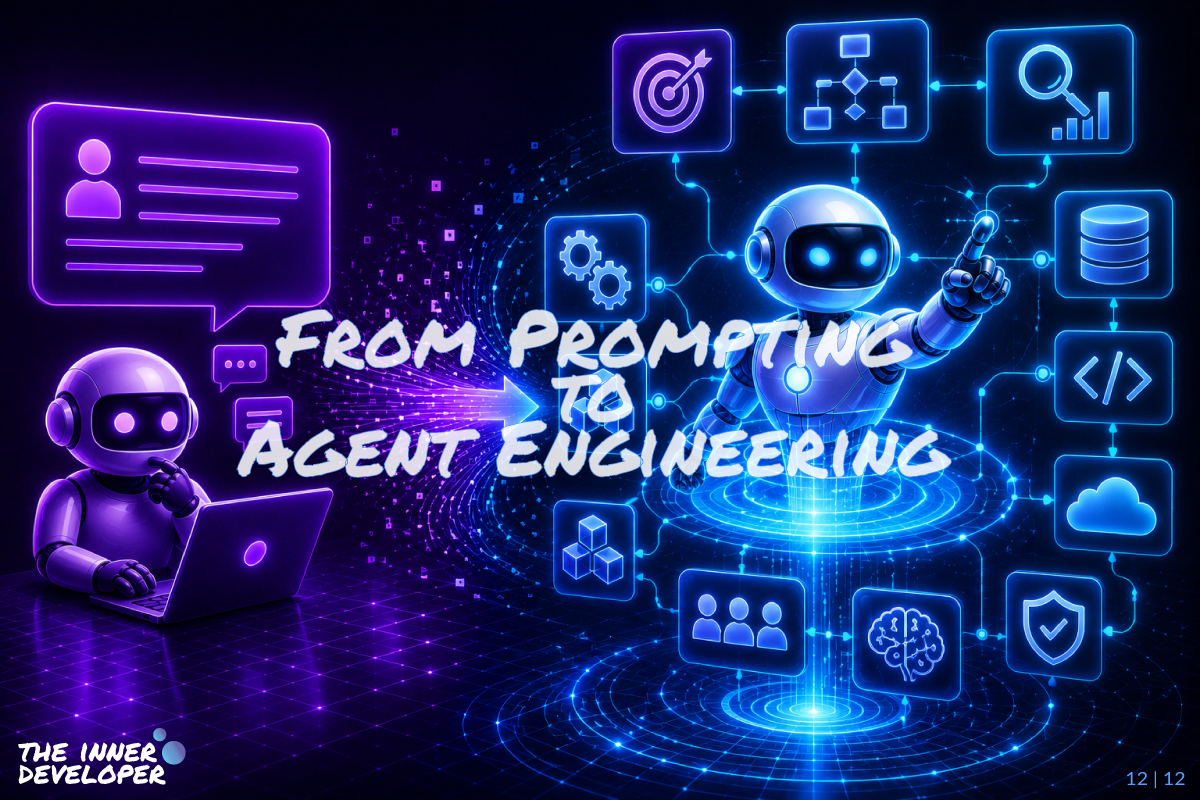
🧠 The shift is not semantic. It is operational.
There is a reason so many agent demos look impressive in week one and feel fragile in week three. The early mental model is usually wrong. Teams think they are building a smarter chatbot, so they focus on better instructions, tighter wording, and more examples in the prompt. That approach works reasonably well for single-turn generation, where the main task is to produce a useful answer from the current context. It breaks down as soon as the model has to choose actions, call tools, carry forward constraints, recover from errors, and decide when it is actually done.
The important shift is not from one buzzword to another. It is from treating the model as a text generator to treating the system as a runtime. In modern AI agents for developers, the prompt is only one layer inside a larger control structure. The system also includes tool schemas, validation rules, retry behavior, state updates, guardrails, and stopping conditions. This is the practical core of LLM agent architecture. If any of those layers are weak, the agent can fail while still sounding confident and polished. That combination is exactly what makes agents deceptive in production. Language quality can hide process failure.
This matters because production failures are rarely about wording alone. A support agent does not usually fail because its final sentence is awkward. It fails because it called the refund tool before verifying identity, extracted the wrong order ID, skipped a required clarification, or stopped after seeing only part of the data. A coding agent does not usually fail because its summary sounded odd. It fails because it edited the wrong file, misunderstood the build output, retried a broken command too many times, or declared success before tests finished. Those are execution failures. They live in the agent loop, not in the surface text.
That is why the useful move is from prompt engineering to agent engineering. You are no longer only asking, “Did the model say the right thing?” You are asking, “Did the system take the right steps, with the right information, under the right constraints?” That question is harder, but it is also the one that makes systems dependable. Once you ask it seriously, the job starts to look much closer to software design than to prompt writing.
🔄 The real unit of quality is the loop
The cleanest way to understand an agent is not philosophical. It is operational. An agent receives a goal, inspects current state, chooses whether to respond or act, emits a structured tool call if needed, waits for the observation, updates state, and then decides whether to continue or stop. That loop is the behavior. Everything else is commentary. If you want to improve reliability, this is the unit you need to understand and measure.
This framing lines up with how current tooling is evolving. The OpenAI Agents SDK centers tools, handoffs, streaming, and traces because those are the moving parts developers actually have to manage. For teams building Responses API agents or more general tool calling agents, the same lesson applies. Similarly, trace grading treats the trace as the thing worth inspecting, not just the final output. That is a quiet but important change. It means the system is judged by decision quality across steps, not only by the final text.
Why this matters becomes obvious the moment a tool enters the picture. A final answer may look reasonable even when the loop failed internally. The model might call the wrong tool, pass malformed arguments, retry too aggressively, or stop after a partial result. Imagine an internal finance assistant asked to “pull last quarter revenue by region.” If it queries the wrong date range and then writes a polished summary, the language is not the problem. The control loop is. Looking only at the final response would reward style while missing the real defect.
Developers need this mental model because it creates a debuggable unit. Prompts alone are too coarse. The loop gives you checkpoints: state before action, chosen action, tool input, tool output, state after observation, and stop decision. Once you think this way, agent reliability starts to look less mystical and more like normal software engineering. You can isolate failures, compare runs, and improve one control layer at a time instead of rewriting instructions and hoping for the best.
🪜 Architecture grows by adding new failure surfaces
One of the most useful ways to reason about agent systems comes from the architecture ladder described in OpenAI’s evaluation guidance. The progression goes from single-turn interaction, to workflow, to single-agent, to multi-agent. Each step is not just more powerful. Each step adds a new source of nondeterminism, which means a new source of failure and a new eval surface.
In a single-turn interaction, the main question is whether the model generated a good answer. In a workflow, you now care whether the control flow and sequencing are right. In a single-agent system, the major new risks are tool selection and argument precision. In a multi-agent system, you add handoff accuracy, coordination overhead, and shared-state drift. This is where agent orchestration becomes a real engineering concern instead of a diagramming exercise.
This framing is practical because it stops teams from romanticizing complexity. More moving parts do not mean more capability by default. They often just mean more places to lose control. That is especially true in supervisor worker agents patterns, where a top-level agent routes tasks to specialists. If the routing logic or context packaging is weak, the whole system becomes harder to reason about.
This is why “just add another agent” is often a bad reaction to a failing system. If a single agent cannot reliably choose tools or carry constraints forward, adding a planner, reviewer, or specialist usually multiplies the ambiguity. You are not fixing a weak control plane. You are hiding it under more orchestration. In practice, that often makes diagnosis slower because it becomes harder to tell whether the problem started in planning, execution, agent handoffs, or final synthesis.
The value of the ladder is that it forces architectural honesty. Every step upward should be justified by evidence. If your current failure is poor argument extraction, multi-agent decomposition will not save you. Better schemas, validation, and trace inspection probably will. That discipline matters for long-term system health because complexity has carrying costs. It increases latency, evaluation burden, and maintenance work. Agent engineering starts when you treat those costs as real, not as abstract tradeoffs.
🛠️ Prompts are only one policy layer
A lot of teams still act as if the prompt is the operating system. It is not. It is one policy layer among several. The actual behavior of a tool-using agent also depends on the shape of tool contracts, the quality of runtime state, the validation path, the retry policy, interruption rules, and the criteria for stopping. Ignoring those layers is why prompt-only thinking feels productive in prototypes and disappointing in production.
Tool schemas are a good example. A schema is not just documentation for the model. It is part of the control plane. If a tool accepts an order ID, account email, and date range, the schema influences what the model extracts, what it asks for, and what errors can be caught before execution. A vague tool definition creates vague behavior. A narrow and validated contract creates better decisions. This is exactly why OpenAI’s eval guidance emphasizes not only tool selection but also data precision: did the model pass the correct structured arguments based on the conversation state?
Retry policy matters too. If a tool times out, should the agent retry automatically, ask the user for confirmation, or stop and report partial failure? Prompt text alone cannot safely answer that at runtime. The runtime needs explicit rules. The same is true for stopping conditions. An agent that always tries one more step can loop. An agent that stops too early can miss required work. Neither problem is solved by “be careful” in the system prompt.
A useful way to think about this is to separate intent from enforcement. The prompt expresses intent. The runtime enforces rules. If you tell an agent to “never issue a refund without identity verification,” that is helpful instruction. But if the refund tool can still be called without a verified identity field in state, the system is trusting language where it should require structure. The design choice matters because policy that is only linguistic is fragile. Policy that is embedded in schemas, validators, and agent state management is much harder to bypass accidentally.
This is the part many teams resist because it feels less magical. But it is more useful. Reliable agent behavior comes from constrained interfaces and deliberate state transitions. That is what makes the system inspectable when things go wrong, and that inspectability is what lets teams keep improving instead of repeatedly rediscovering the same failures.
📦 A concrete example: the support agent that looks smart but fails badly
Customer support is a good example because the gap between nice language and correct execution is easy to see. Imagine an order-status agent with a lookup tool. A user says, “Where is my package?” If there is no order ID in the thread, the correct behavior is not to guess. It is to ask for the missing identifier. If the order ID is present, the correct behavior is to call the lookup tool with the exact extracted value. After the tool responds, the agent should return the delivery date and tracking number, then stop.
Now look at how it actually fails in practice. The agent might skip the clarification and invent a lookup result. It might extract only part of the order ID. It might choose a refund tool because the user sounded frustrated. It might call the right tool twice because it did not recognize that the state already contained a valid result. Or it might answer with “Your order is on the way” while omitting the actual tracking number, even though the tool returned it.
Those are not edge cases. They are the normal shape of real failures. And they map cleanly to engineering checks. Did the agent request missing required fields? Did it choose the correct tool? Did it pass the precise arguments? Did it carry the observation into the final answer? Did it stop after sufficient evidence? The order-status style eval examples are useful because they make this visible without hand-waving.
It helps to make the mechanics explicit. The first step is state inspection. Does the conversation already contain an order identifier, or only a vague shipping question? The second step is policy evaluation. If a required field is missing, the next action should be a clarification question rather than a tool call. The third step is extraction. If the user replies with “It’s order 78431-AZ,” the runtime should store that value in a field the tool layer can validate. The fourth step is execution. The lookup tool should reject malformed IDs instead of accepting anything that resembles one. The fifth step is response assembly. The final answer should reflect the actual tool output, not a generic paraphrase that drops important details.
What matters here is not just correctness for its own sake. In support, wrong tool usage can trigger account actions, expose private data, or waste operator time. Step quality is business quality. That is why loop-first thinking matters so much. It turns a vague complaint like “the agent sometimes messes up” into a concrete diagnosis such as “the agent is under-clarifying on missing identifiers” or “the runtime is not validating tool arguments before execution.”
🔍 Traces turn agents from black boxes into workflows
Once you accept that the loop is the unit of quality, the next question becomes obvious: how do you inspect it? The answer is tracing. A trace records the sequence of decisions, tool calls, observations, and transitions that led to the result. Without that record, agent debugging collapses into guesswork. You see a bad answer and start editing instructions blindly. With a trace, you can pinpoint the failure step.
This is why tracing has become central in current agent tooling. The modern stack is moving toward observable execution, not just prompt iteration. OpenAI’s trace grading guidance pushes this further by treating traces as artifacts that can be scored. You do not just inspect them manually. You can evaluate whether the tool choice was appropriate, whether arguments were complete, whether retries were sensible, and whether the agent stopped at the right moment.
That changes how improvement works. Instead of saying, “The agent feels worse after the last change,” you can say, “Tool selection accuracy dropped on requests that require clarification,” or “Malformed argument rates increased after we broadened the tool schema.” This is a much healthier feedback loop because it localizes responsibility. Sometimes the prompt is the issue. Often it is not. Sometimes the fix belongs in the tool contract, state shape, or validation middleware.
A trace also creates a shared debugging language across a team. Product, engineering, and applied AI staff can all look at the same run and discuss the same sequence of events. That matters because many agent failures are cross-functional. A product rule might require a confirmation step. A backend contract might reject certain values. A model prompt might encourage excessive initiative. Without traces, those layers blur together. With traces, each layer becomes visible enough to review and improve.
Why this matters in real teams is simple: people can only improve what they can see. Prompt-only workflows hide the system. Traces expose it. That exposure is the basis of agent observability. It is also the foundation for serious agent evaluation and tracing. That exposure is the difference between a demo that impresses in a meeting and a system that can survive repeated changes without becoming mysterious.
📏 Evals are where prompting gives way to engineering
Tracing helps you see failures. Evals help you improve them systematically. This is the point where the work stops feeling like creative prompt tuning and starts feeling like engineering. You define the behavior you want, collect examples, score the right layers, and compare runs over time. It is not glamorous, but it is the reason reliable systems keep getting better instead of drifting unpredictably.
For agents, output-only evals are too shallow. They miss the intermediate mistakes that create bad results. Better evals score step-level behavior: correct tool selection, precise argument extraction, appropriate clarification when required fields are missing, sane retry behavior, and clean stopping after sufficient evidence. OpenAI’s evaluation and trace materials are useful here because they make those surfaces explicit rather than treating “agent quality” as one vague metric.
There is also an important cultural shift hidden inside this. Prompting encourages intuition. Evals force specificity. If the agent keeps failing, you have to state what failure means. Is it choosing the wrong tool? Is it over-calling the same tool? Is it losing a user constraint after the first step? Once those failure modes are explicit, fixes become much less random. You can narrow scope, adjust the schema, improve validation, or redesign state transitions based on evidence.
Good evals also separate model weakness from system weakness. Suppose the model is generally capable of extracting account IDs correctly in isolation, but production traces show frequent tool-call failures. That points toward schema design, state formatting, or validation gaps rather than a purely prompting issue. This matters because otherwise teams waste cycles solving the wrong problem. They keep tuning prompts to compensate for weak infrastructure instead of strengthening the infrastructure itself.
That is why evals matter beyond benchmarking. They become the control mechanism for change. Without them, every prompt revision, tool update, or orchestration tweak is a gamble. With them, you can tell whether the loop actually improved. This is where agent engineering becomes real discipline rather than hopeful iteration.
🏗️ Start with a single agent because complexity compounds fast
There is a strong temptation to jump straight to multi-agent systems. Planner agents, reviewer agents, specialist agents, handoffs, supervisors. It sounds advanced, and it makes architecture diagrams look impressive. But in many cases it is premature. A single-agent system already contains enough nondeterminism to demand serious engineering. Adding more agents before stabilizing one loop usually creates a larger blast radius, not a better product.
This is not anti-orchestration. It is about sequence. Both OpenAI guidance and Anthropic’s architecture framing point to the same practical default: start simple, then earn decomposition through evidence. If a single agent cannot reliably inspect state, choose the right tool, ask for missing information, and stop when done, then extra agents are likely to multiply confusion. One agent may call the wrong tool. Three agents may disagree, duplicate work, or hand off bad context to each other.
Why this matters for developers is time to reliability. Multi-agent systems increase cost, latency, and debugging difficulty. They also introduce a new eval surface: handoff accuracy. Did the planner send the task to the right specialist? Did the receiving agent inherit the necessary constraints? Did both agents act on the same state version? These are real engineering problems, not abstract concerns.
There is also a subtler reason to delay complexity. Many organizations reach for multiple agents because they want cleaner conceptual boundaries. One agent for retrieval, one for reasoning, one for action. On paper that sounds tidy. In practice, those boundaries only help when the information passed between them is stable and well-scoped. If the upstream agent sends ambiguous summaries, the downstream agent inherits ambiguity with extra latency attached. Specialization only helps after the basic loop is trustworthy.
The discipline is straightforward. First stabilize one loop. Prove that it handles tools well. Prove that traces are readable and evals are meaningful. Only then ask whether specialization would genuinely improve reliability or scale. Complexity should be a response to measured need, not architectural ambition.
🧱 Runtime design means state, checkpoints, and recovery
The deeper lesson in all of this is that agent engineering is really runtime design. Once the model can act in the world through tools, state becomes a first-class concern. You are no longer managing only text generation. You are managing transitions across time. What was known before the call? What changed after the observation? What should persist? What can be retried safely? Where can the system resume after failure?
This is why production guidance from frameworks like LangChain keeps emphasizing persistence, durability, tenant scoping, and recovery rather than only prompt templates. In going-to-production guidance, checkpoints are not a luxury. They are what make long-running agents replayable. If an agent fails halfway through a task, a checkpointed runtime can resume from a known state rather than re-running everything blindly.
That changes debugging quality dramatically. Without durable execution for agents, a failed run is often just an opaque transcript plus a vague suspicion. With checkpoints, the run becomes a sequence of state snapshots. You can inspect the state before the bad tool call, validate the transition logic, and test a fix against the same point in the workflow. That is a very different operational experience.
State design deserves more attention than it usually gets. A good state model separates durable facts from temporary reasoning artifacts. For example, a verified customer ID should be a durable field that downstream tools can trust. A speculative interpretation of the user’s intent should remain provisional until confirmed. If those get mixed together, the runtime starts treating guesses like facts. That creates a class of bugs that are difficult to detect because they look coherent inside the system while being wrong in reality.
This matters even more for AI coding agents or any system that executes actions in an environment. Once shells, containers, or external APIs are involved, infrastructure choices become part of agent behavior. Isolation, lifecycle control, and audit trails are not side concerns. They are the runtime boundaries that keep the system safe and understandable. Good runtime design does not make the model smarter. It makes the system survivable.
🧠 Memory comes later, and only after the loop is trustworthy
It is tempting to treat memory as the next obvious upgrade. If the agent forgets things, give it memory. But this is exactly where teams can get themselves into trouble. Memory does not fix an unreliable loop. It often amplifies it. If the agent already loses constraints, chooses poor actions, or writes low-quality state, persistent memory can make those mistakes durable.
Current memory guidance is much more careful than the common hype suggests. LangChain’s docs distinguish thread-scoped state from durable memory across threads and warn that hot-path memory writes add latency and force the agent to multitask. See their discussion of long-term memory design for a practical framing: memory is a scoped systems problem, not an infinite context trick.
The first design question is scope, not storage technology. Is this information thread-scoped and temporary, like a missing order ID captured during one support interaction? Or is it user-scoped and durable, like a shipping preference that should persist across sessions? This is the practical difference in short-term vs long-term memory in agents. Mixing these together creates brittle systems. Temporary reasoning artifacts should not quietly become durable memory. Durable user memory should not be lost in a transient scratchpad.
There is also a quality question: who is allowed to write memory, and under what conditions? If every intermediate inference can become stored memory, the system will accumulate noise. A better design is to require explicit thresholds or triggers for persistence. For instance, a preference might only be stored after user confirmation, while a successful transaction ID may be written automatically because it came from a verified tool result. That distinction matters because memory becomes part of future context. Poor memory quality turns future runs into garbage-in, garbage-out systems with a longer time horizon.
This is why the practical rule holds: before adding AI agent memory, make sure the loop can carry constraints correctly within its existing state. If one pass through the loop cannot preserve required information, adding long-term persistence is not maturity. It is just storing confusion more efficiently. In frameworks that support persistent memory layers, including approaches inspired by LangGraph memory and procedural memory for agents, the same principle still applies: good memory depends on a trustworthy loop.
🚦What changes when you adopt the runtime mindset
Once you stop treating agents like slightly better chatbots, your engineering choices become sharper. You stop asking only how to phrase instructions and start asking how to control behavior. You define tool boundaries more carefully. You validate arguments aggressively. You make stopping explicit. You log every step. You build evals around actual failure modes. You choose persistence scopes deliberately. The system becomes less magical, but far more dependable.
There is also a useful psychological shift here. Prompt-only thinking flatters intuition. It lets teams believe that enough clever wording will tame a messy system. In production, that belief usually collapses. The issue is not that prompts do not matter. They do. The issue is that they are too small a lever for the whole problem. Runtime discipline matters because agents fail through interaction with tools, state, and environment, not only through language generation.
That is the real meaning of moving from prompting to agent engineering. You are designing observable behavior under uncertainty. You are building systems where intermediate decisions matter as much as final answers. You are creating control planes, not just prompts. The reward is not theoretical elegance. It is practical reliability.
And that leads to a simple rule worth keeping: stabilize the loop first, then think about memory, then consider orchestration. Earn every new layer. That order is not conservative for the sake of it. It is what keeps complexity attached to evidence instead of excitement. In a field that changes quickly, this is a grounding habit. It shifts attention from what sounds advanced to what actually survives contact with users, tools, and production constraints.
🔢 #12 of 12 | The Agent Loop