
🛑 Stop calling everything an agent
Most confusion around AI agents starts before any code is written. The problem is not intelligence. The problem is language. Teams use the word agent to describe everything from a chatbot with one retrieval function to a long-running coding system operating inside a container. Once the definition gets blurry, architecture gets blurry too. You stop asking how control flows through the system and start talking about autonomy as if that were a design primitive.
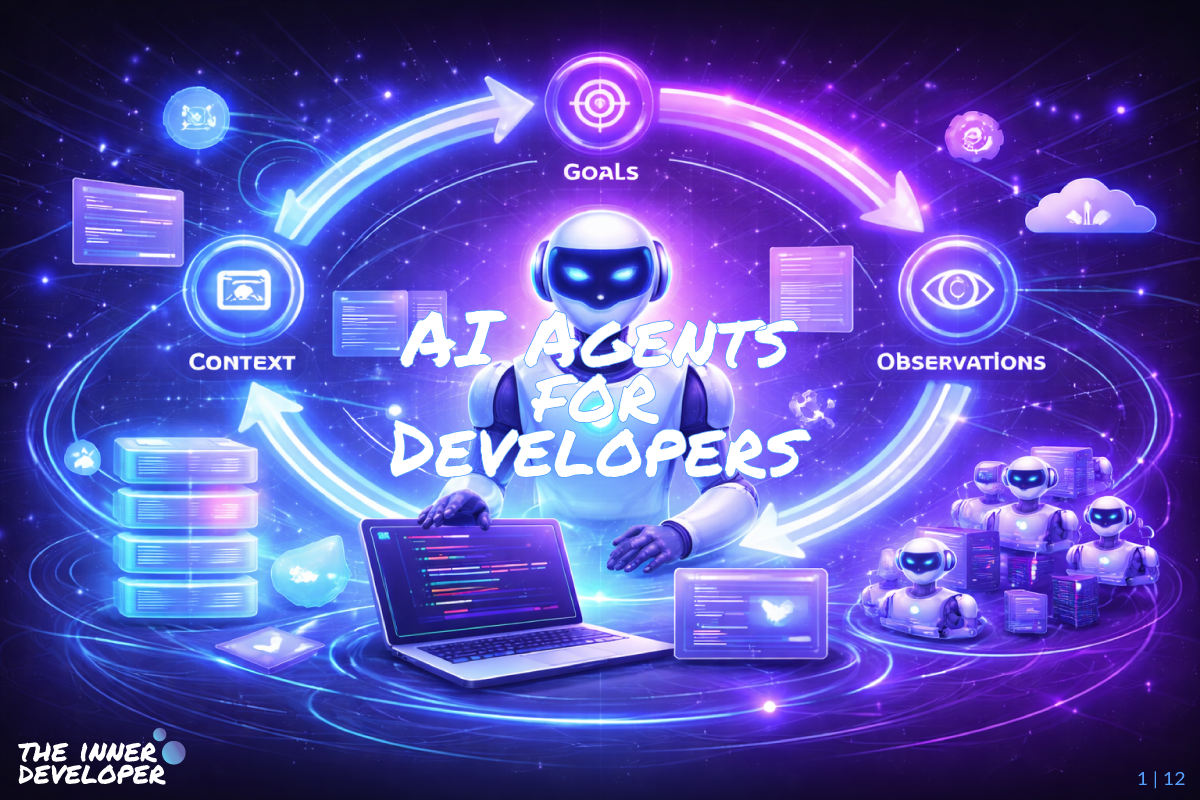
For developers, that framing does not hold up. A more stable definition is simpler and more useful: an agent is a control loop built around an LLM. The model receives a goal, inspects current context, chooses the next action, executes that action through a tool or direct response, observes what happened, updates state, and then decides whether to continue or stop. That is close to how current production guidance describes agentic systems, especially in the OpenAI Agents SDK docs and the move toward the Responses API.
Why this matters is straightforward. If you think in terms of autonomy, you expect the system to be generically smart. If you think in terms of an agent loop, you inspect decisions. That changes how you debug failures, how you constrain tools, how you measure success, and how you reason about cost. The gap between a good demo and a reliable system is usually not the prompt. It is whether the loop is explicit enough to observe and control.
This shift sounds small, but it changes design conversations immediately. Instead of asking, “Can we build an agent for support?” you ask better questions. What decisions should the model make? Which actions belong in code? What state must survive across steps? What should happen if a tool fails twice? These are software questions, not philosophical ones. That is why this mental model holds up under pressure. It keeps the conversation grounded in execution rather than branding.
🧭 The stack is clearer when you separate control from capability
A lot of debates disappear once you separate four architectures that often get collapsed into one bucket. A single-turn model call is just input in, output out. No iteration, no external action, no durable state. A workflow adds multiple steps, but the sequence is predefined by the developer. The model may classify or extract something inside that workflow, but the control flow still belongs to code.
An agent is the next step up. Here, the model gets limited discretion over what should happen next. It can decide whether to answer directly, ask a follow-up question, call a tool, or continue after observing a result. That is the important shift. The system is no longer only executing your plan. It is making local action choices inside a bounded environment. OpenAI’s evaluation guidance uses this distinction directly, separating workflows from single-agent systems because each introduces a different failure surface for evaluation and testing.
Then there are multi-agent systems. These are not a more advanced default. They are a coordination pattern. You add them when decomposition actually improves reliability, specialization, or scale. Anthropic makes a similar point in its guidance on building effective AI agents. More decision makers means more communication, more tracing, more duplicated work, and more ways for the system to drift. Many teams reach for multi-agent designs long before they have built one solid agent with clear tools and good observability.
A concrete example makes the distinction easier to keep straight. Suppose you are building an internal IT assistant. In a workflow, the app always parses the request, checks identity, queries a device inventory system, and renders a response. The model helps with extraction and wording, but your code decides every branch. In an agent, the model can decide whether it already has enough information, whether it needs clarification, whether to check inventory first or look up the user’s history, and whether it should stop after one action or continue. Same capabilities, different control model.
Why this matters for long-term system health is that control determines reliability more than raw model power does. If a process is predictable and repetitive, fixed agent orchestration is often stronger than flexible orchestration. Giving the model freedom where freedom is not needed creates a larger test surface for no clear gain. On the other hand, forcing a rigid workflow onto a problem with many valid next steps usually produces brittle code and awkward user interactions. The practical skill is not choosing the most advanced stack. It is matching the control pattern to the shape of the task.
🔁 The loop is the real unit of understanding
Once you treat the agent as a loop, behavior stops feeling magical. The loop is operational. Receive goal. Inspect context and current state. Choose next action. Call a tool or produce a response. Observe the result. Update state. Stop or continue. Every part of this can be logged, evaluated, and constrained. That is why this model holds up under production pressure. It maps directly to system behavior.
Consider a customer support example. In a workflow version, the code extracts an order ID, calls an order lookup function, then renders a reply. If any input is missing, the code follows a predefined branch. In an agent version, the model decides whether the order ID is missing, whether it should ask for clarification, which tool to call, how to interpret the returned data, and whether it has enough information to stop. Same domain, different control model. The second design is more flexible, but it creates new failure modes because action selection is now learned rather than hardcoded.
That difference explains why teams struggle to debug agents. The failure may not be in the final text. The agent may choose the wrong tool, pass malformed arguments, ask an unnecessary follow-up, repeat a tool call, or stop before verification. Output-only evaluation misses this. Trace-level inspection catches it. This is exactly why modern agent guidance puts so much weight on traces and step-level grading instead of prompt tweaks alone.
It helps to think of the loop the way you would think about an event-driven service. Each iteration takes in current facts, makes a decision, performs work, and then re-enters with new information. Once you see it that way, familiar engineering questions come back into focus. What is the timeout? What is the retry policy? What is the stop condition? What information is trusted? Which events should be persisted? A lot of the mystery around AI agents for developers disappears when you realize the hard part is not intelligence in the abstract. It is managing a dynamic decision loop safely.
🛠️ Tool access does not automatically create agency
A chatbot with tools is not automatically an agent. This distinction sounds picky until you try to operate one in production. If the app always follows the same route, for example classify, retrieve, answer, then the model is participating in a workflow, not controlling one. That can be an excellent design. In fact, it is often the better design because it is easier to test, faster to run, and cheaper to operate.
The word agent becomes useful only when the model has real discretion over the next step. That means the system must tolerate nondeterminism in a controlled way. The model might decide to use a tool now, defer the tool until it gathers more information, or answer directly if the context already supports a response. With that freedom comes a wider reliability problem. You are no longer only validating outputs. You are validating decisions. This is the core difference between basic assistants and true tool calling agents.
This is where weak definitions become expensive. If a team labels every tool-enabled assistant an agent, it often overestimates capability and underestimates engineering work. The system is presented as smart, but the logs are thin, tool schemas are vague, stopping rules are implicit, and nobody can explain why a particular action was taken. The result is a fragile demo. The language matters because it shapes the expectations people bring to architecture and debugging.
There is also a design lesson here. Tools are not just powers you hand to the model. They are interfaces that shape behavior. A tool with a vague description and loose argument schema invites bad decisions. A tool with a clear contract, constrained parameters, and obvious success and failure states gives the model a better decision surface. That is why tool design matters as much as prompting. In practice, a well-designed workflow with strong tools usually beats a loosely defined “agent” with broad access and weak guardrails.
🧩 State is not memory, and that confusion breaks systems
The loop only holds up if state is treated as a first-class concept. State is the information the system needs right now to continue the current task correctly. That can include the current user request, tool outputs from earlier steps, intermediate decisions, and the active constraints for this run. In the modern OpenAI stack, stateful chaining is explicit through primitives like stored responses and
previous_response_id
in the Responses API. That is a systems concept, not a vibe.
Memory is related but different. AI agent memory, short-term thread state, persistent user preferences, retrieved documents, and procedural skills should not be thrown into one conceptual bucket. LangChain’s guidance is especially useful here because it separates thread state from long-lived memory and warns that writing memory on the hot path adds latency and cognitive overhead for the agent during execution. Why this matters is practical. If you store everything as memory, you increase cost, retrieval noise, and failure risk. If you treat all context as ephemeral, the agent loses continuity across steps and sessions.
A stable mental model starts smaller. Ask what the loop needs to know now, what should be fetched from an external system, and what is worth persisting beyond the current run. That separation is what keeps agents understandable. Without it, state becomes vague, prompts become bloated, and bugs become impossible to localize. This is where agent state management and short-term vs long-term memory in agents become design decisions, not just implementation details.
Take a coding agent as an example. The current task, the files changed in this session, recent test output, and the explicit constraints from the user belong to active state. A user’s preferred programming language or formatting style might belong to durable memory. The contents of the repository should not be “memorized” at all. They should be accessed through tools that inspect the actual file system. Mixing those layers creates subtle failures. The agent may act on stale remembered facts instead of fresh system state, or it may carry irrelevant details from one task into another and make worse decisions.
Why this matters over time is that state design becomes architecture. If you cannot explain what lives in transient state, what lives in persistent memory, and what should always be retrieved live, then your agent will slowly accumulate context debt. That debt shows up as longer prompts, slower calls, noisier reasoning, and harder debugging. Clean systems are not the ones that store the most context. They are the ones that store the right context in the right place. This is also the reason developers pay attention to patterns like procedural memory for agents and implementations such as LangGraph memory.
🚨 Most production failures are loop failures, not intelligence failures
The most common production failures do not look like dramatic hallucinations. They look like ordinary systems bugs expressed through model decisions. Tool arguments are malformed. The agent retries the same failing call three times. A follow-up question is asked even though the answer is already in state. A tool result contains untrusted text that leaks into future decisions. The agent stops early because there is no explicit completion rule. None of these are solved by saying the model needs to be smarter.
This is why controlled flexibility is a better design target than maximum autonomy. Tool interfaces need constrained schemas. Sensitive actions may need approvals. Untrusted content should be isolated from action-selecting prompts. OpenAI’s guidance on agent safety emphasizes structured outputs, approvals, and protections against indirect prompt injection because arbitrary text flowing into tools is a real operational risk in agent systems.
There is also a plain performance angle. Every extra loop iteration adds latency, token usage, and another chance to fail. Every memory write adds overhead. Every retry policy can either create resilience or create a storm. LangChain’s production guidance makes this concrete by focusing on persistence, resilience, sandboxing, and durability as deployment realities. Once you think in loops, these tradeoffs become visible. Flexibility is not free. It is purchased with time, spend, and failure surface.
A useful developer habit is to categorize failures by loop stage. Did the agent misunderstand the goal? Did it inspect the wrong context? Did it choose the wrong action? Did the tool call fail? Did state update incorrectly? Did it stop too early or continue too long? This matters because each category points to a different fix. Prompt changes help some issues, but not all. Sometimes the right fix is a tighter schema. Sometimes it is a better stop rule. Sometimes it is removing a tool entirely. Thinking in loop stages keeps the debugging process concrete, and it is central to improving agent reliability.
🧪 If you cannot trace the loop, you cannot really evaluate it
Observability is not a nice extra for agents. It is part of the architecture. A useful trace should show the user input, the selected action, tool name, tool arguments, tool result, state snapshot, stop reason, latency, token usage, and any error events. Without that, you are judging a dynamic system only by its final sentence. That works for single-turn generation. It is weak for agent behavior.
Imagine a trace where the user asks for order status. The agent first asks for an order ID even though it was already present in the message. Then it calls the order lookup tool with a malformed identifier. After the tool fails, it retries with the same bad value, then stops with an apologetic answer. Final output scoring might mark the response as polite. Trace grading reveals the real issue: poor extraction, bad tool argument formation, and weak recovery logic. That is a very different debugging path.
This shift is one of the most important changes in agent engineering. The craft is moving away from pure prompt iteration and toward system-level evaluation. OpenAI’s tracing and grading tools reflect that direction clearly in current documentation, and the broader ecosystem is aligning around the same idea. The right mental model is the one that produces inspectable traces, because inspectability is what turns mysterious behavior into actionable engineering work. In practice, this is the foundation of agent evaluation and tracing and stronger agent observability.
Why this matters operationally is simple. You cannot improve what you cannot see. If all you store is the final output, you lose the sequence that produced it. That makes failures look random when they are often repetitive. Once traces are available, patterns emerge. One tool may be producing poorly formatted responses. One stop condition may be causing early exits. One class of user request may trigger unnecessary retries. This is where agent engineering starts to look much more like standard backend engineering. Logs, metrics, traces, and targeted evaluations become the way you make the system better.
💻 Long running agents make the model real
The control loop becomes easiest to understand when the task lasts longer than one or two turns. A coding agent is the clearest example. It may need to inspect files, run shell commands, edit code, execute tests, observe failures, update its plan, and continue for a while before stopping. At that point, nobody seriously confuses the system with a chatbot plus a function call. It is obviously an execution loop with tools, runtime context, and stopping logic.
OpenAI’s recent work on equipping the Responses API with a computer environment makes this concrete through concepts like shell access, hosted containers, skills, persistent runtime context, and compaction for long tasks. Those primitives exist because long-running execution creates practical problems. Context grows. Intermediate results pile up. The agent needs a place to act. The system has to compress what happened without losing what still matters.
Why this matters for the mental model is simple. The more real the task becomes, the less useful vague words like autonomy become. You need runtime boundaries, durable state, observability, and explicit control over actions. That is why the loop framing is durable. It scales from a small support agent to a long-horizon coding system without becoming mystical or misleading. This is also where terms like long-running agents, AI coding agents, and durable execution for agents stop sounding theoretical and start describing engineering constraints.
You can see the mechanics clearly in a realistic coding session. The user asks the agent to fix a failing test. The agent inspects the repository, reads the failing test output, opens the relevant file, proposes a change, edits the code, runs the tests again, sees a new failure, and revises its approach. Every one of those steps is part of the same loop. The model is not just generating text. It is selecting actions in a live environment. That is exactly why runtime constraints, sandboxing, and durable traces matter so much more for coding agents than for ordinary chat interfaces.
🤝 Multi-agent systems are coordination patterns, not automatic upgrades
Once one agent is working, it is tempting to split everything into specialists. Sometimes that is the right move. A planner can decompose work, a researcher can gather evidence, and an executor can perform actions. But multi-agent systems introduce a second problem beyond reasoning: coordination. That means message passing, state synchronization, conflict handling, and much more tracing.
This is why patterns like supervisor worker agents and agent handoffs need to be justified, not assumed. A supervisor can improve control when tasks are naturally divisible and failure boundaries are clear. Handoffs can reduce overload when one agent should stop and another should take over with a narrower goal. But each extra agent also creates more opportunities for duplicated work, dropped context, and inconsistent decisions.
Why this matters is practical. If one well-instrumented agent with strong tools can solve the task, adding more agents usually makes evaluation harder before it makes outcomes better. Coordination is software overhead. It only pays for itself when specialization clearly improves reliability, speed, or maintainability. Otherwise, the architecture becomes more impressive on paper than in production.
✅ Start with the smallest architecture that gives the model the right decisions
The practical takeaway is not to avoid agents. It is to be precise about where model discretion belongs. If the steps are known in advance, build a workflow. If the model genuinely needs to choose the next action under changing context, use an agent. If specialization and decomposition clearly improve outcomes, then consider multiple agents. But do not start there. Coordination overhead is real, and a sloppy multi-agent design is often worse than one well-instrumented agent with good tools.
This is why the most useful definition is also the least glamorous one. An AI agent for developers is a controlled loop around an LLM with tools, state, and observable execution. That framing makes the system smaller in your head, which is exactly what makes it more buildable. You can reason about where nondeterminism lives, what needs to be logged, what can fail, and what should be evaluated. It replaces vague claims about autonomy with concrete questions about decision quality.
That is the mental model worth carrying into the rest of this series. Not agents as magic. Not agents as branding. Agents as software systems whose behavior emerges from a loop you can inspect, constrain, and improve.
There is something quietly useful about choosing the smaller explanation. It removes the urge to treat agents as a new category of machine that sits outside normal engineering discipline. In reality, the strongest agent systems tend to be the ones built with ordinary discipline applied carefully: explicit interfaces, clear state boundaries, narrow permissions, measurable outcomes, and traces that tell the story of execution. The loop model matters because it gives developers a way to think clearly before they build, while they debug, and after the system reaches production. That is why this mental model remains useful whether you are building with LLM agent architecture, experimenting with Responses API agents, or evaluating the OpenAI Agents SDK.
🔢 #1 of 12 | The Agent Loop